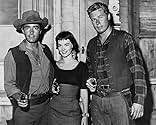
After serving a year for a killing in self-defense, gunfighter Brock Mitchell tries to help his younger brother save his ranch but a crooked lawyer has other ideas.After serving a year for a killing in self-defense, gunfighter Brock Mitchell tries to help his younger brother save his ranch but a crooked lawyer has other ideas.After serving a year for a killing in self-defense, gunfighter Brock Mitchell tries to help his younger brother save his ranch but a crooked lawyer has other ideas.
Robert Griffin
- Sheriff Clay
- (as Robert E. Griffin)
Tyler MacDuff
- Tom Williams
- (as Tyler McDuff)
John Albright
- Townsman
- (uncredited)
Chet Brandenburg
- Waiter
- (uncredited)
John Dennis
- Townsman confronting sheriff
- (uncredited)
- Director
- Writers
- All cast & crew
- Production, box office & more at IMDbPro
6.3395
1
2
3
4
5
6
7
8
9
10
Featured reviews
Superbly Shot Western Is A True Sleeper
The only reason I watched this super-obscure 1957 oater (allegedly shot in seven days) is because Philip Hardy, in his 1980s encyclopedia of westerns, called it a "masterpiece" (his word).
I certainly wouldn't go that far, but the direction (Gerd Oswald) and camera-work (Joseph LaShelle, who IIRC shot Laura) are definitely eye- catching. Many angles include ceilings, and there are a number of striking shots of actor(s) in extreme FG with other(s) in extreme BG. Oswald and LaShelle even use the film noir technique of lining up actors in dialogue scenes at various depths so they can all be in the shot without cutting (or having to re-set up the camera).
This second feature programmer is in fact far more interestingly made than A Kiss Before Dying, Oswald's A picture of the year before. Why Oswald went from that well-publicized production of a bestseller to this B- drive-in special is unknown to me. Too bad he didn't show the same level of creativity on that clever Ira Levin mystery that he does on this horse opera, which is quite routinely scripted aside from a few minor curiosities, such as Nick Adams homoerotically caressing the unconscious face of his big brother John Derek.
I certainly wouldn't go that far, but the direction (Gerd Oswald) and camera-work (Joseph LaShelle, who IIRC shot Laura) are definitely eye- catching. Many angles include ceilings, and there are a number of striking shots of actor(s) in extreme FG with other(s) in extreme BG. Oswald and LaShelle even use the film noir technique of lining up actors in dialogue scenes at various depths so they can all be in the shot without cutting (or having to re-set up the camera).
This second feature programmer is in fact far more interestingly made than A Kiss Before Dying, Oswald's A picture of the year before. Why Oswald went from that well-publicized production of a bestseller to this B- drive-in special is unknown to me. Too bad he didn't show the same level of creativity on that clever Ira Levin mystery that he does on this horse opera, which is quite routinely scripted aside from a few minor curiosities, such as Nick Adams homoerotically caressing the unconscious face of his big brother John Derek.
Cute little western
This is not a major western, this is not a Delmer Daves, John Ford or Anthony Mann's western, it will not stay in memories. It's just a seventy five minutes film, without much ambition, except bringing something unusual, moving, as the Budd Boetticher's western films series was during the same period. Not big budget yarns, but still riveting because of the characters study, not necessarily the gunfights. The two brothers relationship is really the must see of this Gerd Oswald's movie. Not ambitious at first sight, but, I repeat, really worth. Try it, just try, and I am sure you won't regret it. And It's rare too.
Low budget, but high quality
Excellent collaboration between Oscar-winning cinematographer Joseph LaShelle and competent director Gerd Oswald tip the scales on the plus side for this B+ western. The big old Columbia western town set never looked more authentic. Dig the dogs harassing the stagecoach horses. The tracking shots and camera set-ups are all A picture quality. Note the use of the extras. Not the usual aimless wandering, but natural and with attitude. We often see the action from their point of view. Good stuff. The story needs it because their ostracizing of the young hero strains credulity. John Derek is a misunderstood hothead who wants to cool off but they won't let him. Very 50s. He and Nick Adams are very good and quite believable as brothers. The action (aka violence) is unpredictable, well-staged and bloody. The good musical score, played mainly by a lonesome harmonica and guitar, is by another Oscar winner, Harry Sukman. Was the last shot a happy accident or planned? It works.
Very boring
Looks like I stand alone in my review of this western. Whatever great cinematography or acting the movie might have was --for me-- not noticed or drowned out by the boring, trite story. I can't believe this movie got a 6.8 user rating. One of the most boring, talkative (and repetitive) westerns I have ever seen. Little action, and the most ridiculous, abrupt, meaningless fade-out to a movie I have ever seen. I had to strain myself to see it to the end. Even the title is trite. The only thing going for it was John Derek's handsome countenance.
To make ten lines for an acceptable review here, let me add this silly scene which typifies the movie for me. Derek rides out of town to talk to his estranged girlfriend, who he hasn't seen while in prison for a year, and immediately encounters her taking a nude swim. So they talk -- he on his horse and she completely covered by the dark water (save her head and shoulder tops). That's it; no comment by the characters on this awkward scene. ... ... ... Another situation that irked me is that time is running out, and three partners expect a businessman to arrive by stage to complete their crucial deal, but he doesn't show, and two of the partners won't let the third one ride to the town where the businessman is to learn the reason for the delay. It was so important that you'd think they would have thought of the obvious: send a neutral trusted person to make the trip to find out.
Showdown Creek!
Fury at Showdown is directed by Gerd Oswald and adapted to screenplay by Jason James from the novel Showdown Creek written by Lucas Todd. It stars John Derek, John Smith, Carolyn Craig, Nick Adams, Gage Clarke and Robert Griffin. Music is by Harry Sukman and cinematography by Joseph LaShelle.
After killing a man in self defence, reformed gunfighter Brock Mitchell (Derek) finds that the brother of the man he killed is intent on evening the score.
It's a tried and tested formula here, that of a one time gunman trying to reform but finds others simply will not let him. There's a love interest tantalisingly in the balance, some brotherly love playing a key part in the story, a bit of angst, fisticuffs (including a superb saloon brawl) and machismo, and a well constructed finale. Oswald has skills with the camera, nice shots and an ability to ensure each frame has something to offer, his work really belying the quickfire turnaround for release he was tasked with.
Elsewhere, Lashelle's monochrome photography is lush, seen at its best with the TCM-HD print doing the rounds on cable networks. Also appealing is Sukman's musical score, very subtle and stripped back to be a nice tonal accompaniment. Acting is in the main decent, with Derek a likeable presence in the lead, to leave us with a good sturdy Oater where Fury at Showdown manages to overcome its small budget and isolated location setting to hold its head up high. 7/10
After killing a man in self defence, reformed gunfighter Brock Mitchell (Derek) finds that the brother of the man he killed is intent on evening the score.
It's a tried and tested formula here, that of a one time gunman trying to reform but finds others simply will not let him. There's a love interest tantalisingly in the balance, some brotherly love playing a key part in the story, a bit of angst, fisticuffs (including a superb saloon brawl) and machismo, and a well constructed finale. Oswald has skills with the camera, nice shots and an ability to ensure each frame has something to offer, his work really belying the quickfire turnaround for release he was tasked with.
Elsewhere, Lashelle's monochrome photography is lush, seen at its best with the TCM-HD print doing the rounds on cable networks. Also appealing is Sukman's musical score, very subtle and stripped back to be a nice tonal accompaniment. Acting is in the main decent, with Derek a likeable presence in the lead, to leave us with a good sturdy Oater where Fury at Showdown manages to overcome its small budget and isolated location setting to hold its head up high. 7/10
Did you know
- TriviaThe entire 75-minute film was shot in only five days.
- GoofsBrock is described as a "hot dog." The slang usage of that term to describe a person as show-off was not coined until the Twentieth Century.
- Quotes
Ginny Clay: My father is the law, but the law isn't always justice.
- ConnectionsReferenced in Shadows (1958)
- How long is Fury at Showdown?Powered by Alexa
Details
- Runtime
- 1h 15m(75 min)
- Color
- Aspect ratio
- 1.37 : 1
Contribute to this page
Suggest an edit or add missing content