IMDb RATING
6.1/10
1.6K
YOUR RATING
This drama set during the 1950s on a British-ruled Caribbean island deals with local politics, interracial relationships, social inequality, racism, adultery, and murder.This drama set during the 1950s on a British-ruled Caribbean island deals with local politics, interracial relationships, social inequality, racism, adultery, and murder.This drama set during the 1950s on a British-ruled Caribbean island deals with local politics, interracial relationships, social inequality, racism, adultery, and murder.
Jack Armstrong
- Snooker Player at Santa Marta Club
- (uncredited)
Patrick Halpin
- Santa Marta Club Member
- (uncredited)
- Director
- Writers
- All cast & crew
- Production, box office & more at IMDbPro
6.11.5K
1
2
3
4
5
6
7
8
9
10
Featured reviews
Succeeds on several different levels; a personal favorite
While there are many other more "contemporary" films which examine race relations issues equally as competently if not more so - considering this one was produced back in 1957 it should be recognized as genuine breakthrough! Sure, you may have heard about some of its cop outs, but bear in mind that interracial relationships were political dynamite at the time - and yet some of the film's observations remain poignant even today. But the ultimate beauty of this film is that even if you could care less about the racial issues, it still excels as a mystery / "whodunit" with some intriguing plot twists, as a mini musical with Harry Belafonte performing at the top of his game, and even as a sort of Travel Channel feature-of-the-week, which might leave you booking reservations to your own tropical paradise. So tune out the naysayers for a moment and give this one a fair shot. It may not be technically perfect, but most will be entertained, one way or another.
A soapy film about an island in the final days of colonialism
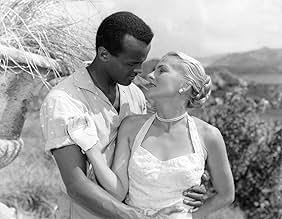
"Island in the Sun" was filmed in Barbados and Grenada, though it's about a fictional British colonial island...roughly like Barbados or Grenada! In many ways, it's a film about the racism inherent in colonialism and in other ways is a soap opera set on a tropical island. It also features something shocking for its time...and interracial romance between Joan Fontaine and Harry Belafonte...something which, sadly, caused a bit of a commotion when it debuted.
The movie is odd in that it seems to have many, many plots...too many for my taste. Much of it involves the Fleury family-- especially the incredibly strange character played by James Mason. But in addition to the Fleurys, there are many others--and the common thread to all of this is soapy romance. Many of the romances are interracial and the stories thrust seems to be that with the ending of colonialism comes the elimination of racial boundaries in love.
As I mentioned, I actually think the film has too many plots. I also thought Mason's character was enough for one film....so either the film should have been all about him OR they should have eliminated him completely. Regardless, it's a confusing sort of film--with many excellent moments but not nearly enough focus. Decent but the film could have been so, so much better...especially since so many things that are brought up in this film are important and deserve a better presentation.
The movie is odd in that it seems to have many, many plots...too many for my taste. Much of it involves the Fleury family-- especially the incredibly strange character played by James Mason. But in addition to the Fleurys, there are many others--and the common thread to all of this is soapy romance. Many of the romances are interracial and the stories thrust seems to be that with the ending of colonialism comes the elimination of racial boundaries in love.
As I mentioned, I actually think the film has too many plots. I also thought Mason's character was enough for one film....so either the film should have been all about him OR they should have eliminated him completely. Regardless, it's a confusing sort of film--with many excellent moments but not nearly enough focus. Decent but the film could have been so, so much better...especially since so many things that are brought up in this film are important and deserve a better presentation.
I have never forgotten this movie!
This came out when I was 9 and my cousin and I saw it at a theater 7 times! It was the first time I gave any attention to an adult movie! I have seen it a few times over the last many years and It still is provocative to me. When I was 9 I did not fully understand the interracial thing, and I was brought up to ignore color. What I remember was imagining what happened when the film faded out at the height of intense moments. What me imagine happening is far worse than anything they could ever show on film. that fact that it was shot in a beautiful location was not lost on my 9 year old mind and for years dreamed of living in a beautiful island paradise. The music ie: title song I learned every word! Unlike others who saw this 30 years later and through adult eyes with agendas of their own, I lived the editing, the acting and the photography. I sometimes think people expect to much out of a movie. It is after all, just entertainment! Watch this movie, without preconceived notions of script, editing, story etc, enjoy it!
1950s tale of interracial relationships and racial tensions on a British Caribbean island.
This was a very unique movie for Hollywood in the 1950s because it explored interracial relationships from both a political as well as romantic perspective. No doubt, it made audiences extremely uncomfortable.
The cast is very strong (with Dorothy Dandridge, Joan Fontaine, John Williams and James Mason--who never disappoints,) and the storyline both intriguing and unpredictable. Harry Belafonte portrays a proud, outspoken labor leader who fights racial injustice on a British Caribbean island, but this is only a secondary plot line. The "forbidden fruit" of interracial relationships is explored from several different perspectives giving this movie an important place in the history of American Cinema. Although racism and class-ism are common elements, the characters are empathetically portrayed. This movie was released in Jim Crow America and, younger viewers may not fully appreciate its' unique portrayal of Blacks in non-subservient roles. Blacks were typically cast as inarticulate maids and butlers, but Dorothy Dandridge (nominated as Best Actress for Carmen Jones in 1954) and Harry Belafonte (a top ten pop singer) were particularly stunning and sophisticated, an anomaly for Black actors in films roles at the time. Nevertheless, Belafonte's acting is often stilted, revealing that this was an early role while Dandridge's character lacks depth--though her acting superb, given that she has been given so little with which to work.
An important side note is that Harry Belafonte was a top-selling West Indian Calyso singer (Day-0-The Banana Boat Song) at the time that this movie was released and performed the title song. In addition to making a strong political statement about the need for racial justice--via his character in this film--he also was a high-profile figure within the Civil Rights Movement, marching with the Reverend Doctor Martin Luther King.
The cast is very strong (with Dorothy Dandridge, Joan Fontaine, John Williams and James Mason--who never disappoints,) and the storyline both intriguing and unpredictable. Harry Belafonte portrays a proud, outspoken labor leader who fights racial injustice on a British Caribbean island, but this is only a secondary plot line. The "forbidden fruit" of interracial relationships is explored from several different perspectives giving this movie an important place in the history of American Cinema. Although racism and class-ism are common elements, the characters are empathetically portrayed. This movie was released in Jim Crow America and, younger viewers may not fully appreciate its' unique portrayal of Blacks in non-subservient roles. Blacks were typically cast as inarticulate maids and butlers, but Dorothy Dandridge (nominated as Best Actress for Carmen Jones in 1954) and Harry Belafonte (a top ten pop singer) were particularly stunning and sophisticated, an anomaly for Black actors in films roles at the time. Nevertheless, Belafonte's acting is often stilted, revealing that this was an early role while Dandridge's character lacks depth--though her acting superb, given that she has been given so little with which to work.
An important side note is that Harry Belafonte was a top-selling West Indian Calyso singer (Day-0-The Banana Boat Song) at the time that this movie was released and performed the title song. In addition to making a strong political statement about the need for racial justice--via his character in this film--he also was a high-profile figure within the Civil Rights Movement, marching with the Reverend Doctor Martin Luther King.
Worth sitting through the racial tensions to hear Harry Belafonte sing
The wealthy whites are the hissable ones once again, lording their money-driven power over the black Caribbean field workers in this timely but talky issue-film. The Barbados locations are just beautiful, and so is Harry Belafonte's buttery voice, crooning Jamaican songs at sunset (his acting isn't bad either, and his relationship with Joan Fontaine is surprisingly chummy--if not especially romantic). The love story sidebars are soapy but not dull, and they give the film what passion it has. The heated racial debates haven't dated, giving the film some relevance, but who needs them? (Certainly not the principal audience targeted for this windswept travelogue). What we really want to see is more of Belafonte. He was at a peak here, and since he didn't get to use his own singing voice in "Carmen Jones", this is a great chance to watch and hear him perform unfettered. **1/2 from ****
Did you know
- TriviaJoan Fontaine received hundreds of hate letters, containing dimes and quarters, which read, "If you're so hard up that you have to work with a nigger..." They were post-marked from various parts of the country, but they seemed to be dictated by one organization, as many of the phrases were identical. Fontaine turned the letters over to the FBI.
- Quotes
Mavis Norman: Do you care what stupid, prejudiced people think?
David Boyeur: You've never had to fight stupidity or prejudice.
- ConnectionsFeatured in Biography: Darryl F. Zanuck: 20th Century Filmmaker (1995)
- How long is Island in the Sun?Powered by Alexa
Details
Box office
- Budget
- $2,250,000 (estimated)
- Runtime
- 1h 59m(119 min)
- Color
- Aspect ratio
- 2.35 : 1
Contribute to this page
Suggest an edit or add missing content