The Man Who Could Cheat Death
- 1h 23m
IMDb RATING
6.3/10
2.8K
YOUR RATING
A centenarian artist and scientist in 1890 Paris maintains his youth and health by periodically replacing a gland with that of a living person.A centenarian artist and scientist in 1890 Paris maintains his youth and health by periodically replacing a gland with that of a living person.A centenarian artist and scientist in 1890 Paris maintains his youth and health by periodically replacing a gland with that of a living person.
- Director
- Writers
- Stars
Arnold Marlé
- Dr. Ludwig Weiss
- (as Arnold Marle)
Ronald Adam
- Second Doctor
- (uncredited)
Marie Burke
- Woman At Private View
- (uncredited)
Renee Cunliffe
- Tavern Customer
- (uncredited)
John Harrison
- Servant
- (uncredited)
Ian Hewitson
- Roget
- (uncredited)
Gerda Larsen
- Street Girl
- (uncredited)
Charles Lloyd Pack
- Man At Private View
- (uncredited)
Louis Matto
- Tavern Customer
- (uncredited)
Frederick Rawlings
- Footman
- (uncredited)
Michael Ripper
- Morgue Attendant
- (uncredited)
Denis Shaw
- Tavern Customer
- (uncredited)
Barry Shawzin
- Third Doctor
- (uncredited)
- Director
- Writers
- All cast & crew
- Production, box office & more at IMDbPro
6.32.7K
1
2
3
4
5
6
7
8
9
10
Featured reviews
Well acted classic
A good thriller in the old-style classic sense, beautifully filmed in color by England's Hammer company. "The Man Who Could Cheat Death" is somewhat static near the beginning and almost stage play in its construction, but that is OK as it is well acted by a fine ensemble cast.
Anton Diffring offers a nervous-energy-driven, neurotically sinister presence from the very beginning of the film. He provides the requisite menace that is essential to his role. Beautiful Hazel Court, Diffring, Christopher Lee and others contribute elegant, psychologically interesting characterizations that are rendered within an uncluttered thriller format.
I can't emphasize enough how thoroughly this film epitomizes the unique Hammer production values, decor, color scheme and general style, while also effectively evoking foggy turn-of-the-century nighttime Paris streets. Despite the Paris locale, it is distinctively Hammer. Laboratories, scalpels, weird medicines, fog, and all the classic elements are here. Fans of the genre and of the era in thriller filmmaking should not miss it.
Anton Diffring offers a nervous-energy-driven, neurotically sinister presence from the very beginning of the film. He provides the requisite menace that is essential to his role. Beautiful Hazel Court, Diffring, Christopher Lee and others contribute elegant, psychologically interesting characterizations that are rendered within an uncluttered thriller format.
I can't emphasize enough how thoroughly this film epitomizes the unique Hammer production values, decor, color scheme and general style, while also effectively evoking foggy turn-of-the-century nighttime Paris streets. Despite the Paris locale, it is distinctively Hammer. Laboratories, scalpels, weird medicines, fog, and all the classic elements are here. Fans of the genre and of the era in thriller filmmaking should not miss it.
The Ageless Man
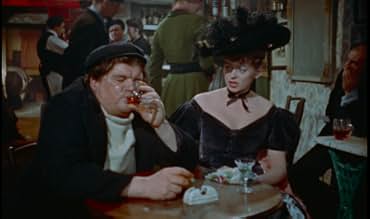
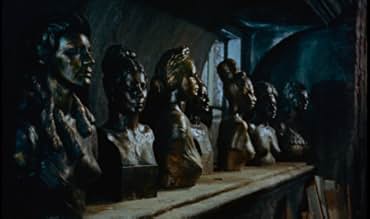
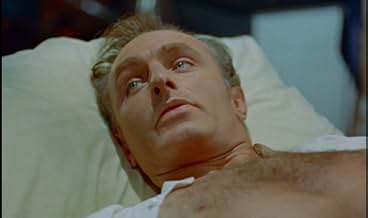
In 1890, in Paris, the artist Dr. Georges Bonnet (Anton Diffring) invites a group of friends for a private exposition of his new sculpture. Among the guests are Dr. Pierre Gerrard (Christopher Lee) and his companion Janine Du Bois (Hazel Court) that had an affair with Dr. Bonnet ten years ago in Italy. When they see each other, their love rekindle. However Dr. Bonnet has a dark secret since he is 104 years old and needs to have a gland transplanted every ten years to keep his youth. But his partner and friend Dr. Ludwig Weiss (Arnold Marle) had a stroke in Switzerland and cannot perform the surgery.
"The Man Who Could Cheat Death" is a combination of "Dr. Jekyll and Mr. Hyde" and "The Picture of Dorian Gray", with a doctor that discovers a means to stay young with thirty and something years. This Hammer production has wonderful sets, great story and excellent cast. My vote is seven.
Title (Brazil): "O Homem que Enganou a Morte" ("The Man Who Cheated Death")
"The Man Who Could Cheat Death" is a combination of "Dr. Jekyll and Mr. Hyde" and "The Picture of Dorian Gray", with a doctor that discovers a means to stay young with thirty and something years. This Hammer production has wonderful sets, great story and excellent cast. My vote is seven.
Title (Brazil): "O Homem que Enganou a Morte" ("The Man Who Cheated Death")
How About a DVD Double Feature?
THE MAN WHO COULD CHEAT DEATH (the Hammer Films remake of 1945's THE MAN IN HALF MOON STREET, based on the play by Barre' Lyndon) seems to be a forgotten fantasy-thriller. Often compared with Oscar Wilde's PICTURE OF DORIAN GRAY, this film rarely seems to get the same airplay on late night TV or on any of the "Shock Theatre" programs that many of the other Hammer horror hits did, and has yet to receive a home video release. With so much of the Hammer library now out on DVD, and since Paramount handled Hammer's distribution for this (as well as having produced the 1945 original), it would be nice to see the two films released to DVD as a double feature. (Much like the HOUSE OF WAX/MYSTERY OF THE WAX MUSEUM or the Frederic March and Spencer Tracy versions of DR. JEKYLL AND MR. HYDE.)
Perpetual life, it's a killer!
The Man Who Could Cheat Death is directed by Terence Fisher and adapted to screenplay by Jimmy Sangster from the Barré Lyndon play The Man in Half Moon Street. It stars Anton Diffring, Hazel Court, Christopher Lee, Arnold Marlé, Francis de Wolff and Delphi Lawrence. Out of Hammer Film Productions, music is by Richard Rodney Bennett and Technicolor photography by Jack Asher.
Paris 1890 and sculptor Georges Bonnet (Diffring) has perfected a way to halt the aging process. Trouble is that it involves murdering young women so as to extract their parathyroid gland to formulate his eternal life elixir.
Disappointingly weak Hammer Horror that would be near unwatchable were it not for the efforts of Asher, Fisher and Bernard Robinson (production design). The source story is made to measure for Hammer, where berserker science mixes with Gothic murder tones, all the ingredients are there for a lively fusion of Dr Jekyll and Mr Hyde with The Picture of Dorian Gray. But the film is more concerned with much talking and posturing, thinking that sci-fi babble and moral quandaries are going to keep things interesting. We of course want some meat and reasoning for main characters to impact on the plotting, but using up an hour for it, in a film that only runs an hour and twenty minutes, leaves very little room for thrills and drama. It also demands that the finale be explosive, a whirlwind of horror revelations and biting comeuppance, sadly the ending we get is rather a damp squib.
Things aren't helped by the casting of Diffring, who overacts far to often, or that Lee is underwritten and firmly disinterested in making the thin characterisation work. Court looks ravishing and gives the film its best performance, but she is also hindered by a bare bones script from the usually excellent Sangster. The story just plods to its inevitable conclusion, the screenplay never daring to veer away from the safe formula road. While much of the detective work from de Wolff's Inspector LeGris leaves a great deal to be desired. On the plus side it looks real nice, a triumph over low budget restrictions, the minimal sets dressed in period splendour, the colour sizzling and Fisher uses wide shots to make certain scenes that are played out on tiny sets actually look expansive.
Devoid of up-tempo terror and finishing on a whimper, this is very much average Hammer and not easily recommended to the horror faithful. 5/10
Paris 1890 and sculptor Georges Bonnet (Diffring) has perfected a way to halt the aging process. Trouble is that it involves murdering young women so as to extract their parathyroid gland to formulate his eternal life elixir.
Disappointingly weak Hammer Horror that would be near unwatchable were it not for the efforts of Asher, Fisher and Bernard Robinson (production design). The source story is made to measure for Hammer, where berserker science mixes with Gothic murder tones, all the ingredients are there for a lively fusion of Dr Jekyll and Mr Hyde with The Picture of Dorian Gray. But the film is more concerned with much talking and posturing, thinking that sci-fi babble and moral quandaries are going to keep things interesting. We of course want some meat and reasoning for main characters to impact on the plotting, but using up an hour for it, in a film that only runs an hour and twenty minutes, leaves very little room for thrills and drama. It also demands that the finale be explosive, a whirlwind of horror revelations and biting comeuppance, sadly the ending we get is rather a damp squib.
Things aren't helped by the casting of Diffring, who overacts far to often, or that Lee is underwritten and firmly disinterested in making the thin characterisation work. Court looks ravishing and gives the film its best performance, but she is also hindered by a bare bones script from the usually excellent Sangster. The story just plods to its inevitable conclusion, the screenplay never daring to veer away from the safe formula road. While much of the detective work from de Wolff's Inspector LeGris leaves a great deal to be desired. On the plus side it looks real nice, a triumph over low budget restrictions, the minimal sets dressed in period splendour, the colour sizzling and Fisher uses wide shots to make certain scenes that are played out on tiny sets actually look expansive.
Devoid of up-tempo terror and finishing on a whimper, this is very much average Hammer and not easily recommended to the horror faithful. 5/10
Worth a DVD
Although not one of Hammer's best films, it is a good movie. The Victorian setting (although it is supposed to take place in Paris) is very charming. Some people have criticized the use of heavy fog in Paris but I feel it adds to the eerie and mysterious atmosphere. Christopher Lee is very effective and is a hero - which is rare in early Hammer films. Hazel Court is absolutely beautiful as the heroine. The plot is interesting and moves quite well. Compared to some other old movies that have been released on DVD, this one is a winner. It is truly a film that belongs in a Hammer fan's collection. Too bad Peter Cushing was not in the film because it would have been even better. I hope some Hammer fans read this and make a plea to have the movie released on DVD. At least it could be one movie of a double feature.
Did you know
- TriviaHazel Court played the Anton Diffring sculpting scene topless. Only her bare back is shown in the British and U.S. versions, but her breasts are visible in the scene shot for European versions. It was one of the first nude scenes of its kind to be shot in England. They cleared the set and had just a skeleton crew. She said she agreed to do it because the scene warranted the nudity and it was shot beautifully. If had been gratuitous, she'd have refused.
- GoofsWhen the doctor performs an operation on Diffring's thyroid, he makes the incision somewhere below the waist. The thyroid is actually in the neck.
- Quotes
Janine Du Bois: [about the disappearance of Margo] But that's terrible. What could have happened?
Inspector Legris: Quite a number of things could have happened, Man'selle, and it's up to me to find out the one that did.
- Alternate versionsThe "European" print of the film includes scenes of a topless Hazel Court.
- ConnectionsFeatured in Aweful Movies with Deadly Earnest: The Man Who Could Cheat Death (1966)
- How long is The Man Who Could Cheat Death?Powered by Alexa
Details
- Release date
- Country of origin
- Language
- Also known as
- Covjek koji je prevario smrt
- Filming locations
- Production company
- See more company credits at IMDbPro
Box office
- Budget
- £84,000 (estimated)
- Runtime
- 1h 23m(83 min)
- Color
- Aspect ratio
- 1.66 : 1
Contribute to this page
Suggest an edit or add missing content