IMDb RATING
7.5/10
3.9K
YOUR RATING
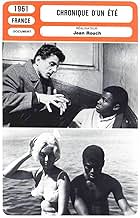
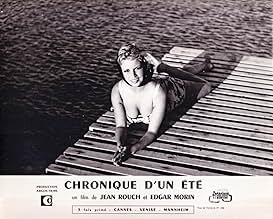
A documentary about the everyday lives of ordinary Parisians, done in the style of cinéma vérité.A documentary about the everyday lives of ordinary Parisians, done in the style of cinéma vérité.A documentary about the everyday lives of ordinary Parisians, done in the style of cinéma vérité.
- Awards
- 1 win total
Marceline Loridan Ivens
- Self
- (as Marceline)
Marilù Parolini
- Self
- (as Mary Lou)
Jean-Pierre Sergent
- Self
- (as Jean-Pierre)
Jacques Gautrat
- Self - un ouvrier
- (as Jacques)
Régis Debray
- Self - un étudiant
- (as Régis)
Nadine Ballot
- Self
- (as Nadine)
Modeste Landry
- Self - un étudiant africain
- (as Landry)
Jacques Gabillon
- Self - un employé
- (as Jacques)
Simone Gabillon
- Self - une employée
- (as Simone)
7.53.9K
1
2
3
4
5
6
7
8
9
10
Featured reviews
a must see thought provoking cinema verite documentary for a targeted audience
this was fascinating and brilliant doc in my opinion ahead of its time compared to this generation of reality TV and social media. the film focus and the parisian working class in serious of interviews and a brief look at there daily lives and conducting interviews about happiness, the struggles and goals and dreams. i am 44 and i was fascinated watching this film and how life was, and how it has changed in over 53 years. The fascinating film is for an acquired taste for an audience that can appreciate this type of film. This Film won the international critics prize at the 1960 Cannes film festival at the time of its release it was not popular with most critics or audience.
Cool film, landmark documentary
"Chronicle of A Summer" invented the cinema verité movement, the idea being that by celebrating and revealing the artificial nature of the film-making process, the truth, or more accurately, some truths will emerge. The film is enveloped with a luminous and appealing humanism, and it is a very cool and cinematic portrait of Paris in the beat days. Remember that World War Two was only a decade or so before this and somehow the fog of that war hangs over the film, especially given the backstory of one of the participants, at least this is what I remember..As historic documents go, it is also amazingly compelling today. I find the film much more absorbing than "Salesman" or Drew Associates stuff. Drink espresso instead of a pint before the film, my friend and you'll be fine..
JB-81
PS If you want to watch paint dry, check out Melville- Although he's pretty great too..
JB-81
PS If you want to watch paint dry, check out Melville- Although he's pretty great too..
Rouch and the Intersubjective Reality
Jean Rouch is remembered as an oddity in film history, an artist working in between of fact and fiction as well as the era of colonialism and post-colonialism. He is especially often crowned as the founder of ethnographic cinema, but "Chronicle of a Summer" (1961) made by Rouch and Edgar Morin is something a little different. It is the breakthrough film of cinéma vérite or "truth cinema" which had a huge impact on the following French New Wave, most of whose filmmakers admired Rouch.
Already in his earliest documentaries, Rouch isolates himself from his own time by focusing on engagement and immersion instead of observation. Interaction between the observer and his object -- or rather between subjects -- becomes vital. As vital is embracing the presented subjects' personal and collective world views, which form a fascinating entirety in Rouch's "I, a Black Man" (1958). In a word, the other and the self are of the same reality to Rouch.
Although a representative of so-called truth cinema, Rouch and Morin's film does not concern any epistemic and scientific truth, but rather the truth of the appearance of the intersubjective reality. The camera takes part in action, ceases to exist, but at the same is inseparably present. A fabric of real emotions, thoughts, lies and acts is born which can be taken as a truth of one kind. On the one hand, Rouch and Morin attempt to revolutionize the cinema or at least to turn its lens to itself, but on the other, their sociological mission is to find out how does the modern man live. Hence they ask "Are you happy?" from random people in the streets.
Rouch's "The Human Pyramid" (1961) might be more well organized, though utterly poetic, than "Chronicle of a Summer", but the latter is more essay-like which also associates it with the new wave. The remarks of the meta-level are not as detached from the rest of the film as in "The Human Pyramid", but still fact and fiction merge in an essential fashion.
However, Rouch didn't only affect new wave filmmakers for his cinematic methods but also for his image of the world and man. There is indeed great human beauty in the film. During the interviews and other scenes, the camera becomes a penetrating mirror to whom one can reveal all of one's secrets. Perhaps this also happens to the viewer in a lesser extent. On one level, Rouch and Morin reveal the need to talk and share in an individualistic society. On the other, they tell something enduring about man, life and cinema.
Already in his earliest documentaries, Rouch isolates himself from his own time by focusing on engagement and immersion instead of observation. Interaction between the observer and his object -- or rather between subjects -- becomes vital. As vital is embracing the presented subjects' personal and collective world views, which form a fascinating entirety in Rouch's "I, a Black Man" (1958). In a word, the other and the self are of the same reality to Rouch.
Although a representative of so-called truth cinema, Rouch and Morin's film does not concern any epistemic and scientific truth, but rather the truth of the appearance of the intersubjective reality. The camera takes part in action, ceases to exist, but at the same is inseparably present. A fabric of real emotions, thoughts, lies and acts is born which can be taken as a truth of one kind. On the one hand, Rouch and Morin attempt to revolutionize the cinema or at least to turn its lens to itself, but on the other, their sociological mission is to find out how does the modern man live. Hence they ask "Are you happy?" from random people in the streets.
Rouch's "The Human Pyramid" (1961) might be more well organized, though utterly poetic, than "Chronicle of a Summer", but the latter is more essay-like which also associates it with the new wave. The remarks of the meta-level are not as detached from the rest of the film as in "The Human Pyramid", but still fact and fiction merge in an essential fashion.
However, Rouch didn't only affect new wave filmmakers for his cinematic methods but also for his image of the world and man. There is indeed great human beauty in the film. During the interviews and other scenes, the camera becomes a penetrating mirror to whom one can reveal all of one's secrets. Perhaps this also happens to the viewer in a lesser extent. On one level, Rouch and Morin reveal the need to talk and share in an individualistic society. On the other, they tell something enduring about man, life and cinema.
One of the greatest doucmentaries ever made
Often cited as one of the greatest documentaries ever made Jean Rouch and Edgar Morin's "Chronicles of a Summer" takes a look at the lives of of ordinary Parisiennes over the course of the summer of 1960. It was filmed in a 'cinema vertie' style, using the people who appear as if they were actors 'acting out' their lives. There is no voice-over; their technique is to use interviews or simply silently film these people going about their business. What distinguishes this extraordinary film from others of its kind is that this is a work both sociological and deeply political, a piece of social history in which Africans are side-lined and homosexuality never mentioned.
Rouch and Morin pick and choose their subjects, mostly workers, students and intellectuals, and back them into a corner where the politics of the proletariat becomes the benchmark. These people talk fearlessly about their treatment by the State and the drugery of their daily routine with white Parisiennes oblivious to their inherent racism.
The film-makers fundamental question is, 'Are you happy?' Initially two women interview people on the street asking them if they are happy and as the film progresses this becomes its focal point while the level of intimacy Rouch and Morin achieves is extraordinary. Theirs is a technique other film-makers have used many times since, perhaps more skillfully as film-making has become more sophisticated but this masterpiece remains the granddaddy of them all. Unmissable.
Rouch and Morin pick and choose their subjects, mostly workers, students and intellectuals, and back them into a corner where the politics of the proletariat becomes the benchmark. These people talk fearlessly about their treatment by the State and the drugery of their daily routine with white Parisiennes oblivious to their inherent racism.
The film-makers fundamental question is, 'Are you happy?' Initially two women interview people on the street asking them if they are happy and as the film progresses this becomes its focal point while the level of intimacy Rouch and Morin achieves is extraordinary. Theirs is a technique other film-makers have used many times since, perhaps more skillfully as film-making has become more sophisticated but this masterpiece remains the granddaddy of them all. Unmissable.
fascinating new cinema
It's Paris in the summer of 1960. This film has no professional actors. It's everyday people and their slice of life in the style of the new cinéma vérité. A group of sociologist filmmakers starts doing interviews with different people. They grab them on the streets, at their work, or anywhere else. There are little fascinating snippets like the girl who used to make fake antiques. There are a lot of rambling discussions about anything. It must have been unlike most cinema from that time. This may not be the absolute first, but it is pushing the envelope wide open. I do find myself falling in and out of the film.
Did you know
- TriviaThe 6th greatest documentary of all time according to the 'Sight & Sound' poll 2014. The list was compiled after polling from over 200 critics and curators and 100 filmmakers.
- Quotes
Sophie - the cover-girl: People are bored everywhere now. But boredom comes from within. If you've got an inner life, you're never bored.
- ConnectionsFeatured in Les échos du cinéma: Episode #1.23 (1961)
- How long is Chronicle of a Summer?Powered by Alexa
Details
- Runtime
- 1h 25m(85 min)
- Color
- Sound mix
- Aspect ratio
- 1.37 : 1
Contribute to this page
Suggest an edit or add missing content