
During the 1960s in Britain, tense race relations between whites and blacks are affecting the workplace, the family, the dating scene, and the society at large.During the 1960s in Britain, tense race relations between whites and blacks are affecting the workplace, the family, the dating scene, and the society at large.During the 1960s in Britain, tense race relations between whites and blacks are affecting the workplace, the family, the dating scene, and the society at large.
- Nominated for 1 BAFTA Award
- 1 nomination total


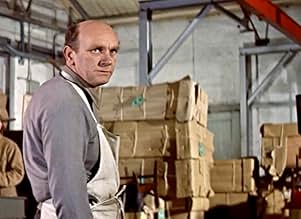


John Adams
- Man Attending Union Meeting
- (uncredited)
Bart Allison
- Man Attending Union Meeting
- (uncredited)
- Director
- Writer
- All cast & crew
- Production, box office & more at IMDbPro
6.7465
1
2
3
4
5
6
7
8
9
10
Featured reviews
`Guess Who's Coming to Dinner?' among the British working class
Some people might steer clear of this movie because of its race relations theme. They'd be missing a good movie.
Despite a few warts, this is mostly a well-acted and well-directed drama. To be sure, some of the issues that the characters confront are dated. However, other issues are as relevant today as they were in 1961 when this film was made.
Above all else, I enjoyed the dominating performance of the always reliable John Mills. I enjoyed his stirring speeches as Jacko Palmer, a leader in his labor union. I also enjoyed his sensitive handling of family issues, trying to negotiate a difficult path between the starkly conflicting viewpoints of his wife Nell and his daughter Kathie.
Some of the dialogue in this movie is painful to hear. A couple of white factory workers tell Jacko `We don't like to take orders from spades.' Nell Palmer tells her daughter `They're not like us . If you marry him (her West Indian boyfriend), you'll have a roomful of black children . The thought of them (Kathie and her boyfriend) in bed makes me sick . You're worse than a whore.' Nell uses the `N word' twice.
Not surprisingly, Kathie shrugs off her mother's acid-tongued advice. However, it's harder for her to ignore her father's advice, which is geared toward making her understand the risks of her (marriage) decision. Her reasoning is so clouded by love that she tells him `Prejudice will end someday.' Well, not in her lifetime, as we in the 21st Century know.
The movie is sometimes heavy-handed and melodramatic. Even the title is somewhat `inflammatory' (There is only one flame in the movie ... a large bonfire, a British tradition for the celebration of Guy Fawkes Day). The movie ends without a tidy resolution, but this is fitting considering the predicament of the characters and their social environment.
I reviewed this movie as part of a project at the Library of Congress. I've named the project FIFTY: 50 Notable Films Forgotten Within 50 Years. As best I can determine, this film, like the other forty-nine I've identified, has not been on video, telecast, or distributed in the U.S. since its original release. In my opinion, it is worthy of being made available again.
Despite a few warts, this is mostly a well-acted and well-directed drama. To be sure, some of the issues that the characters confront are dated. However, other issues are as relevant today as they were in 1961 when this film was made.
Above all else, I enjoyed the dominating performance of the always reliable John Mills. I enjoyed his stirring speeches as Jacko Palmer, a leader in his labor union. I also enjoyed his sensitive handling of family issues, trying to negotiate a difficult path between the starkly conflicting viewpoints of his wife Nell and his daughter Kathie.
Some of the dialogue in this movie is painful to hear. A couple of white factory workers tell Jacko `We don't like to take orders from spades.' Nell Palmer tells her daughter `They're not like us . If you marry him (her West Indian boyfriend), you'll have a roomful of black children . The thought of them (Kathie and her boyfriend) in bed makes me sick . You're worse than a whore.' Nell uses the `N word' twice.
Not surprisingly, Kathie shrugs off her mother's acid-tongued advice. However, it's harder for her to ignore her father's advice, which is geared toward making her understand the risks of her (marriage) decision. Her reasoning is so clouded by love that she tells him `Prejudice will end someday.' Well, not in her lifetime, as we in the 21st Century know.
The movie is sometimes heavy-handed and melodramatic. Even the title is somewhat `inflammatory' (There is only one flame in the movie ... a large bonfire, a British tradition for the celebration of Guy Fawkes Day). The movie ends without a tidy resolution, but this is fitting considering the predicament of the characters and their social environment.
I reviewed this movie as part of a project at the Library of Congress. I've named the project FIFTY: 50 Notable Films Forgotten Within 50 Years. As best I can determine, this film, like the other forty-nine I've identified, has not been on video, telecast, or distributed in the U.S. since its original release. In my opinion, it is worthy of being made available again.
Hard Hitting and Powerful.
Considering this was made over 60 years ago it still packs a powerful punch, not least because of the use of extreme racial language which is not considered PC today.
The sound and vision is amazing. It could have been made last week.
Sylvia Syms and John Mills give stellar performances.
I wonder how it would be received today by the snowflake generation.
The fights at the end, possibly inspired by the 1958 Notting Hill Riots, somewhat distracted from the real issues within the film. These were about relationships and prejudice, non more so than Brenda de Banzie's shameful character.
Historically this is a very interesting and important film.
The sound and vision is amazing. It could have been made last week.
Sylvia Syms and John Mills give stellar performances.
I wonder how it would be received today by the snowflake generation.
The fights at the end, possibly inspired by the 1958 Notting Hill Riots, somewhat distracted from the real issues within the film. These were about relationships and prejudice, non more so than Brenda de Banzie's shameful character.
Historically this is a very interesting and important film.
Tensions (rather stiltedly) boiling over...
UK drama has working class Brits simmering under racial tensions: in the warehouses, the factories, even at the public pool--the catalyst being a hard-working black man who gets a coveted factory promotion over the petty, envious whites (wasn't this the same situation in "Black Legion" from 1937?). John Mills plays a union organizer who tries bringing peace to the locals but is confounded by the unexpected romance between his white daughter and a black teacher from the West Indies. Ted Willis adapted his play "Hot Summer Night", forgetting that screen material needs to be less theatrical, more subtle and sensitive. Each character spouts off with such pedagogic fervor, vigorously puffed up with their own righteous anger, that the main theme of tolerance is diffused (with that faux-calypso music playing, you'd think there would be more dancing than feuding!). OK melodrama, it beat "Guess Who's Coming To Dinner?" to the screen by several years, and a few of the performances are thoughtfully rendered. Color film released by the The Rank Organisation was distributed to the States by Atlantic Pictures in black-and-white. ** from ****
Ethnic tensions on Guy Fawkes Day.
Coming six years before "guess who's coming to dinner " , "flame on the streets ' is much more convincing ;here one does not meet a bourgeois family whose daughter wants to marry a future Nobel Prize ;it takes place in the British low middle-class ; it all happens in one day ,on Guy Fawkes '.
The fifth of November is a judicious choice: it's time for celabration,merrymakings in the streets , but it also means alcohol, violence,interracial resentment which has been building up for years. Kathy Palmer's plan does not bode well in that context : to marry an educated black schoolteacher (Peter Lincoln ,check the surname) in the early sixties is a thing her mom -who blames her husband for not climbing up the social scale- would never accept ,in a month of Sundays . The dad 's attitude is more ambiguous : in the meeting , superbly played by John Mills , he delivers a liberal speech, urging the men from the union to stand together , and championing the promotion as a foreman of a colored man ;but when confronted to his daughter's plan , without being so openly racist as his wife , his finer feelings have vanished into thin air and he tells the young schoolmistress what she should "ideally " do.
In the streets , meanwhile ,hatred is simmering , the riot is brewing : not only the angry young white louts ,but also the colored girls , or the gossip ladies who "warn " Kathy's mom , nobody is prepared to accept peace,love and understanding .So Kathy 's predicament is mirrored by this town on fire ; given the hostile milieu ,the denouement cannot ,by any means,considered a happy end .There was still a hard road to hoe.
The fifth of November is a judicious choice: it's time for celabration,merrymakings in the streets , but it also means alcohol, violence,interracial resentment which has been building up for years. Kathy Palmer's plan does not bode well in that context : to marry an educated black schoolteacher (Peter Lincoln ,check the surname) in the early sixties is a thing her mom -who blames her husband for not climbing up the social scale- would never accept ,in a month of Sundays . The dad 's attitude is more ambiguous : in the meeting , superbly played by John Mills , he delivers a liberal speech, urging the men from the union to stand together , and championing the promotion as a foreman of a colored man ;but when confronted to his daughter's plan , without being so openly racist as his wife , his finer feelings have vanished into thin air and he tells the young schoolmistress what she should "ideally " do.
In the streets , meanwhile ,hatred is simmering , the riot is brewing : not only the angry young white louts ,but also the colored girls , or the gossip ladies who "warn " Kathy's mom , nobody is prepared to accept peace,love and understanding .So Kathy 's predicament is mirrored by this town on fire ; given the hostile milieu ,the denouement cannot ,by any means,considered a happy end .There was still a hard road to hoe.
Still relevant today
Roy Ward Baker, who had a good track record for directing colourful films (eg: The Vampire Lovers), gives us an extremely interesting retrospective of racial tensions in London in the early 1960's with Flame In The Streets. Race issues still exist and it would be naive to pretend otherwise judging by some recent events in 2020 although mixed marriages seem to have cleared hurdles that were more of an issue in 1960 which is the dominant theme in this film. Sylvia Syms, never looking more beautiful, falls in love with a black colleague and wants to marry him, much to the aggravation of her prejudiced mother. Mum, played with gusto by Brenda De Banzie (never better) is shocked to her core when she discovers her daughter is seeing the young black man. Dad, played by John Mills is far more liberal and as a union leader, he's argued for equality in the workplace for recent immigrants and in a particularly punchy scene, fights for Earl Cameron to be promoted. Mr Cameron only recently passed away at the grand age of 102 by the way. What surprised me, looking back 60 years, is that the film seems so relevant still today with black and white issues. It will be better when things can eventually unite peacefully and I have seen improvements in my lifetime but we still have a long way to go otherwise we wouldn't still recognise some of the issues in Flame In The Streets so readily. It's a film that although dated is an interesting snapshot that many could learn from if they recognised the obvious human failings depicted in it, particularly from De Banzie's prejudice, some of the ugly thuggery carried out by white youths and the bad attitudes of some of John Mills' work colleagues. Beware also of offensive racial language although it would be dishonest if all these films were hidden away as we can learn from historical films like this and be aware.


Did you know
- TriviaWilfrid Brambell (Mr. Palmer Senior) was four years younger than Sir John Mills (Jacko Palmer).
- Quotes
Gabriel Gomez: He say a car for him is a number-one necessity.
Judy Gomez: He's just a number-one pimp.
Details
- Release date
- Country of origin
- Language
- Also known as
- Schwarze Fackel
- Filming locations
- Hawley Road, Camden Town, London, England, UK(scene of Guy Fawkes bonfire)
- Production companies
- See more company credits at IMDbPro
- Runtime
- 1h 33m(93 min)
- Sound mix
- Aspect ratio
- 2.35 : 1
Contribute to this page
Suggest an edit or add missing content