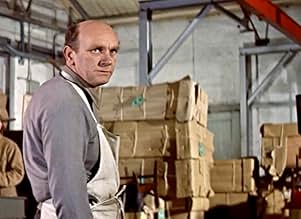
During the 1960s in Britain, tense race relations between whites and blacks are affecting the workplace, the family, the dating scene, and the society at large.During the 1960s in Britain, tense race relations between whites and blacks are affecting the workplace, the family, the dating scene, and the society at large.During the 1960s in Britain, tense race relations between whites and blacks are affecting the workplace, the family, the dating scene, and the society at large.
- Nominated for 1 BAFTA Award
- 1 nomination total
John Adams
- Man Attending Union Meeting
- (uncredited)
Bart Allison
- Man Attending Union Meeting
- (uncredited)
- Director
- Writer
- All cast & crew
- Production, box office & more at IMDbPro
6.7465
1
2
3
4
5
6
7
8
9
10
Featured reviews
10reviewmr
Worth watching
A look at racial tension back in the early 60's
This film still carries a strong mention even in today's modern world
Great cast , with excellent performances from John Mills and Sylvia Sims
10/10
Look out for it and watch if you get chance.
Melodramatic but daring for its time, still relevant today
Flame in the Streets was adapted from a stage play and often feels like it. The acting is occasionally stilted and other times too heavy-handed. Not the worst offender nor entirely out of step of other performances of its mostly pre-method era. It's just that, given it's serious subject matter, it didn't need any extra help to wind up the audience and it might have done a better overall job if it was more clever and subtle in its approach. Additionally, some of the dialog, especially from minor characters, is very on the nose and almost comically rote. In some ways this film feels more like it's from the 30s or 40s and not the early 60s.
The plot involves a union leader who, full of righteousness, defends a black man's promotion to a minor management role in a manufacturing company. His progressivism and sense of fairness is challenged and turned on its ear when he learns his daughter intends to marry a black man. All of this takes place amid the backdrop of his crumbling marriage and a neighborhood that has started to boil over with racial tensions.
While it's easy to criticize the execution, I appreciated how directly and incisively it goes after its controversial themes, particularly that of the half-way liberal who will righteously advocate for the downtrodden as long as, on some level, he can continue to see them as lower and separate from himself, and those truly close to him. That hypocrisy is still very relevant today as many talk endlessly and fiery about inclusion, but at the end of the day still seem to be surrounded by people who look the same as they do.
The plot involves a union leader who, full of righteousness, defends a black man's promotion to a minor management role in a manufacturing company. His progressivism and sense of fairness is challenged and turned on its ear when he learns his daughter intends to marry a black man. All of this takes place amid the backdrop of his crumbling marriage and a neighborhood that has started to boil over with racial tensions.
While it's easy to criticize the execution, I appreciated how directly and incisively it goes after its controversial themes, particularly that of the half-way liberal who will righteously advocate for the downtrodden as long as, on some level, he can continue to see them as lower and separate from himself, and those truly close to him. That hypocrisy is still very relevant today as many talk endlessly and fiery about inclusion, but at the end of the day still seem to be surrounded by people who look the same as they do.
Still relevant today
Roy Ward Baker, who had a good track record for directing colourful films (eg: The Vampire Lovers), gives us an extremely interesting retrospective of racial tensions in London in the early 1960's with Flame In The Streets. Race issues still exist and it would be naive to pretend otherwise judging by some recent events in 2020 although mixed marriages seem to have cleared hurdles that were more of an issue in 1960 which is the dominant theme in this film. Sylvia Syms, never looking more beautiful, falls in love with a black colleague and wants to marry him, much to the aggravation of her prejudiced mother. Mum, played with gusto by Brenda De Banzie (never better) is shocked to her core when she discovers her daughter is seeing the young black man. Dad, played by John Mills is far more liberal and as a union leader, he's argued for equality in the workplace for recent immigrants and in a particularly punchy scene, fights for Earl Cameron to be promoted. Mr Cameron only recently passed away at the grand age of 102 by the way. What surprised me, looking back 60 years, is that the film seems so relevant still today with black and white issues. It will be better when things can eventually unite peacefully and I have seen improvements in my lifetime but we still have a long way to go otherwise we wouldn't still recognise some of the issues in Flame In The Streets so readily. It's a film that although dated is an interesting snapshot that many could learn from if they recognised the obvious human failings depicted in it, particularly from De Banzie's prejudice, some of the ugly thuggery carried out by white youths and the bad attitudes of some of John Mills' work colleagues. Beware also of offensive racial language although it would be dishonest if all these films were hidden away as we can learn from historical films like this and be aware.
Far Too Stagey
This film is more of a social document than an entertaining piece of film making.It was made just 3 years after the infamous Notting Hill Riots.This was at a time when immigrants were just starting to settle in the Uk and met some resistance from the local population.I would add that prejudice was still rife in the population at the time.Both myself at school and my father in public office suffered anti semitism.So this country was good for a good shake up.I doubt that this film did much to advance the cause.It is just so dull at times i am sure that it would not have done that well commercially at the time.It is odd to note that John mills here plays Sylvia Sims father when a couple of years earlier in "Ice Cold In Alex" he portrayed her potential lover.
Hard Hitting and Powerful.
Considering this was made over 60 years ago it still packs a powerful punch, not least because of the use of extreme racial language which is not considered PC today.
The sound and vision is amazing. It could have been made last week.
Sylvia Syms and John Mills give stellar performances.
I wonder how it would be received today by the snowflake generation.
The fights at the end, possibly inspired by the 1958 Notting Hill Riots, somewhat distracted from the real issues within the film. These were about relationships and prejudice, non more so than Brenda de Banzie's shameful character.
Historically this is a very interesting and important film.
The sound and vision is amazing. It could have been made last week.
Sylvia Syms and John Mills give stellar performances.
I wonder how it would be received today by the snowflake generation.
The fights at the end, possibly inspired by the 1958 Notting Hill Riots, somewhat distracted from the real issues within the film. These were about relationships and prejudice, non more so than Brenda de Banzie's shameful character.
Historically this is a very interesting and important film.
Did you know
- TriviaWilfrid Brambell (Mr. Palmer Senior) was four years younger than Sir John Mills (Jacko Palmer).
- Quotes
Gabriel Gomez: He say a car for him is a number-one necessity.
Judy Gomez: He's just a number-one pimp.
Details
- Release date
- Country of origin
- Language
- Also known as
- Schwarze Fackel
- Filming locations
- Hawley Road, Camden Town, London, England, UK(scene of Guy Fawkes bonfire)
- Production companies
- See more company credits at IMDbPro
- Runtime
- 1h 33m(93 min)
- Sound mix
- Aspect ratio
- 2.35 : 1
Contribute to this page
Suggest an edit or add missing content