

A middle-aged college professor becomes infatuated with a 14-year-old girl.A middle-aged college professor becomes infatuated with a 14-year-old girl.A middle-aged college professor becomes infatuated with a 14-year-old girl.
- Director
- Writers
- Stars
- Nominated for 1 Oscar
- 2 wins & 10 nominations total





Terry Kilburn
- Man
- (as Terence Kilburn)

- Director
- Writers
- All cast & crew
- Production, box office & more at IMDbPro
7.5114.5K
1
2
3
4
5
6
7
8
9
10
Featured reviews
A Masterwork of Translation
A significant part of Stanley Kubrick's genius was his ability to translate a literary style into a visual one. It is demonstrated nowhere more brilliantly than in LOLITA and A CLOCKWORK ORANGE.
LOLITA is perhaps the more stunning accomplishment, in that Nabokov's style is complex and multi-layered. Yet Kubrick captures the effect of it in camera angles and movements, in timing and point of view.
The broadest layer of Nabokov's novel, the parable of the aging culture of Europe trying to revivify itself by debauching the seductive young culture of America, is really missing in the film. But everything else is there, despite the fact that the film departs from the exact events of the novel.
Not to say that the film depends on the novel. It stands by itself quite easily. But it succeeds brilliantly in conveying the ideas and feelings that are the core of the novel, and it does so in completely cinematic terms. If films are to be based on works of literature, this is the way to do it, and the way it is almost never done.
LOLITA is perhaps the more stunning accomplishment, in that Nabokov's style is complex and multi-layered. Yet Kubrick captures the effect of it in camera angles and movements, in timing and point of view.
The broadest layer of Nabokov's novel, the parable of the aging culture of Europe trying to revivify itself by debauching the seductive young culture of America, is really missing in the film. But everything else is there, despite the fact that the film departs from the exact events of the novel.
Not to say that the film depends on the novel. It stands by itself quite easily. But it succeeds brilliantly in conveying the ideas and feelings that are the core of the novel, and it does so in completely cinematic terms. If films are to be based on works of literature, this is the way to do it, and the way it is almost never done.
A controversial masterpiece
Inspired by the eponymous novel (Vladimir Nabokov, 1955), this film admirably describes the sulfurous relationship between a middle-aged writer and his nymph Dolores Haze, aka Lolita.
By chance, looking for a furnished rental, the professor Humbert Humbert encounters Charlotte Haze and her beloved daughter Dolores. From the very first sight, the professor irrevocably accepts the rental conditions! A triangular relationship settles quickly between 1) an intellectual sensitive to beauty and youth, 2) a desperate widow impressed by this professor, both unable to fight against theirs own obsessive desires, and 3) a manipulative and nonchalant teen. Consecutively to a fatal accident and because of the inquisitive and invasive look of Clare Quilty, the teacher will progressively and ineluctably descend in the depths of the abyss.
James Mason is awesome and monumental. He is also excellently seconded by Sue Lyon, Peter Sellers and Shelley Winters. And Stanley Kubrick is definitely a regular of successful and even improved literary adaptations, with Shining (1980), 2001, A space odyssey (1968), Barry Lyndon (1975), A clockwork orange (1971), The Killing (1956), ...
This movie is truly a masterpiece.
By chance, looking for a furnished rental, the professor Humbert Humbert encounters Charlotte Haze and her beloved daughter Dolores. From the very first sight, the professor irrevocably accepts the rental conditions! A triangular relationship settles quickly between 1) an intellectual sensitive to beauty and youth, 2) a desperate widow impressed by this professor, both unable to fight against theirs own obsessive desires, and 3) a manipulative and nonchalant teen. Consecutively to a fatal accident and because of the inquisitive and invasive look of Clare Quilty, the teacher will progressively and ineluctably descend in the depths of the abyss.
James Mason is awesome and monumental. He is also excellently seconded by Sue Lyon, Peter Sellers and Shelley Winters. And Stanley Kubrick is definitely a regular of successful and even improved literary adaptations, with Shining (1980), 2001, A space odyssey (1968), Barry Lyndon (1975), A clockwork orange (1971), The Killing (1956), ...
This movie is truly a masterpiece.
One of the finest films of The Sixties
8/10
Kubrik's version of Nabokov's tale of a middle-aged professor's self-destructive obsession with a young schoolgirl. Making a film that dealt with underage sex was considered impossible in 1962 due to the strict censorship regulations. Kubrik manages to get round this by merely alluding to sexual encounters and subtle wordplay and symbolism creeps into several scenes. He also raises the girl's age from 12 in the novel to 14 in the film. Lolita is also rich in Kubrik's trademark dark humour.
The three central characters of the novel are all portrayed more than adequately in the film; James Mason as the smitten professor, Shelley Winters as the suburban widow with pretensions of culture and Sue Lyons as the young nymphet. However, it is Sellars' performance as the creepy eccentric Clare Quilty (a relatively minor character in the book) that steals the show and, ultimately, makes the film. The opening scene (which is the ending of the film) is an outstanding testament to his talent and versatility. The said scene gives the film the same "circular structure" used by David Lean in "Brief Encounter".
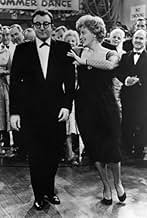
My favourite moments include; Quilty's re-introduction to the film at the school's summer ball as the camera pans across the dancefloor and subtly reveals a look of comic ambivalence on his face as he dances with his lover, Humbert awkwardly trying to book the only remaining hotel-room at the police convention and Humbert again trying to teach the cynical Lolita the joys of Edgar Allen Poe's poetry.
I thoroughly recommend this film. My only complaint is the length - the final third seemed to drag a bit.
Kubrik's version of Nabokov's tale of a middle-aged professor's self-destructive obsession with a young schoolgirl. Making a film that dealt with underage sex was considered impossible in 1962 due to the strict censorship regulations. Kubrik manages to get round this by merely alluding to sexual encounters and subtle wordplay and symbolism creeps into several scenes. He also raises the girl's age from 12 in the novel to 14 in the film. Lolita is also rich in Kubrik's trademark dark humour.
The three central characters of the novel are all portrayed more than adequately in the film; James Mason as the smitten professor, Shelley Winters as the suburban widow with pretensions of culture and Sue Lyons as the young nymphet. However, it is Sellars' performance as the creepy eccentric Clare Quilty (a relatively minor character in the book) that steals the show and, ultimately, makes the film. The opening scene (which is the ending of the film) is an outstanding testament to his talent and versatility. The said scene gives the film the same "circular structure" used by David Lean in "Brief Encounter".
My favourite moments include; Quilty's re-introduction to the film at the school's summer ball as the camera pans across the dancefloor and subtly reveals a look of comic ambivalence on his face as he dances with his lover, Humbert awkwardly trying to book the only remaining hotel-room at the police convention and Humbert again trying to teach the cynical Lolita the joys of Edgar Allen Poe's poetry.
I thoroughly recommend this film. My only complaint is the length - the final third seemed to drag a bit.
Tasteful and Entertaining
Not the two words that came to mind when I first read the book. This movie nicely handles the taboo subject matter and is tremendously funny as well. Peter Sellers was warming up for his triumph in Dr. Strangelove, Shelly Winters gave her best performance, and James Mason made us feel his pain. As Lolita, Sue Lyon is convincing although Kubrick makes her character a bit older (probably to satisfy the censors, which still slapped this with an X rating originally, much to my surprise). The movie could play on TV today with no edits. I have not seen the 1997 remake but can only imagine, given its director with a reputation of going over the top, that it's not as classy and tasteful as this one. Since this was made in 1962, the risque elements from the book were left to our imagination. And the movie scores highly because of it. The movie's story is stuck in the '60s (that bubblegum music, which played during Lolita's early scenes, will stick with you), and if you are bored with the story, or cannot believe what you're seeing, you can always get a culture lesson: Hula hoops, malt shops, pseudo intellectuals, faulty cots and gas stations where they still pump your gas.
"Cha-cha-cha..."
All the acting in Stanley Kubrick's "Lolita" is top notch, but I could not get enough of Sue Lyon's sleepy/sexy gaze, the suspicious eyes and crooked smile, the flip talk and deep voice. She was given a bad rap at the time because she's of course much older than the character was in Nabokov's book (critics seemed to blame this on Sue!); however, she's more than capable in the role, at times excellent, always a presence and a very exciting one. James Mason--despite a monotone British voice which exudes masculinity but little inflection--is a decent Humbert Humbert, the lover of little girls (when I read Vladimir Nabokov's book, I pictured Rex Harrison). Shelley Winters is a scream as Lolita's mother, though the picture really picks up once she's gone. Peter Sellers is indeed overused as Humbert's walking paranoia, and the story-threads involving his character fail to come together. Still, the photography, most of the writing, Kubrick's direction, and Nelson Riddle's score are marvelous, as is Sue Lyon. What a temptress this one is! *** from ****


Did you know
- TriviaPeter Sellers modeled the voice of his character Clare Quilty on that of his director, Stanley Kubrick.
- GoofsDirector Stanley Kubrick walks out of the very first interior shot (center to right bottom) of Humbert entering Quilty's house.
- Quotes
Charlotte Haze: Do you believe in God?
Humbert Humbert: The question is does God believe in me?
- Crazy creditsThe credits are played over footage of Lolita's toenails being painted.
- Alternate versionsThe scene where Lolita first "seduces" Humbert as he lies in the cot is a good 10 seconds longer in the British cut of the film. In the U.S. cut, the shot fades as she whispers the details of the "game" she played with Charlie at camp. In the U.K. print, the shot continues as Humbert mumbles that he's not familiar with the game. She then bends down again to whisper more details. Kubrick then cuts to a closer shot of Lolita's head as she says "Well, allrighty then" and then fades as she begins to descend to Humbert on the cot. The British cut of the film was used for the Region 1 DVD release.
- ConnectionsEdited into Hai-Kubrick (1999)
Details
Box office
- Budget
- $2,000,000 (estimated)
- Gross worldwide
- $7,411
- Runtime
- 2h 33m(153 min)
- Color
- Aspect ratio
- 1.66 : 1
Contribute to this page
Suggest an edit or add missing content