IMDb RATING
6.7/10
6.9K
YOUR RATING


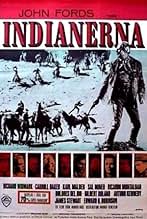
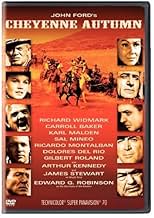
The Cheyenne, tired of broken U.S. government promises, head for their ancestral lands but a sympathetic cavalry officer is tasked to bring them back to their reservation.The Cheyenne, tired of broken U.S. government promises, head for their ancestral lands but a sympathetic cavalry officer is tasked to bring them back to their reservation.The Cheyenne, tired of broken U.S. government promises, head for their ancestral lands but a sympathetic cavalry officer is tasked to bring them back to their reservation.
- Director
- Writers
- Stars
- Nominated for 1 Oscar
- 1 win & 3 nominations total




Dolores Del Río
- Spanish Woman
- (as Dolores Del Rio)


Elizabeth Allen
- Guinevere Plantagenet
- (as Betty Ellen)


- Director
- Writers
- All cast & crew
- Production, box office & more at IMDbPro
6.76.9K
1
2
3
4
5
6
7
8
9
10
Featured reviews
John Ford changes his tone...
This film is the perfect counterpoint to early John Ford films such as Stagecoach. In Stagecoach every indian was painted as a bloodthirsty savage, out to menace all of the civilized folk. Cheyenne Autumn, on the other hand is a very revealing film... behind it all you can almost feel John Ford questioning himself and his previous views on American history. In this film it is the US soldiers who are painted as the brutal savages, and the indians are the civilized folk. It's amazing to see Ford, who practically built his career glorifying the chivalry of the western hero, do a complete 360 to end up de-glorifying it. I have the feeling that this was a very personal film for Ford and in that light it really does make him one of the great auteurs of cinema.
Great beginning, then it drags
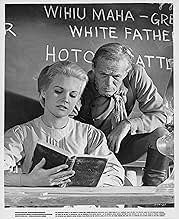
The first half hour of Cheyenne Autumn promises a moving western akin to How the West Was Won. There's a great romance, family tensions, and a large promise broken to the Native Americans. When the white government officials promise to meet the Indian chiefs and discuss the terms of an already broken treaty, everyone in the tribe walks the great distance to the white settlement. They stand for hours in the sun, waiting in vain. It's very sad, but it starts off a compelling drama. Richard Widmark is in love with a Quaker schoolteacher, Carroll Baker, and he writes her an absolutely adorable marriage proposal on the chalkboard of her classroom. Since he loves her, he wants her to leave for safety instead of traveling with the Indians to the new territory.
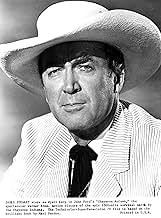
The rest of the long movie really disappoints. I tried to forgive the bad casting of Carroll as a Quaker, but she certainly didn't act like an unworldly woman. Karl Malden gave his usual intense, penetrating stare, but little else. Ricardo Montalban and the remarkably well-preserved Gilbert Roland play Native Americans; you'd think that by 1964 Hollywood would stop putting dark makeup on actors. Sal Mineo, also playing an Indian, strutted around with his shirt off to impress a tribal girl - but that made no sense, since Native Americans always ran around bare-chested. Why were there blushes and giggles exchanged? And randomly, there was a chunk of time in the middle of the movie that included Wyatt Earp (played by James Stewart) and Doc Holliday (played by Arthur Kennedy) in a saloon playing poker. They don't add to the story, and there's no acting required. Jimmy throws a few winks among his jokes, and Arthur keeps up. I can't imagine why this comic relief section was included in this drama. Edward G. Robinson also has a small role in the movie. Can't imagine him in a western? He plays a government official, so no cowboy hat for him. Keep an eye out for cutie pie Patrick Wayne, though, which is fun.
This movie is very long, and at times it does drag. The middle section is uneven, and after a while, you forget how the beginning even started. If you watch it, it won't hurt you, but it's not as good as it seems.
The rest of the long movie really disappoints. I tried to forgive the bad casting of Carroll as a Quaker, but she certainly didn't act like an unworldly woman. Karl Malden gave his usual intense, penetrating stare, but little else. Ricardo Montalban and the remarkably well-preserved Gilbert Roland play Native Americans; you'd think that by 1964 Hollywood would stop putting dark makeup on actors. Sal Mineo, also playing an Indian, strutted around with his shirt off to impress a tribal girl - but that made no sense, since Native Americans always ran around bare-chested. Why were there blushes and giggles exchanged? And randomly, there was a chunk of time in the middle of the movie that included Wyatt Earp (played by James Stewart) and Doc Holliday (played by Arthur Kennedy) in a saloon playing poker. They don't add to the story, and there's no acting required. Jimmy throws a few winks among his jokes, and Arthur keeps up. I can't imagine why this comic relief section was included in this drama. Edward G. Robinson also has a small role in the movie. Can't imagine him in a western? He plays a government official, so no cowboy hat for him. Keep an eye out for cutie pie Patrick Wayne, though, which is fun.
This movie is very long, and at times it does drag. The middle section is uneven, and after a while, you forget how the beginning even started. If you watch it, it won't hurt you, but it's not as good as it seems.
Starts as compelling drama but turns into bad farce and never recovers
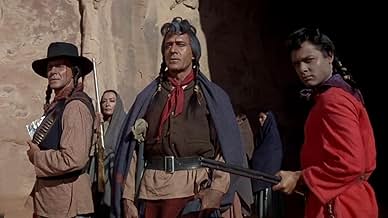
The Cheyenne nation has been gathered on their desert reservation waiting for supplies. The people are starving. Captain Thomas Archer (Richard Widmark) is sympathetic but powerless in the face of government indifference. Deborah Wright (Carroll Baker) is a Quaker trying to help the Cheyenne. Chiefs Little Wolf (Ricardo Montalban) and Dull Knife (Gilbert Roland) lead over 300 Cheyenne from their reservation in the Oklahoma territory to their traditional home in Wyoming. Archer is forced to stop them. The media exaggerate army casualties. Secretary of the Interior Carl Schurz (Edward G. Robinson) resists political pressure to increase the conflict.
This starts off well with the vast landscape and compelling story of the Cheyenne mistreatment. Director John Ford is able to give dignity to the movie. Even with the mostly Latinos portraying Cheyennes, it isn't that badly done. There is some good action. It's set up for a serious compelling western. It is a somewhat long march. It's meandering and struggles to keep up the pace. Then it takes a bad comedy detour in Dodge City. Other than having James Stewart play Wyatt Earp, there is nothing worthwhile in that section. The tone is all wrong and breaks down the realism of the movie once and for all.
This starts off well with the vast landscape and compelling story of the Cheyenne mistreatment. Director John Ford is able to give dignity to the movie. Even with the mostly Latinos portraying Cheyennes, it isn't that badly done. There is some good action. It's set up for a serious compelling western. It is a somewhat long march. It's meandering and struggles to keep up the pace. Then it takes a bad comedy detour in Dodge City. Other than having James Stewart play Wyatt Earp, there is nothing worthwhile in that section. The tone is all wrong and breaks down the realism of the movie once and for all.
Conveniently adapted story of Northern Cheyenne
This film shows just a bit of the tragedy of Northern Cheyenne. The film or John Ford did not show that they initially fought together with Sioux led by Sitting Bull war in 1876 and were partially massacred by Custer. Later they fought once again and were defeated at McKenzie compelling them to surrender. Two years later, the prisoners Dull Knife, Wild Hog, and Little Wolf were brought down as prisoners to Fort Reno, from where they escaped and were later killed without mercy. Part of the survivors were killed later when they tried to escape from Fort Robinson, Nebraska, and the others finally confined to a reservation in Montana. Probably Ford wanted to show this story softly giving some feeling of justice to Captain Archer (Richard Widmark), but at the end the film became an approximate story of the reality. Cheyenne, either northern or southern were expelled out from their natural areas, they missed bull hunting and their ancestral traditions. Beside this historical considerations, one must admit that Ford had a very good cast for the film with Widmark, Carroll Baker, always efficient Edward G. Robinson, Karl Malden and others. The only thing difficult to understand was the scene with James Stewart (as Wyatt Earp) together with the veterans Arthur Kennedy and John Carradine, which in my opinion was out of the context.
Some people believe that Westerns are not more of use in Hollywood. I believe that some westerns giving real stories of what happened with the Indians are very much necessary to understand the history of the real American people. Geronimo, Sitting Bull, Dull Knife and others were not criminals, they were only defending the land where they were born and raised. So their lives should be brought fairly to the screen in the coming future.
Some people believe that Westerns are not more of use in Hollywood. I believe that some westerns giving real stories of what happened with the Indians are very much necessary to understand the history of the real American people. Geronimo, Sitting Bull, Dull Knife and others were not criminals, they were only defending the land where they were born and raised. So their lives should be brought fairly to the screen in the coming future.
The desperation of an artist, shown by a beautiful film
I have recently seen again "Cheyenne Autumn", and, perhaps, I finally got it. In my opinion, this film represents the desperation of an artist, the director John Ford. Forget the usual stunning beauty of the cinematography, the accuracy in filming action scenes, the care for poetic details, and all Ford's trade-mark style. We readily see that "Cheyenne Autumn" is completely different from any other western movie, and not only from the remainder of Ford's work.
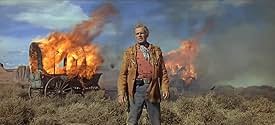
Compared with other western movies, the main difference and innovation is that here any killed man is a REAL tragedy, that exhaustion, famine, cold, violence are REAL sufferings for the miserable people on the screen (not just for the Cheyennes, even for the whites). And all that is shown us by Ford ruthlessly, uncompromisingly. The fact that the director stands for the Indians is not as much innovative as it seems. All along his career Ford showed respect and sympathy for them. In the finale, just after an apparent happy ending, we have again violence, again a murder, again a distressed mother: we almost feel the same grief of hers. It is somewhat ironic that in the same year the film was made, 1964, the fashion of Italian western movies invaded the world of cinema, with furious, acrobatic gun-fights and hundreds of shot-dead people, like in a sort of funny game.
The movie is split into two parts by a comic interlude, the episode placed in Dodge City, which is actually a farce. I think that Ford wanted to pay a homage and bid his personal farewell to the old silent western-movies of the 1920s, when his career started. The funny situations are deliberately over the top: see the sensational, licentious joke, when Wyatt Earp (Jimmy Stewart) realizes that he actually had met the girl in Wichita... In any case, a somewhat gloomy mood permeates even this comic part. The main characters are all aged, grey-haired and seemingly life-weary. And the episode is introduced by a particularly brutal, cruel murder.
I think that "Cheyenne Autumn" is a beautiful film, with a good story, great visual beauties, and, in particular, an excellent acting by the whole cast. But it is tough for me to face John Ford's desperate vision. After all, what I most like in the movie is to see, once again, Ben Johnson and Harry Carey Jr on horse-back, in their blue uniforms (by the way: why are they uncredited?). They are both aged and bulkier compared with their look in the great Ford's western-epics of their youth. Never mind: they are almost dearer to me for this very reason...
Compared with other western movies, the main difference and innovation is that here any killed man is a REAL tragedy, that exhaustion, famine, cold, violence are REAL sufferings for the miserable people on the screen (not just for the Cheyennes, even for the whites). And all that is shown us by Ford ruthlessly, uncompromisingly. The fact that the director stands for the Indians is not as much innovative as it seems. All along his career Ford showed respect and sympathy for them. In the finale, just after an apparent happy ending, we have again violence, again a murder, again a distressed mother: we almost feel the same grief of hers. It is somewhat ironic that in the same year the film was made, 1964, the fashion of Italian western movies invaded the world of cinema, with furious, acrobatic gun-fights and hundreds of shot-dead people, like in a sort of funny game.
The movie is split into two parts by a comic interlude, the episode placed in Dodge City, which is actually a farce. I think that Ford wanted to pay a homage and bid his personal farewell to the old silent western-movies of the 1920s, when his career started. The funny situations are deliberately over the top: see the sensational, licentious joke, when Wyatt Earp (Jimmy Stewart) realizes that he actually had met the girl in Wichita... In any case, a somewhat gloomy mood permeates even this comic part. The main characters are all aged, grey-haired and seemingly life-weary. And the episode is introduced by a particularly brutal, cruel murder.
I think that "Cheyenne Autumn" is a beautiful film, with a good story, great visual beauties, and, in particular, an excellent acting by the whole cast. But it is tough for me to face John Ford's desperate vision. After all, what I most like in the movie is to see, once again, Ben Johnson and Harry Carey Jr on horse-back, in their blue uniforms (by the way: why are they uncredited?). They are both aged and bulkier compared with their look in the great Ford's western-epics of their youth. Never mind: they are almost dearer to me for this very reason...


Did you know
- TriviaYears earlier Richard Widmark had the historical subject matter researched at Yale. He brought the material to John Ford, who didn't want to make it. Years later Ford, who had kept the research, changed his mind and asked Widmark to star.
- GoofsThe Navajos travel 1500 miles but never seem to leave Monument Valley, except for some snow scenes.
- Quotes
Secretary of the Interior: Oh, Henry... you and I fought together at Gettysburg. You had never seen a Negro slave. All you ever knew was that they were human beings with the rights of human beings - and it was worth an arm to you.
- Alternate versionsMany television prints run 145 minutes, and omit the scene with James Stewart as Wyatt Earp. The video release is the full 154-minute version.
- ConnectionsEdited into Film socialisme (2010)
Greatest Character Actors of All Time
Greatest Character Actors of All Time
The talented actors totally transform for their roles. How many do you recognize?

- How long is Cheyenne Autumn?Powered by Alexa
Details
- Release date
- Country of origin
- Language
- Also known as
- El ocaso de los cheyenes
- Filming locations
- Production company
- See more company credits at IMDbPro
Box office
- Budget
- $4,200,000 (estimated)
- Gross worldwide
- $10,980
- Runtime
- 2h 34m(154 min)
- Aspect ratio
- 2.20 : 1
Contribute to this page
Suggest an edit or add missing content