

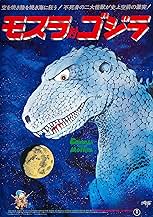
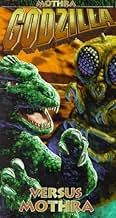
When greedy tycoons refuse to return Mothra's egg to the people of Infant Island, they must decide if they are willing to answer Japan's own pleas for help when Godzilla arises near Nagoya.When greedy tycoons refuse to return Mothra's egg to the people of Infant Island, they must decide if they are willing to answer Japan's own pleas for help when Godzilla arises near Nagoya.When greedy tycoons refuse to return Mothra's egg to the people of Infant Island, they must decide if they are willing to answer Japan's own pleas for help when Godzilla arises near Nagoya.
- Awards
- 1 nomination total




- Director
- Writer
- All cast & crew
- Production, box office & more at IMDbPro
Featured reviews
"The Thing" Is A... Um... Giant Moth?
A franchise rising on the wings of a moth
After a terrible typhoon, a strict news reporter and his creative photographer find a mysterious object in the debris. A gigantic egg is also discovered next to a village and quickly bought by a greedy entrepreneur and the backstabbing businessman behind him. Two tiny twin girls from Infant Island reveal that the egg belongs to gigantic moth Mothra and that the dying gigantic monster will be reborn as a larva once the egg hatches. The entrepreneur and businessman ignore the twin girls' warning and the complaints of local fishermen but soon get into an argument regarding promotion and wealth. Meanwhile, the reporter and photographer contact a professor and they discover that the mysterious object is a radioactive scale. When they investigate the place where they found the debris again, they are immediately stopped by a selfish politician who wants to avoid negative articles. However, the ground suddenly starts to shake as Godzilla rises from the underground as it becomes obvious that the radioactive scale belonged to him. The king of monsters goes on a rampage and attacks the city of Nagoya. The military isn't able to stop the monster this time around. The reporter, photographer and professor ask the tribe from Infant Island to send Mothra as her egg is also likely to get destroyed by Godzilla. The tribe is initially hesitant to agree but the twin girls convince them and decide to summon Mothra to fight Godzilla.
This highlight in the franchise convinces on multiple levels. The film criticizes egoism, greed and ignorance by spreading powerful, relevant and even timeless messages.
The story is quite diversified with its many twists and turns. The story about the greedy businessmen is as captivating as the reporter's, photographer's and professor's quest for truth and the dramatic battle between the two titular gigantic monsters.
The settings are particularly exotoc this time around. Especially the scenes filmed on Infant Island are splendid to watch. The rituals to summon Mothra are certainly highlights as well.
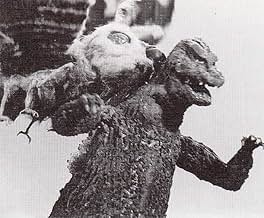
The speciall effects have greatly improved since the previous installment. The opening scene with the terrible typhoon is already quite impressive. The gigantic egg is stunning to watch. Aged moth Mothra, a resilient Godzilla and the larva that hatches from the egg are beautiful as well. Even the fight choreographies between the monsters are of a rare intensity.
Mothra versus Godzilla might not reinvent the kaiju movie genre but it's an impressive return to form for the frachise after nine years. This movie sets the bar for all upcoming Showa Era Godzilla movies. Fans of the franchise will find everything they like about it here such as sympathetic characters, moral lessons and impressive monsters.
hey, not too bad
But...so flippin' what? Despite screamingly obvious flaws, this flick is a blast. The surprisingly rich storyline involves corporate greed, nuclear testing, and totally bizarre mysticism. The science fiction and fantasy elements blend well, and it's fascinating as always to get the occasional insight into Japanese culture.
The acting is obviously good, even in the dubbed version, and some of the directing isn't bad (although Honda did a much better job on the first film - perhaps he had less money for this one). The fights are a bit silly, of course, but there is the occasional thrilling moment, such as when Godzilla's head gets set on fire, and when he melts a whole mess of nicely detailed model tanks. Ifkube's dramatic score elevates the film considerably, except of course when he gets into wailing horns turf, which is when I always reach for the "volume down" button.
If you can't stand the cheese, stay out of Godzilla's way. If you can, there's some fun to be had here.
Special effects master Eiji Tsuburaya was born on July 7th, 1901
In 1961 they released Mothra (1961) and followed that up with King Kong VS Godzilla (1962), which blew the doors off of movie screens around the world. It cemented this kaiju (monster), franchise as being an ageless one. The Japanese filmmakers knew they needed to keep things going, so this time they squared the great lizard-king against another one of their previous successes, Mothra, the giant butterfly-like mystical protector of Infant Island. Mothra VS Godzilla (1964), would be another great clash of the titans and would become the film, that best explains what a classic Godzilla movie was all about. It would become the text-book example of why these films appealed to millions over the last 70 years. It explains why these films were creative, always exciting, sometimes even scary and playfully executed. They were the best representation of the science fiction nerd's imagination.
This brings me to the plot of this film, because it carries over from what we saw in the two films that proceeded it. Mothra VS Godzilla (1964), opens up with a major typhoon hitting the Japanese coastline. Huge waves swirl onto the beaches with the winds knocking everything over in its path, flooding the areas inland. The pounding soundtrack by legendary, Japanese film composer Akira Ifukube, is thundering in the background. A few days later, in the wake of the storm, the people of the area begin the clean-up of their coastal towns. In one particular area a giant Mothra-sized egg washes close to shore. In another area, while pumps are sending the storm-waters back into the sea, a giant kaiju tail ascends up from underneath the sand and dirt, washed ashore by the storm. Godzilla has returned. This is where the previous two movies come in.
At the conclusion of King Kong VS Godzilla (1962), Godzilla disappears into the sea. Gojira, probably bored of his fight with Kong, goes into hibernation and doesn't return until the storm in this film washes him ashore. It is actually the Mothra egg that wakes him up. As the audience gets reunited with Mothra and the magical tiny twins from Infant Island (The Peanuts - Emi and Yumi Ito), we are reminded of what we learned in Mothra (1961). Mothra is an ancient mystical creature, that the twins (who could be just as old), are telekinetically linked to. Their peaceful island existence was ruined by human-kind's atomic tests, thus rendering Infant Island useless. Only the great power of Mothra has kept the island going and somewhat still alive. Now with Godzilla on a rampage and Mothra's egg in the hands of corrupt businessmen, the stage is set for a battle of the century.
Part of the Japanese filmmakers' craft was creating the monster suits for the various kaiju found in the films. The technical, physical effects in these movies consisted of various special effects techniques. One of the main technical hurtles was the monster suit design. The best suits had the following positive criteria; the suits were slick-looking, concealed the actor inside well and looked real enough for audiences of the time period. To put it bluntly, the craft revolved around guys in giant monster suits. It was a cost-effective way of trying to tell a special kind of science fiction story on film. As we would find out, kaiju films, especially in Japan, made a boatload of money and the preferred practice of Japanese special effects artists, for more than 50 years, was an actor in a monster suit. Once you get past this you can accept the films easier. It's what all movies usually are trying to do. The goal of a film is to make things a two-way street. That is done, by the filmmakers presenting their craft and the audience using their imaginations. The Japanese kaiju films play a large part in world-cinema history.
With the suits aside, the other physical effects involved the miniature cities, mountains, towns, oceans, coastlines, vehicles, planes, you name it. The Japanese would build whole cities in order to capture the clash of the actors inside the suits. It was basically world-building on a warehouse scale. It is that aspect of these films, that truly make them good. The amount of work it took to create these mini-cities and landscapes, the attention to detail the artists took and the idea that all of that hard work is mostly going to get destroyed, is what sold these movies the most. You also get a clever science fiction story, that usually has to go on a two-prong attack in order to be successful. The stories need to involve sub-plots involving the human characters in the film, as well as a basic reason why the monsters are here. The monsters need their story too.
This film has all these components. It has all the big names that made this sub-genre a cult-classic favorite. Along with music from Akira Ifukube, legendary Japanese special effects master Eiji Tsuburaya and director Ishiro Honda, this film contains all the main filmmakers needed to be authentic. It also has some of the best actors found in these films. Repeat classic, legacy actors like, Akira Takarada (who was in the original Gojira (1954), Hiroshi Koizumi (who's in Mothra (1961) and Kenji Sahara (King Kong VS Godzilla (1962), are just to name a few. This is a text-book example of the best of 1960s Japanese kaiju films. It also came before the embarrassing kaiju era, that turned Godzilla into a superhero. Those films are another conversation for another day.
It also is important to note, that finding the original American version of this film would be good for fans to see as well. When this film was being marketed to the international box office the decision was made to shoot an extra scene needed for the international market. The international distributers felt the film needed one more, extra, action scene. Something that would appeal to the west, most notably the United States. This scene was also done by the same Japanese special effects artists, bur featured an American Frontier missile attack against Godzilla on a beach. The film was released in America as Godzilla VS the Thing (1964). The English-dubbed version has many of the talented voice-actors who helped entertain millions of American kaiju fans all through the 1960s and 70s. This film is the one to see, if you have an interest in, what is now referred to as, the Showa Era of Godzilla (1954-1975).
7.6 (C+ MyGrade) = 7 IMDB.
The finest of the Godzilla films


Did you know
- TriviaWhen the protagonists arrive on Infant Island, the skeleton of a turtle is seen in the background where it appears move slightly. This is often misunderstood to be an error but it's actually an intentional choice, inspired by the Italian documentary A Dog's Life (1962), which showcased the decomposed remains of a turtle that swayed in the wind. Many fans however took it further, pointing out that it appeared to blink suggesting it was indeed a living, albeit disfigured, creature. The creature eventually was nicknamed "Skeleturtle" and developed a cult following. It would make a cameo in a Godzilla comic and Toho themselves would sell merchandise of the creature, cementing its status as an actual kaiju with it's official name being translated to "Mystery Bones of Infant Island".
- GoofsWhen the Mothra larva grabs onto Godzilla's tail and Godzilla flings it around, the skin of the Mothra larva cracks. This is because it is being damaged by Godzilla.
- Quotes
[the natives of Infant Island must decide if they are willing to answer Japan's pleas for help]
Professor Miura: It's a selfish request, but can you help us?
Shobijin (Twin Fairy), Shobijin (Twin Fairy): We must refuse. We have no faith in your world.
Professor Miura: Including us?
Shobijin (Twin Fairy), Shobijin (Twin Fairy): We're very sorry.
Ichiro Sakai: What do we do now?
Professor Miura: It's clear we're not welcome here.
Junko Nakanishi: Please listen to me. I understand why you don't trust us, but even as we speak, many are dying because of Godzilla. Many of them are good people, but even bad people have a right to live. You may call it divine retribution, but all people are equal before God. God plays no favorites. Please, we need your help.
Ichiro Sakai: We too want a world where we can trust one another. But the more people there are, the more difficult it becomes. Nevertheless, we'll never give up. We're working hard to make the world a better place. Please, don't be quick to judge us.
- Alternate versionsThe "Frontier Missile" sequence is the only example of kaiju footage contained in foreign release prints but not in the original cut. This footage slightly alters the arrangement of events of the American and European versions. This footage was filmed at AIP's request and originally excluded from the Japanese cut to keep out the very patriotic American iconage of the scene. It is now featured as bonus material on the Japanese laserdisc.
- ConnectionsEdited from The Mysterians (1957)
Details
- Release date
- Country of origin
- Languages
- Also known as
- Godzilla vs. Mothra
- Filming locations
- Production company
- See more company credits at IMDbPro
Box office
- Gross worldwide
- $492
- Runtime
- 1h 29m(89 min)
- Sound mix
- Aspect ratio
- 2.55 : 1