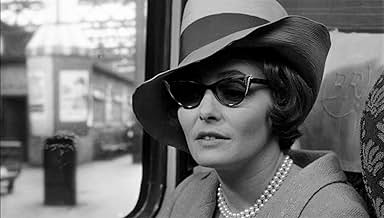
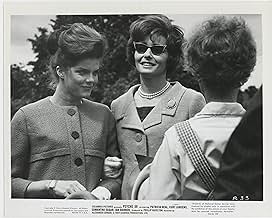
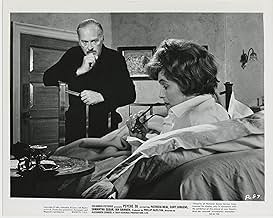
In London, the pregnant wife of an industrialist falls down the stairs, loses her sight and has no recollection of the events but suspects that a mentally traumatic experience prior to the f... Read allIn London, the pregnant wife of an industrialist falls down the stairs, loses her sight and has no recollection of the events but suspects that a mentally traumatic experience prior to the fall caused her accident.In London, the pregnant wife of an industrialist falls down the stairs, loses her sight and has no recollection of the events but suspects that a mentally traumatic experience prior to the fall caused her accident.
- Director
- Writers
- Stars
- Nominated for 1 BAFTA Award
- 1 nomination total
Curd Jürgens
- Eric Crawford
- (as Curt Jurgens)
Rex Garner
- Waiter
- (uncredited)
Pat Hagan
- Diner in Restaurant
- (uncredited)
Victor Hagan
- Diner in Restaurant
- (uncredited)
Aileen Lewis
- Lady in Teashop
- (uncredited)
Edward Malin
- Attendant in Men's Room
- (uncredited)
Jack Mandeville
- Man Exiting Lift
- (uncredited)
Louis Matto
- Waiter
- (uncredited)
- Director
- Writers
- All cast & crew
- Production, box office & more at IMDbPro
6.0676
1
2
3
4
5
6
7
8
9
10
Featured reviews
Freudian Frolics.
Psyche 59 is directed by Alexander Singer and adapted to screenplay by Julian Zimet from the novel written by Francoise des Ligneris. It stars Patricia Neal, Curd Jurgens, Samantha Eggar, Ian Bannen and Beatrix Lehmann. Music is by Kenneth V. Jones and cinematography by Walter Lassally.
Blind Alison Crawford (Neal) lives with her husband Eric (Jurgens) and finds the equilibrium of life upset when her young sister Robin (Eggar) comes to stay. It seems there are secrets to will out, both with Robin and the matter of how Alison came to be blind.
A strange, almost hypnotic type of movie, Psyche 59 aims to be a Freudian thriller but just misses the mark of being great. The set up is intriguing, the twists risqué and the photography suitably moody. Neal gives a fine performance as the afflicted Alison, both physically and emotionally, Eggar is super sultry and raises the temperatures considerably, while both Bannen and Jurgens are fine considering the former is under written and the latter gets a character arc that's a bit of a stretch. Unfortunately the pay off is hopelessly weak, the whole build up holds the attention, you sense we are heading for great dramatic denouement, but sadly that's not the case and it leaves a disappointing taste in the mouth. 6/10
Blind Alison Crawford (Neal) lives with her husband Eric (Jurgens) and finds the equilibrium of life upset when her young sister Robin (Eggar) comes to stay. It seems there are secrets to will out, both with Robin and the matter of how Alison came to be blind.
A strange, almost hypnotic type of movie, Psyche 59 aims to be a Freudian thriller but just misses the mark of being great. The set up is intriguing, the twists risqué and the photography suitably moody. Neal gives a fine performance as the afflicted Alison, both physically and emotionally, Eggar is super sultry and raises the temperatures considerably, while both Bannen and Jurgens are fine considering the former is under written and the latter gets a character arc that's a bit of a stretch. Unfortunately the pay off is hopelessly weak, the whole build up holds the attention, you sense we are heading for great dramatic denouement, but sadly that's not the case and it leaves a disappointing taste in the mouth. 6/10
A dirty old man and his wrecked family
Patricia Neal makes this film the whole way, although Samantha Eggar as her baby sister also dominates the scenes. Curd Jürgens is the husband of Patricia Neal (Alison) while previous to his marrying her, he had a relationship with the sister, which has left some irreversible marks. Samantha Eggar (Robin) is courted by Ian Bannen (Paul) who wants to marry her, but there is some psychological barrier between them, as he can't really reach her. The problem is that Alison is blind after some trauma, she knows it is psycho-somatic as she went blind when there was something she refused to see, which shocked her out of her wits. Gradually this problem is sorted out. The most interesting part is perhaps the grandmother (Beatrix Lehmann) who probably has seen everything quite clearly from the beginning but consistently keeps a perfect poker face - we never learn what she really knows. The film is made with considerable artifice, it's quite a small drama dragged out to preposterous dimensions by transport stretches, making the film appear much longer than it is. There is a fine moment in the end when Patricia Neal finally opens her eyes and lets in the light, while she virtually leaves everyone else in the darkness of their mess.
Almost a masterpiece
"Psyche '59" opened at an art theatre in New York City in 1964. Receiving lukewarm reviews, it closed quickly, and was then used as a co-feature in neighborhood theatres. I consider it a near-masterpiece. Starring Patricia Neal, Curt Jurgens, and Samantha Eggar, it is a spellbinding study of a woman suffering from hysterical blindness, her sex addict husband, and her younger sister, who it seems was sexually imposed-upon at a young age, and who is both cruelly nymphomaniacal and masochistic as a result. This film was clearly ahead of its time.
The screenplay by Julian Zimet, from a novel by Francoise des Ligneris, is a finely-nuanced piece of work.
Alexander Singer might be considered a great director of films about women's issues, as well as a great director of actresses. Consider his direction of Lola Albright in "A Cold Wind in August" three years before, and his direction of Lana Turner in "Love Has Many Faces" the year following. The fact that all three of these films were failures is clearly the reason why Singer is not widely known ("Love Has" having failed simply because its critics and audiences could not appreciate its deliberately melodramatic style).
The cinematography in "Psyche '59" is outstanding. One shot, in which the camera manages to look upward towards Samantha Eggar, while she is lying on the sand, took my breath away. Within the context of the scene, this use of strange camera angle was intensely effective, and not at all pretentious. Whether it was Singer's idea, or that of cinematographer Walter Lassally, I guess I'll never know.
The only flaw in "Psyche '59" is that the actress in the role of the grandmother seems too young for the part.
The screenplay by Julian Zimet, from a novel by Francoise des Ligneris, is a finely-nuanced piece of work.
Alexander Singer might be considered a great director of films about women's issues, as well as a great director of actresses. Consider his direction of Lola Albright in "A Cold Wind in August" three years before, and his direction of Lana Turner in "Love Has Many Faces" the year following. The fact that all three of these films were failures is clearly the reason why Singer is not widely known ("Love Has" having failed simply because its critics and audiences could not appreciate its deliberately melodramatic style).
The cinematography in "Psyche '59" is outstanding. One shot, in which the camera manages to look upward towards Samantha Eggar, while she is lying on the sand, took my breath away. Within the context of the scene, this use of strange camera angle was intensely effective, and not at all pretentious. Whether it was Singer's idea, or that of cinematographer Walter Lassally, I guess I'll never know.
The only flaw in "Psyche '59" is that the actress in the role of the grandmother seems too young for the part.
A fairly sophisticated and stylish melodrama for grown-ups...
Françoise des Ligneris's novel "Psyche '59" becomes a fine dramatic vehicle for the always-sympathetic Patricia Neal, here playing the wife of a wealthy businessman who is suffering from 'hysterical blindness' after a mysterious fall; when sister Samantha Eggar comes to live with her after a failed attempt at marriage, years-old tensions (both resentful and sexual) between Eggar and brother-in-law Curt Jurgens rise to the surface. As photographed in glossy black-and-white by the esteemed Walter Lassally, the picture is a shiny, classy piece of goods, yet director Alexander Singer takes an awfully long time to warm up. The plot (or rather, the point inherent to the plot) doesn't make itself known for at least an hour into the proceedings, while the pretty images and visual tricks eventually become a nuisance. Singer doesn't appear to wrap things up cohesively with his finale, yet it's actually his best bit: Neal's mental handicap and Eggar's need to be the proverbial thorn in the rosebush are dealt with in solely visual terms, and the silent emotions released are triumphant. A near-miss, but worthwhile for fans of psychological melodramas verging on soap opera. **1/2 from ****
Awe Inspiringly Pretentious
Obviously based on a novel (and on a novel by a woman too). I saw this film on TV forty years ago and remembered only the menacing conversation the heroine has with her mother, but that was sufficient to make me want to take another look at it again.
Having enjoyed enormous critical acclaim a couple of years earlier with 'A Cold Wind in August', Alexander Singer blew all the clout he'd gained with that freak success in this elaborate, breaktakingly pretentious folly about the love lives of the fabulously wealthy; and found himself condemned to spend the rest of his career in television. But 'Psyche 59' has awarded him the last laugh, it exists.
A weird hybrid of 'The Miracle Worker' and 'The Pumpkin Eater' (both of which ironically starred Anne Bancroft, who replaced Patricia Neal when she nearly died following a series of debilitating strokes while filming '7 Women' in 1965, barely a year after she'd won an Oscar for 'Hud'). Had Ms Neal died this film would probably be better remembered today, and it would certainly make it an even more vivid experience to watch than it already is. She wears a succession of fabulous outfits devised by Julie Harris plus a pair of those chic sunglasses that blind people always do in the movies, the photography by Walter Lassally is stunning, and the restless score by Kenneth V. Jones creates a similar mood to that his music lent soon afterwards to Roger Corman's 'The Tomb of Ligeia'.
Definitely a film to be watched at least once.
Having enjoyed enormous critical acclaim a couple of years earlier with 'A Cold Wind in August', Alexander Singer blew all the clout he'd gained with that freak success in this elaborate, breaktakingly pretentious folly about the love lives of the fabulously wealthy; and found himself condemned to spend the rest of his career in television. But 'Psyche 59' has awarded him the last laugh, it exists.
A weird hybrid of 'The Miracle Worker' and 'The Pumpkin Eater' (both of which ironically starred Anne Bancroft, who replaced Patricia Neal when she nearly died following a series of debilitating strokes while filming '7 Women' in 1965, barely a year after she'd won an Oscar for 'Hud'). Had Ms Neal died this film would probably be better remembered today, and it would certainly make it an even more vivid experience to watch than it already is. She wears a succession of fabulous outfits devised by Julie Harris plus a pair of those chic sunglasses that blind people always do in the movies, the photography by Walter Lassally is stunning, and the restless score by Kenneth V. Jones creates a similar mood to that his music lent soon afterwards to Roger Corman's 'The Tomb of Ligeia'.
Definitely a film to be watched at least once.
Did you know
- TriviaThis is the movie Neal consented to do, regretfully, after the role she wanted in The Pumpkin Eater (1964) wasn't definitely confirmed as hers; the part was given instead to Ann Bancroft, who earned an Oscar nomination for her performance.
- ConnectionsFeatured in Come to Silence with Samatha Eggar (2019)
- How long is Psyche 59?Powered by Alexa
Details
- Release date
- Country of origin
- Languages
- Also known as
- Das Verlangen
- Filming locations
- Shepperton Studios, Studios Road, Shepperton, Surrey, England, UK(studios: made at Shepperton Studios, England)
- Production company
- See more company credits at IMDbPro
- Runtime
- 1h 34m(94 min)
- Color
- Aspect ratio
- 1.66 : 1
Contribute to this page
Suggest an edit or add missing content