IMDb RATING
7.2/10
3.6K
YOUR RATING

An injured thief on the run finds sanctuary within a brothel of united, ruthless women.An injured thief on the run finds sanctuary within a brothel of united, ruthless women.An injured thief on the run finds sanctuary within a brothel of united, ruthless women.




Jô Shishido
- Shintaro Ibuki
- (as Joe Shishido)


Chico Lourant
- Black Pastor
- (as Chico Roland)

- Director
- Writers
- All cast & crew
- Production, box office & more at IMDbPro
7.23.6K
1
2
3
4
5
6
7
8
9
10
Featured reviews
Renegade Filmmaking
Born on May 24, 1923, Seijun Suzuki was a trade school drop-out and a soldier before studying film at Kamakura academy. After graduating in 1948, he was employed at Ofuna Studio as an assistant director. He began his full-fledged directing career at Nikkatsu in 1954, where he subsequently made 40 films. Most of these were quickie crime thrillers which were akin to Hollywood B-movies. Within the constricting confines of the mercenary studio system, Suzuki was nonetheless able to find his own unique creative sensibility.
His earliest films bear a renegade, sensual flair and a vibrant visual style unsurpassed by more recent work in both the West and Asia. Working in Cinemascope, he used the widescreen frame to full effect, composing intricate shots which seem almost three dimensional, due to somewhat elaborate staging and the novel device of using dissolves to show characters and action on the opposite side of the room or space to which the main camera is pointing.
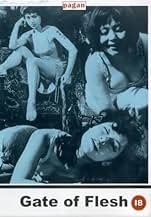
GATE OF FLESH (1964) exemplifies this. One of Suzuki's most atypical films, it tells the tale of a pimp-less group of hellcat prostitutes trying to survive in the chaotic, crime-ridden arena of post-war Tokyo. Living by a strict code, any of their number can be severely physically punished for sleeping with a man for free. Puffy-cheeked Suzuki regular Jo Shishido plays Shintaro Ibuki, a macho renegade former soldier who deals on the black market and comes to lord it over the band of women. Captivating each of them, he causes a rift among them in which the young novice hooker Maya suffers the most, as she is totally enamored of him. The film is intensely visceral, outrageous, and risque, even today. It must have been positively explosive in 1964, with its sweating, erotically-driven characters, fairly explicit depictions of sex, and savage scenes in which naked women are tied up and whipped by other women. The aggressive sensuality is further enhanced by the Fujicolor processing, which accentuates the reds and greens.
Due to his interpid nonconformism, Suzuki was fired from Nikkatsu in 1968. Amid shake-ups and financial problems at the studio, the suits decided to jettison him for making "incomprehensible" films. This prompted a massive movement on his behalf organized by his fans of time, who were mostly college students. With their support, as well as that of the Director's Guild of Japan, Suzuki filed a court case for wrongful dismissal. He won the case, but the resulting furor got him blacklisted out of the studio system, and Suzuki was only able to resume making feature films in 1977, albeit independently.
His earliest films bear a renegade, sensual flair and a vibrant visual style unsurpassed by more recent work in both the West and Asia. Working in Cinemascope, he used the widescreen frame to full effect, composing intricate shots which seem almost three dimensional, due to somewhat elaborate staging and the novel device of using dissolves to show characters and action on the opposite side of the room or space to which the main camera is pointing.
GATE OF FLESH (1964) exemplifies this. One of Suzuki's most atypical films, it tells the tale of a pimp-less group of hellcat prostitutes trying to survive in the chaotic, crime-ridden arena of post-war Tokyo. Living by a strict code, any of their number can be severely physically punished for sleeping with a man for free. Puffy-cheeked Suzuki regular Jo Shishido plays Shintaro Ibuki, a macho renegade former soldier who deals on the black market and comes to lord it over the band of women. Captivating each of them, he causes a rift among them in which the young novice hooker Maya suffers the most, as she is totally enamored of him. The film is intensely visceral, outrageous, and risque, even today. It must have been positively explosive in 1964, with its sweating, erotically-driven characters, fairly explicit depictions of sex, and savage scenes in which naked women are tied up and whipped by other women. The aggressive sensuality is further enhanced by the Fujicolor processing, which accentuates the reds and greens.
Due to his interpid nonconformism, Suzuki was fired from Nikkatsu in 1968. Amid shake-ups and financial problems at the studio, the suits decided to jettison him for making "incomprehensible" films. This prompted a massive movement on his behalf organized by his fans of time, who were mostly college students. With their support, as well as that of the Director's Guild of Japan, Suzuki filed a court case for wrongful dismissal. He won the case, but the resulting furor got him blacklisted out of the studio system, and Suzuki was only able to resume making feature films in 1977, albeit independently.
Not for the Squeamish
This film proves that good directors are able to make first-rate films in spite of very modest budgets if they have the desire and creativity necessary to succeed. Essentially, this movie concerns the plight of a small number of prostitutes who are trying to survive in post-World War II Tokyo during the American occupation. With food, medicine, shelter and employment in scarce supply those without any resources became like animals just trying to stay alive. So 5 or 6 young prostitutes take refuge in a bombed out basement and agree to live by a very strict code which forbids, among other things, sex without payment. Those who fail to comply are tortured and then thrown back onto the cold streets without any means of protection or support. At any rate, things are going well for this small group until a war-weary Japanese soldier arrives suffering from a gunshot wound. Now, rather than giving away the entire plot I will just say that the director, Seijun Suzuki, uses various techniques (like different colors to differentiate the women) to create something quite impressive out of almost nothing. Just be advised that there is some nudity and violence that wasn't usual for this period in time. But even here he uses symbolism in many cases so that it doesn't seem crass or vulgar. In short, this is a picture that I recommend to those who can appreciate artistry and ingenuity and don't depend on special effects and CGI for their film entertainment. But it's not for the squeamish.
Lurid Pulp Covers come to life!
Yet another brilliant work from director Suzuki Seijun, who manages to create (in almost every frame) a world in which lurid pulp paperback cover paintings have come to life! This tale of the rampant desperation of mere existence in post-WWII Tokyo is simply stunning on all counts. "Nikutai no Mon" ("Gate of Flesh") is both bleakly realistic, and flamboyantly artistic. It is brutal, shocking, funny, and depressing--sometimes all at once! Excellent cinema--not to be missed by any Japanese film buffs.
Rely on your own instincts
After WW II, a gang of prostitutes has their home base in the slums of Tokyo. They live in a world where the old generation of 'big shots still talk big.' For them, 'democracy means (having sexual intercourse with) foreigners.' These foreigners are GIs, members of the occupying forces in Japan. The main principle of the gang is 'no sex for free'. If a member of the gang transgresses this rule, she will be harshly punished. The movie contains some very sadistic lashing scenes.
Vision on mankind Seijun Suzuki unveils in an interview published on this DVD his view on mankind: 'physiology is the strongest force and only acts through human will. We can depend on nothing but the physicality of the flesh.' The gate to the world is the gate of flesh, where you have to 'rely on your own instincts'. Morality and religion, here represented by a black catholic priest, are hopeless pipe dreams.
Highly recommended, like other films by Seijun Suzuki's: his 'manga' movie 'Pistol Opera', his 'ghost' movie 'Princess Raccoon' (with Ziyi Zhang) and his gangster movie 'Underworld Beauty'.
Vision on mankind Seijun Suzuki unveils in an interview published on this DVD his view on mankind: 'physiology is the strongest force and only acts through human will. We can depend on nothing but the physicality of the flesh.' The gate to the world is the gate of flesh, where you have to 'rely on your own instincts'. Morality and religion, here represented by a black catholic priest, are hopeless pipe dreams.
Highly recommended, like other films by Seijun Suzuki's: his 'manga' movie 'Pistol Opera', his 'ghost' movie 'Princess Raccoon' (with Ziyi Zhang) and his gangster movie 'Underworld Beauty'.
in the rubble of civilization
Seijun Suzuki's wide screen portrait of post-war Tokyo shows a ruined city reverted back to a primitive state of barbarity, where the only law among the society of pimps, thieves and prostitutes is Survival of the Fittest. Be forewarned: although it may be tame by today's permissive standards the film is still overtly violent, in both content and style. The garish color scheme alone is often more shocking than the animal philosophy of the gang of hookers, whose punishment for compassion among their ranks is an enthusiastic whipping. Suzuki never was the most subtle filmmaker, and the crass, uncensored vitality displayed here approaches low exploitation even while it probes with subtle insight the psychology of a vanquished nation.


Did you know
- TriviaIn an interview Seijun answered the question of the uniqueness of this film in relation to other B/Program pictures he made in the time: "The studio wanted to make a skin flick, that's all. We couldn't make a real porno back then, though."
- GoofsA downward shot pans across a crowd following a stretcher. When straight down, you see the shadow of the camera, crane and the camera operator.
- ConnectionsFeatured in From the Ruins: Making 'Gate of Flesh' (2005)
- How long is Gate of Flesh?Powered by Alexa
Details
- Release date
- Country of origin
- Languages
- Also known as
- Nakito - Profis der Liebe
- Filming locations
- Nikkatsu Studios, Tokyo, Japan(Studio)
- Production company
- See more company credits at IMDbPro
- Runtime
- 1h 30m(90 min)
- Sound mix
- Aspect ratio
- 2.35 : 1
Contribute to this page
Suggest an edit or add missing content