

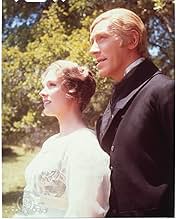
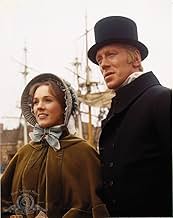
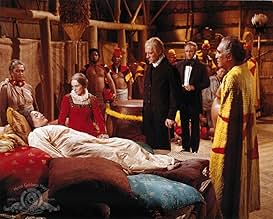
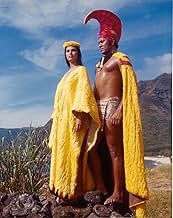
An American missionary and his wife travel to the exotic island kingdom of Hawaii, intent on converting the natives. But the clash between the two cultures is too great and instead of unders... Read allAn American missionary and his wife travel to the exotic island kingdom of Hawaii, intent on converting the natives. But the clash between the two cultures is too great and instead of understanding there comes tragedy.An American missionary and his wife travel to the exotic island kingdom of Hawaii, intent on converting the natives. But the clash between the two cultures is too great and instead of understanding there comes tragedy.
- Directors
- Writers
- Stars
- Nominated for 7 Oscars
- 2 wins & 10 nominations total


- Charity Bromley
- (as Diane Sherry)
- Directors
- Writers
- All cast & crew
- Production, box office & more at IMDbPro
Featured reviews
Hawaii then, and Hawaii now....
One way of living towards a different way of living. To say one is the incorrect way is not correct. The 'Christian' way of living is the 'correct' way of living for the Christian - the 'Hawaiin way of life is the 'correct' way of living for the Hawaiin.
I have not known any one religion that tried or have succeeded in forcing their beliefs on others, may be the Romans and/or Greeks (I think basically their belief structures at the time were of the same). That is the one doctrine that Christianity is about: converting. But, then as even now, they do it in a crude and callous manner. They do not let those they wish to convert - choose. They force their ideals upon others for the 'betterment' of 'their' religion and beliefs. Christians only believe that their religion is supreme and all other religions and God's must be false, and they succeed in their ego's.
This picture touches such matters. It shows from both sides. It shows how the Christians conquer their objective and how the Hawaiin's react to such conquering.
There is no 'good' in this epic yet at the same moment there is no 'bad'. It is just what it is - a story to be told.
The actors play well in their roles, Julie Andrews acts the same in my opinion as all the rest of the movies she has been in. Gene Hackman I think was good and Max Von Sydow who has played various roles (my favorite being the lawyer in Snow Falling On Cedars - and the worst being in Flash Gordon) plays this role to ease and temperment.
Tho, I do not agree with some aspects, as I am sure others do not as well as I have read in previous comments, this movie is well made and well put.
There is a story and the story is told.
Hawaii then, and Hawaii now - is it for the betterment? Or is it just a part of life where some nations conquer, some nations claim things that are not theirs for the betterment of their beliefs and the betterment of human kind?
6.5/10
What do Hawaii and Poland have in common?
Hawaii located where it is between North America and the Orient, when sea travel improved it was only a matter of time before the big powers came a-callin'. And they came from both directions. Not shown in the time frame this film covers, but soon after, waves of Japanese and Chinese immigrants landed on the shore. Hawaii was coveted by all and America got it.
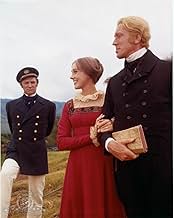
Max Von Sydow plays a young New England minister out to bring the gospel to the heathen as he sees them and has been taught to see them. His church won't send him out to the south seas without a wife, lest he be tempted by sins of the flesh, so on a short acquaintance he marries Julie Andrews. She in turn has been home pining away for whaling captain Richard Harris. When Von Sydow and Andrews get to Hawaii over the course of their story Harris would reappear.
Naturally its quite a culture shock for the New Englanders when they get to Hawaii. The film's story covers about a quarter of a century of Hawaiian history and the history of the changing attitudes of Andrews and Von Sydow.
James Michener's original novel was of War and Peace duration and I suppose the final script was as best they could get it and cover what he was trying to convey. Despite the obvious racist feelings that Von Sydow has, he's a basically decent man who does do some positive good.
His problem is that everything with him has to be filtered through the Bible. There's a lot of incest going on in Hawaii when he lands there. Reason being is that these are islands with a limited number of mating partners. Now incest is bad as we know because it does eventually weaken the gene pool. But Von Sydow hardly takes a scientific approach, how could he, he doesn't know it, he hasn't been taught it.
Julie Andrews is a far cry from the perky Mary Poppins. She develops quite an attachment to Hawaii and its people and her approach with them is fundamentally different than her husband's. It's not a bad performance.
Richard Harris is the lusty whaling captain of Andrews previous affections. I tend to think his part might have been edited down. In a recent biography of Harris, it was stated he and Andrews did not get along at all on the set. Harris in those days was a whole lot like the characters he played like this one in Hawaii.
Of course when you've got Hawaii as a subject for a camera, the photography could not be anything but gorgeous.
Hawaii covers a period not well known to most Americans except Hawaiians. And indeed they are Americans and have been since 1959. I think people could learn something from this film even with the script flaws.
Beautiful with one fatal flaw
The one fatal flaw in all this is the actor playing the central male character, Reverend Abner Hale. While Max von Sydow was always good in the great Ingmar Bergman films ("The Seventh Seal"), in most of his English-language films, with the sole exception of "The Exorcist," he always came off as something of a well-dressed stiff. It's an image he upholds here. Perhaps it's the fact that he's working in a language not his own, perhaps it's just the hopeless nature of the lines he's saddled with, but his is an Abner Hale who could transform the staunchest Christian into a Druid. He, quite simply, generates no sympathy. Plus, as many of the best clergymen seem to know, you can win more converts by stressing the kind, loving qualities of Jesus than by belching out fire and brimstone. It seems to me that, for Andrews's character, choosing between this mannered stiff and Richard Harris's vigorous sea captain shouldn't have been much of a choice at all.
But this shouldn't drive you away from "Hawaii." For all the good points I mentioned, it's definitely worth seeing at least once.
Epic-scale adventure drama or history lesson?
"A ministry in which love has no place"
But Hawaii is not some flagrant and roughshod denunciation of church and faith. The picture was adapted (quite liberally) from its source by acclaimed screenwriters Daniel Taradash and Dalton Trumbo, and it has in particular Trumbo's tendency to treat all his characters with respectful and human portrayals, in spite of what antagonisms they may have towards each other. Thus while Max von Sydow is seen at turns as a callous fanatic, a trumped-up fool and a general negative influence, we first see him as a shy yet well-meaning youngster, clumsily trying to woo Julie Andrews. In these early scenes he is somewhat endearing figure, and even though most viewers will not condone much of what he later does, this first impression sticks with us, preventing us from completely despising him and allowing us to believe in his wife's devotion to him.
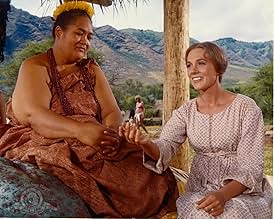
Max von Sydow was an excellent choice for this role. Admittedly his Swedish accent is a bit of a non-sequitur, but he is perfect at bringing out both the sympathetic young lad and the unshakable preacher. His performance occasionally seems to border on the hammy, but this is acceptable because it fits in with his strength of character and the earnest manner with which he takes up his ministerial duties. Julie Andrews is great too. After having made her name with the more or less fantasy figures of Mary Poppins and Maria von Trapp there's a strange kind of poignancy seeing her suffer the strains of being a more realistic wife and mother. She seems sadly underused here however, although apparently she was the main victim of the cuts in the edited version I have, which is a real pity. Richard Harris and Gene Hackman bring their forceful presences to make some of the more powerful statements in the dialogue, while Jocelyn LaGrande makes a terrific impact with her full-of-life performance. Although she spoke no English and learned her lines phonetically, it's incredible the way she communicates meaning and emotion around those words.
Hawaii was the first large-scale picture directed by George Roy Hill, and by and large he handles the broad canvas well. Of note is that fact that he gives a constant life and rhythm to the island, often featuring a few figures working in the background or framing a character with gently swaying foliage. Hill was of course a child of the New Wave and this is evident in the occasional zoom or whip pan, but his touch is generally quite light and minimalist. Unlike some of the other younger directors around at this time he favours long takes with few close-ups. The only trouble with this is doesn't seem to quite have developed the knack of subtly making a point within the frame, sometimes using the camera to force our attention on something. An example is when Iliki runs to greet Richard Harris's ship, throwing off her western dress, a moment which seems rather contrived and clunky by the way the camera pans down onto the discarded garment.
Hawaii is a far from perfect picture, being neither quite the stunning extravaganza that epics are generally meant to be, nor the stirring human drama it also seems to aspire to. However, it has many moments which come close to both goals, and most importantly has a very honest humanity to it – something so many epics lack – and this allows it to speak its message directly without ever threatening to alienate its audience.


Did you know
- TriviaJocelyne LaGarde is the only performer in Academy Award history to be nominated for her only screen role. LaGarde had never acted before, and never acted again in her entire life.
- GoofsIn the opening scene, which is set in 1818, Jerusha is said to be 22, but a later shot of her gravestone has her born in 1799.
- Quotes
Dr. John Whipple: [Addressing Abner, while holding Keoki's lifeless body, victim of the measles epidemic that has ravaged the native Hawaiians] There's nothing you could've done for him... When Captain Cook discovered these islands 50 years ago, they were a true paradise. Infectious disease was unknown. They didn't even catch cold! And there were 400,000 of them - now there are less than 150,000. You and I may well live to see the last Hawaiian lowered into his grave - with proper Christian services, of course.
- Alternate versionsOriginal version ran 189 minutes; subsequently cut to 171 minutes. The general release version ran 151 minutes. Full-length version available on home video.
- ConnectionsFeatured in The Dick Cavett Show: Julie Andrews/Blake Edwards (1971)
Details
- Release date
- Country of origin
- Languages
- Also known as
- Hawai
- Filming locations
- Bodo, Norway(Missionary boat saing thru Magellan Straits)
- Production companies
- See more company credits at IMDbPro
Box office
- Budget
- $15,000,000 (estimated)
- Runtime
- 3h 9m(189 min)
- Color
- Aspect ratio
- 2.35 : 1