
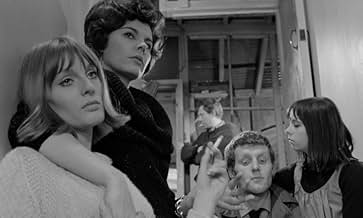
An American businessman visits London and is horrified to discover his nubile teenage daughter has become involved with a gang of thuggish "beatniks". Her involvement leads to wild parties, ... Read allAn American businessman visits London and is horrified to discover his nubile teenage daughter has become involved with a gang of thuggish "beatniks". Her involvement leads to wild parties, sex, death and necrophilia.An American businessman visits London and is horrified to discover his nubile teenage daughter has become involved with a gang of thuggish "beatniks". Her involvement leads to wild parties, sex, death and necrophilia.




Katherine Woodville
- Nina
- (as Catherine Woodville)


Chris Adcock
- Station Porter
- (uncredited)
Fred Griffiths
- Taxi Driver
- (uncredited)
Joe Phelps
- Police Constable
- (uncredited)
- Director
- Writer
- All cast & crew
- Production, box office & more at IMDbPro
6.3797
1
2
3
4
5
6
7
8
9
10
Featured reviews
One of Oliver Reed's best performances in a very little known film.
This dark and disturbing drama of the '60's is notable for two reasons.The first is the very taboo nature of the storyline.Hardly surprising that it had problems with the British Board of Censors.The second is Oliver Reed's performance has the leader of a group of disillusioned young people,none of whom seemingly have any particular aim in life.These people do not seem to show any emotion or compassionate,even toward each other,something which is very evident in their attitudes towards the deaths of two of their number. I have read somewhere of this film being described as "Oliver Reed meets Necrophia".Watch this film,if you are a fan of Oliver Reed and if you can obtain it,but be prepared to feel depressed afterward.
The beat generation
The party may have been over for the beatniks who form the centerpiece of this strange but compelling film, but for the rest of London it was just beginning. Unusually for a British production of this vintage (1963) it doesn't fit easily in any genre. An American girl who has been hanging around with the 'beats' goes missing amid lurid rumours of rape and even necrophilia. The atmosphere is one of existential angst laced and a fin de siecle fatalism, all conveyed by way of some studiously framed b&w photography. Aside from some clunky dialogue and plumy accents this could easily be French, perhaps because the story is by Marc Behm an American expat based in France who wrote Eye of the Beholder, later transposed by Claude Miller into the excellent thriller Mortelle Radonnee starring Isabelle Adjani.
Oliver Reed plays the leader of the 'beats' in such manner that you feel the void each time he's off-screen, he really is terrific and makes the rest of the cast look like the b-movie stalwarts they were. Particularly dreadful is Mike Pratt who plays Geronimo, an artist/drummer. The party scenes with all the beats lounging around or trying to twist to modern jazz are great,as is the jazz itself with John Barry and Annie Ross contributing.
Oliver Reed plays the leader of the 'beats' in such manner that you feel the void each time he's off-screen, he really is terrific and makes the rest of the cast look like the b-movie stalwarts they were. Particularly dreadful is Mike Pratt who plays Geronimo, an artist/drummer. The party scenes with all the beats lounging around or trying to twist to modern jazz are great,as is the jazz itself with John Barry and Annie Ross contributing.
Evocative, illuminating, unnerving and enjoyable
Quite splendid London based film containing a towering performance from Oliver Reed amidst his fellow 'beatniks'. Interesting time capsule affair coming as it does as The Beatles break and before the so called 'swinging London'. Dream of an opening with the cast lazily/drunkenly and seemingly aimlessly walking across Albert Bridge in the early morning. Like the film generally, a beautifully shot sequence that clearly references European cinema despite the subsequent American references and cast inclusions. Much troubled history with heavily cut version being released two years after completion and only now available uncut on DVD. Surprisingly frank portrayal of sex and rock 'n' roll without the drugs and even the rock 'n' roll being replaced by jazz. Evocative, illuminating, unnerving and enjoyable with much London location exteriors.
An insight into the decay of post-Empire Britain
Somewhere around the middle of the 1950's the teenager became an autonomous commodity in the west, garnering their own, distinctive "movements". In Britain - before The Beatles - the majority of youth identities were extracted from American sub-cultures. In Guy Hamilton's The Party's Over, the youthful group, or gang, are heavily influenced by the beat generation whose poetry and writing confronted political and social change through nihilistic, non-conformist characters and ideologies. Known in popular culture and the media as Beatniks (the "niks" added later in America to codify the group with communist affiliations - the nik was taken from the Sputnik, the Russian satellite that was launched in 1957), Oliver Reed's gang leader, Moise, guides his group through the hedonistic party scene of early 1960's London, opening with a shot of the Albert bridge in the early morning as the partied-out gang mope zombie-like, with Annie Ross's dour theme tune playing on their mournful souls. But what the film seems to focus the majority of its attentions on is the damaging consequences of both group mentality and heavy, prolonged partying. It's a moral tone that both reflects British society.
Along with the iconography of youth gang, with the tribal costuming - contrary to the idea of individuality and non-conformity, it's ironic that these ideas are scuppered by the entourage to the central trend- setting leader, - the film is about the changing political and social setting of Britain. In the still war-torn London of the early 1960's, an American businessman, Carson (Cifford David), has been sent over the Atlantic in search of his fiancée, Melina (Louise Sorel), who has been enveloped by the Chelsea set gang. Carson has been sent over by her father, a rich and powerful businessman himself. The gang, co-ordinated by Moise, send Carson on a cat and mouse chase around London, in search of the girl whom seems to be either an enigma or a skillful evader. It seems to be no accident that the American character is suave, sophisticated, smart and in control of his life, whilst the gang members are rough and without moral values. Britain was losing its Empire, and America was becoming the dominant super-power. The juxtaposition of the two transatlantic male central characters shows the parallel between the optimism of the new power and the degrading attitudes of the dying empire. As Carson begins to move deeper into the gangs secrets and situations, the dark and jarring truth changes everyone around them.
The Party's Over was an incredibly controversial film at the time, and inevitably, the film was problematic for the British Board of Film Censors. At the centre of this contention was a particular scene at a party. Melina is seen laying at the edges of the dance floor. Members of the gang stand over her, mocking her, claiming that she is unable to handle her drink. The scene quickly turns to sinister and depraved areas, which become even harder to swallow once we discover that Melina was in fact dead. The gang, like vultures, dive onto her, pulling her clothes off. A young member of the gang, Phillip (Jonathan Burn), mounts Melina in this scene, kissing and fondling her - an action that he later fatefully regrets. This scene is shown from different perspectives, much like Akira Kurosawa's Rashomon (1950). Unfortunately, due to its very suggestive nature, the British censors cut around 18 minutes from the film, and was overlooked on its release. In the cut released in 1965, the power of the film is totally lost, as these scenes are central to both the films themes and narrative. These cuts also lead to director Guy Hamilton (who would later make his name on several Bond films) and producer Anthony Perry removing their names from the credits.
But it is Reed's central performance that dominates the screen. It is not a large step away from a previous role in Joseph Losey's The Damned (1963), but his brooding, antagonistic presence is illuminating. He mocks and berates at those sycophants around him, bleating at them like a sheep, laughing at their following natures. He does however, respect those who defy him, despite his later moral maturity. In one sense the film offers an insight into the decay of post-Empire Britain, and a glimpse into the moralising of the newly dominant America. But also the film highlights what many youth films tend to forget. These youth movements (particularly in the 1960's - including the later "Hippie" movement) are fundamentally entrenched in privilege. Therefore, whilst the films young characters are rough, violent, self-absorbed, these are the future Representatives of the British class system. Perhaps more the reason for the BBFC's attack on the film: it may well have been a different release if the gang members were from the other side of London, the East-end, as opposed the West.
www.the-wrath-of-blog.blogspot.com
Along with the iconography of youth gang, with the tribal costuming - contrary to the idea of individuality and non-conformity, it's ironic that these ideas are scuppered by the entourage to the central trend- setting leader, - the film is about the changing political and social setting of Britain. In the still war-torn London of the early 1960's, an American businessman, Carson (Cifford David), has been sent over the Atlantic in search of his fiancée, Melina (Louise Sorel), who has been enveloped by the Chelsea set gang. Carson has been sent over by her father, a rich and powerful businessman himself. The gang, co-ordinated by Moise, send Carson on a cat and mouse chase around London, in search of the girl whom seems to be either an enigma or a skillful evader. It seems to be no accident that the American character is suave, sophisticated, smart and in control of his life, whilst the gang members are rough and without moral values. Britain was losing its Empire, and America was becoming the dominant super-power. The juxtaposition of the two transatlantic male central characters shows the parallel between the optimism of the new power and the degrading attitudes of the dying empire. As Carson begins to move deeper into the gangs secrets and situations, the dark and jarring truth changes everyone around them.
The Party's Over was an incredibly controversial film at the time, and inevitably, the film was problematic for the British Board of Film Censors. At the centre of this contention was a particular scene at a party. Melina is seen laying at the edges of the dance floor. Members of the gang stand over her, mocking her, claiming that she is unable to handle her drink. The scene quickly turns to sinister and depraved areas, which become even harder to swallow once we discover that Melina was in fact dead. The gang, like vultures, dive onto her, pulling her clothes off. A young member of the gang, Phillip (Jonathan Burn), mounts Melina in this scene, kissing and fondling her - an action that he later fatefully regrets. This scene is shown from different perspectives, much like Akira Kurosawa's Rashomon (1950). Unfortunately, due to its very suggestive nature, the British censors cut around 18 minutes from the film, and was overlooked on its release. In the cut released in 1965, the power of the film is totally lost, as these scenes are central to both the films themes and narrative. These cuts also lead to director Guy Hamilton (who would later make his name on several Bond films) and producer Anthony Perry removing their names from the credits.
But it is Reed's central performance that dominates the screen. It is not a large step away from a previous role in Joseph Losey's The Damned (1963), but his brooding, antagonistic presence is illuminating. He mocks and berates at those sycophants around him, bleating at them like a sheep, laughing at their following natures. He does however, respect those who defy him, despite his later moral maturity. In one sense the film offers an insight into the decay of post-Empire Britain, and a glimpse into the moralising of the newly dominant America. But also the film highlights what many youth films tend to forget. These youth movements (particularly in the 1960's - including the later "Hippie" movement) are fundamentally entrenched in privilege. Therefore, whilst the films young characters are rough, violent, self-absorbed, these are the future Representatives of the British class system. Perhaps more the reason for the BBFC's attack on the film: it may well have been a different release if the gang members were from the other side of London, the East-end, as opposed the West.
www.the-wrath-of-blog.blogspot.com
Don't Watch It on Tubi
I've got a soft spot for British B&W films from the late 50s & early 60s, just before London was set to swinging. It was the era of kitchen sink, Angry Young Man realism. When the opportunity to catch this film came along, I jumped.
Like its later, mid-to-late 60s American counterparts, Party's Over tries to capture an emerging counter culture, but fails. Clunky dialogue - although quick, clever and sprinkled with slang - isn't enough to prop up a story based on a group of dissatisfied folks who do nothing but talk, smoke, drink and 'groove.' We see them walking home the next morning, like vampires from a night of blood-letting.
There's a peppy soundtrack by John Barry and, as others have noted, Reed's performance dazzles. Almost everyone else makes the most of their parts; it's not their fault that their characters are so shallow.
The reviews here mentioned an event that is a turning point in the story. I'm glad they did because the version I saw on Tubi completely cut the scene.
That did it for me. Plus, the Carson character as the Yank was very annoying and was an instant buzz kill every time he'd crash a groovy scene. Grateful to have experienced what I did, but I wouldn't recommend the Tubi version to anyone. I guess you get what you pay for.
Like its later, mid-to-late 60s American counterparts, Party's Over tries to capture an emerging counter culture, but fails. Clunky dialogue - although quick, clever and sprinkled with slang - isn't enough to prop up a story based on a group of dissatisfied folks who do nothing but talk, smoke, drink and 'groove.' We see them walking home the next morning, like vampires from a night of blood-letting.
There's a peppy soundtrack by John Barry and, as others have noted, Reed's performance dazzles. Almost everyone else makes the most of their parts; it's not their fault that their characters are so shallow.
The reviews here mentioned an event that is a turning point in the story. I'm glad they did because the version I saw on Tubi completely cut the scene.
That did it for me. Plus, the Carson character as the Yank was very annoying and was an instant buzz kill every time he'd crash a groovy scene. Grateful to have experienced what I did, but I wouldn't recommend the Tubi version to anyone. I guess you get what you pay for.


Did you know
- TriviaDirector Guy Hamilton, executive producer Jack Hawkins, and producers Peter O'Toole and Anthony Perry had their names removed from the credits in protest at the censorship of the film.
- ConnectionsFeatured in London: The Modern Babylon (2012)
- How long is The Party's Over?Powered by Alexa
Details
- Release date
- Country of origin
- Language
- Also known as
- Вечеринка закончилась
- Filming locations
- Production company
- See more company credits at IMDbPro
- Runtime
- 1h 34m(94 min)
- Color
- Aspect ratio
- 1.66 : 1
Contribute to this page
Suggest an edit or add missing content