IMDb RATING
5.7/10
2.7K
YOUR RATING

A man desperate for money and no income, turns prostitute and interplays with a variety of clients and hustlers.A man desperate for money and no income, turns prostitute and interplays with a variety of clients and hustlers.A man desperate for money and no income, turns prostitute and interplays with a variety of clients and hustlers.
- Awards
- 1 win total

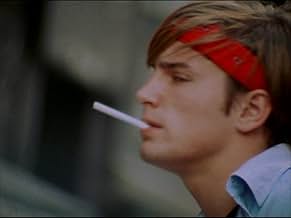
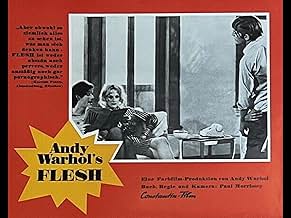


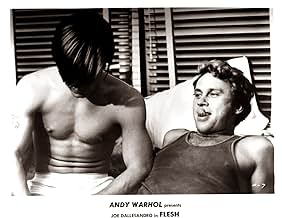


Roberto D'Allesandro
- Boy in the Street #2
- (uncredited)

Jed Johnson
- Solicitor
- (uncredited)
- Director
- Writer
- All cast & crew
- Production, box office & more at IMDbPro
5.72.7K
1
2
3
4
5
6
7
8
9
10
Featured reviews
FLESH (Paul Morrissey, 1968) **
I guess only a selected number of audience members really had any interest in watching how a male hustler in New York operates but I'd be willing to bet that even these brave souls were turned off by the irritating patchwork technique and deliberately muffled sound recording on display here; the fact that these inherent 'defects' were a direct result of the film's low-budget/underground/experimental nature is, I'd say, beside the point. Anyway, for those so inclined, the film features extensive male nudity and Joe Dallesandro, understandably, became an underground and gay icon!
The episodic structure showing the day-to-day routine of the hustler protagonist offers a couple of mildly interesting scenes: his meeting with (and eventually posing for) an eccentric elderly artist; the one where Dallesandro expresses his views on his unusual line of work and delineates his particular modus operandi to a couple of prospective 'colleagues' including perhaps the unlikeliest of hustlers a bespectacled nerd! Perhaps mercifully, the film ran for only 89 minutes against the IMDb's claim that its complete length is 105 (but the latter could well be a mistake)!
I had watched a few other of Warhol's 'movies' and this one is decidedly not as satisfying as the most tolerable example I've run into yet, BAD (1977), and only slightly better than the likes of MY HUSTLER (1965) which were mostly a strain to sit through. The fact that this was only the first part of a trilogy did not augur well but, as the saying goes, you gotta to do what you gotta do and the other two 'chapters' had to follow in quick succession...
Despite my generally negative reaction to it, FLESH is nevertheless still valuable as a 1960s time capsule and as a prototype of the Underground scene of that era, both cinematically and in real life. For the record, an image of Dallesandro from this film adorns the sleeve of The Smiths' self-titled 1984 debut album and transsexual Candy Darling (who appears here rather unremarkably) was immortalized in "Candy Says", the opening track of The Velvet Underground's eponymous 1969 album. Although the latter band is my all-time favorite, and one of the reasons for this is that, through their sheerly unique and ground-breaking music, they described a lifestyle so utterly different from my own, this is truly a case where I'd much rather experience something aurally instead of visually!
The episodic structure showing the day-to-day routine of the hustler protagonist offers a couple of mildly interesting scenes: his meeting with (and eventually posing for) an eccentric elderly artist; the one where Dallesandro expresses his views on his unusual line of work and delineates his particular modus operandi to a couple of prospective 'colleagues' including perhaps the unlikeliest of hustlers a bespectacled nerd! Perhaps mercifully, the film ran for only 89 minutes against the IMDb's claim that its complete length is 105 (but the latter could well be a mistake)!
I had watched a few other of Warhol's 'movies' and this one is decidedly not as satisfying as the most tolerable example I've run into yet, BAD (1977), and only slightly better than the likes of MY HUSTLER (1965) which were mostly a strain to sit through. The fact that this was only the first part of a trilogy did not augur well but, as the saying goes, you gotta to do what you gotta do and the other two 'chapters' had to follow in quick succession...
Despite my generally negative reaction to it, FLESH is nevertheless still valuable as a 1960s time capsule and as a prototype of the Underground scene of that era, both cinematically and in real life. For the record, an image of Dallesandro from this film adorns the sleeve of The Smiths' self-titled 1984 debut album and transsexual Candy Darling (who appears here rather unremarkably) was immortalized in "Candy Says", the opening track of The Velvet Underground's eponymous 1969 album. Although the latter band is my all-time favorite, and one of the reasons for this is that, through their sheerly unique and ground-breaking music, they described a lifestyle so utterly different from my own, this is truly a case where I'd much rather experience something aurally instead of visually!
The lost art of joe dallesando
It seems inhumane to describe someone as a work of art but in the Warhol
Art Sphere there seems little other way to describe Joe Dallesandro in
"Flesh". His body is displayed constantly in the nude, more consistently
naked than any other actor I can think of in American film history.
Warhol/Morrissey (the authorship of the movie remains contentious though
Morrisey is the credited director, the film rides under the "Andy
Warhol's" banner) objectify and expose every part of Dallesandro's
hustler in the film. He was truly the first sex symbol of the 70s. It
was only in "Flesh" he was so un-self-conscious and innocent though
always with survivalist and self-serving cunning. Joe (the character) is
an interesting kafka-esque (unable to control the world around oneself,
prone to the ebb and flow of circumstance and external control) figure
in the midst of a collage of underground culture figures of the 60s from
drag artistes to quivering tricks. Its a high camp affair at times but
Morrissey has a loving camera when it comes to Joe. Joe's beauty is
vividly captured and the fly-on-the-wall style story of a day in his
life remains engaging a
Art Sphere there seems little other way to describe Joe Dallesandro in
"Flesh". His body is displayed constantly in the nude, more consistently
naked than any other actor I can think of in American film history.
Warhol/Morrissey (the authorship of the movie remains contentious though
Morrisey is the credited director, the film rides under the "Andy
Warhol's" banner) objectify and expose every part of Dallesandro's
hustler in the film. He was truly the first sex symbol of the 70s. It
was only in "Flesh" he was so un-self-conscious and innocent though
always with survivalist and self-serving cunning. Joe (the character) is
an interesting kafka-esque (unable to control the world around oneself,
prone to the ebb and flow of circumstance and external control) figure
in the midst of a collage of underground culture figures of the 60s from
drag artistes to quivering tricks. Its a high camp affair at times but
Morrissey has a loving camera when it comes to Joe. Joe's beauty is
vividly captured and the fly-on-the-wall style story of a day in his
life remains engaging a
Flesh... the First of the Warhol/Morissey/Dallesandro Trilogy
I was a junior in high school when "Flesh" hit the big screens, but had the good fortune to see it at midnight movie houses in NYC just two years later.
Flesh is the first part of a so-called "trilogy" of films, featuring Joe Dallesandro, as an object of desire. It bears the "Warhol" name, but is more the work of Paul Morissey. Essentially the story concerns itself with the exploits surrounding one day in the life of a street-wise male hustler (played by Joe Dallesandro). Joe is young, beautiful, and a bit naive... but he manages to bring home the bacon to his wife, for reasons which should not be explained to appreciate the film fully.
Of special note to film buffs is that this film (along with the remaining two of the trilogy), had no script, per se. Warhol's superstars were given simply a premise... and the words and actions which the viewer sees are quite natural (even at times ridiculous or non-sensical). But all in all it works... "Rolling Stone" noted in its review that the film was better than "Midnight Cowboy", a film of the same year, more polished by Hollywood (An Academy Award winner for Best Film) , with big name talent (I equally admire the film)... but FLESH, being improvised, was somehow more gut wrenching and realistic, without the need for complex sub-plots and any "cause de celebre" .. or for that matter any cause at all!
The film grossed more than $3 million dollars and was an absolute sensation, particularly in the German market (which, ironically, thought they were given a "censored version" of the film because of the post-editing....see note below).
Curiously, the film is very much "cut and paste" with "pops". "clicks", "flashes", and dialogue literally cut off mid-sentence. It is almost as if Warhol/Morissey are stating a simple truth that it is a "day in the life" of a superstar, snippets for your voyeuristic tendencies. Far better than earlier Warhol works of 8 hours of sleeping, and the statue of liberty as a 20+ hour movie.
FLESH, in my opinion, is the first of the Warhol films that actually is digestible (given a wide pallette) and Warhol's/the Factory's first legitimate response to the Hollywood phenomenon of "stardom".
As the first of a "trilogy", it portrays a young, desirable male icon, naive, sought after, responding to invitations to please his family. Subsequent films would show the "same character" with a differing set of values. (See "Trash" and "Heat")
Flesh is the first part of a so-called "trilogy" of films, featuring Joe Dallesandro, as an object of desire. It bears the "Warhol" name, but is more the work of Paul Morissey. Essentially the story concerns itself with the exploits surrounding one day in the life of a street-wise male hustler (played by Joe Dallesandro). Joe is young, beautiful, and a bit naive... but he manages to bring home the bacon to his wife, for reasons which should not be explained to appreciate the film fully.
Of special note to film buffs is that this film (along with the remaining two of the trilogy), had no script, per se. Warhol's superstars were given simply a premise... and the words and actions which the viewer sees are quite natural (even at times ridiculous or non-sensical). But all in all it works... "Rolling Stone" noted in its review that the film was better than "Midnight Cowboy", a film of the same year, more polished by Hollywood (An Academy Award winner for Best Film) , with big name talent (I equally admire the film)... but FLESH, being improvised, was somehow more gut wrenching and realistic, without the need for complex sub-plots and any "cause de celebre" .. or for that matter any cause at all!
The film grossed more than $3 million dollars and was an absolute sensation, particularly in the German market (which, ironically, thought they were given a "censored version" of the film because of the post-editing....see note below).
Curiously, the film is very much "cut and paste" with "pops". "clicks", "flashes", and dialogue literally cut off mid-sentence. It is almost as if Warhol/Morissey are stating a simple truth that it is a "day in the life" of a superstar, snippets for your voyeuristic tendencies. Far better than earlier Warhol works of 8 hours of sleeping, and the statue of liberty as a 20+ hour movie.
FLESH, in my opinion, is the first of the Warhol films that actually is digestible (given a wide pallette) and Warhol's/the Factory's first legitimate response to the Hollywood phenomenon of "stardom".
As the first of a "trilogy", it portrays a young, desirable male icon, naive, sought after, responding to invitations to please his family. Subsequent films would show the "same character" with a differing set of values. (See "Trash" and "Heat")
lots of flesh, lots of fun for the crew
Because this flick is the first feature fruit of a long lasting collaboration between Paul Morrissey, Andy Warhol and Joe Dallessandro, it is too much obvious that it was mostly made for having fun among themselves. The script is quite loose, the dialogues are too obviously improvised, one even suspects that there probably is no script at all, just thematic concepts: prostitution, addiction and poverty (which all seem to continue in the following films Trash and Heat).
Joe Dallessandro reveals unashamedly his gorgeous body at any chance, to the hungry eyes of other addicts (not only drug addicts).
Although the whole film seems like amateurish, especially the scene with other hustlers at the park is very intriguing, like a documentary project.
I would not recommend to see this by itself, but watching the trilogy (Flesh, Heat and Trash) altogether will be much enlightening.
Joe Dallessandro reveals unashamedly his gorgeous body at any chance, to the hungry eyes of other addicts (not only drug addicts).
Although the whole film seems like amateurish, especially the scene with other hustlers at the park is very intriguing, like a documentary project.
I would not recommend to see this by itself, but watching the trilogy (Flesh, Heat and Trash) altogether will be much enlightening.
the passive object of desire
Flesh is the first film of a trilogy by Paul Morrissey and Andy Warhol, and is perhaps the first attempt to create an icon of desire out of a male leading role. Although the film is focused on an uncomplicated character development of Joe (Joe Dallesandro), a gentle and subtly unhappy hustler, it depicts him as a passive and ambivalent object, who, in spite of a semi-evident sense of self-control, is possessed, shaped, and evaluated entirely by others. Joe is a young and somewhat naive Adonis who exudes comfort and beauty in his independence, but he works the streets to support his lesbian wife and her girlfriend. He is restlessly bored by an artist/customer's speeches on Greek athletic sculpture and 'body worship', but he sells his nudity anyway. He regards the increasing advances of his homosexual friend with ambivalence, but lets them happen nonetheless. This passivity dominates the film and succeeds in creating a visceral element to Dallesandro's appeal: not only is he desired, he is had.
Perhaps the film's most interesting element is the balance of its obviously experimental nature with its palpable directness. The snappy editing and fragmented dialogue make it fresh and 'real', yet it manages not to rely on the clichéd abstractness of art-films. It is rough, and indeed a weaker effort than Trash or Heat, but nonetheless presents a collection of perfectly plausible characters in a light of almost absolute neutrality.
Perhaps the film's most interesting element is the balance of its obviously experimental nature with its palpable directness. The snappy editing and fragmented dialogue make it fresh and 'real', yet it manages not to rely on the clichéd abstractness of art-films. It is rough, and indeed a weaker effort than Trash or Heat, but nonetheless presents a collection of perfectly plausible characters in a light of almost absolute neutrality.


Did you know
- TriviaUK censor John Trevelyan was wary of issuing the film a cinema certificate and suggested to the distributors that the film be shown on a club basis. When it was initially shown at the Open Space Theatre in London in February 1970 the cinema was raided by police who attempted to seize the film, leading Trevelyan himself to hastily rush to the cinema and vigorously defend the movie against possible prosecution, calling the police action 'unjustified and preposterous'. In the light of this incident Trevelyan was able to grant the film an uncut 'X' certificate.
- GoofsDuring a scene with the go-go dancer, Candy and Jackie alternately call her by the character's first name (Terry) and that of the actress playing her (Geri Miller).
- Quotes
Joe, the Hustler: How am I supposed to make any money without clean underwear?
- Crazy creditsThe opening credits run sideways and list Warhol's name, the title, the main cast members, and that it was written, photographed and directed by Paul Morissey.
- ConnectionsEdited into Porn to Be Free (2016)
- SoundtracksMakin' Wicky Wacky Down in Waikiki
Performed by Sophie Tucker.
- How long is Flesh?Powered by Alexa
Details
- Release date
- Country of origin
- Language
- Also known as
- Andy Warhol's Flesh
- Filming locations
- Greenwich Village, New York City, New York, USA(At the apartment of critic David Bourdon)
- Production company
- See more company credits at IMDbPro
Box office
- Budget
- $4,000 (estimated)
- Runtime
- 1h 29m(89 min)
- Sound mix
- Aspect ratio
- 1.37 : 1
Contribute to this page
Suggest an edit or add missing content