IMDb RATING
6.7/10
1.2K
YOUR RATING

Three Swedish stage actresses give differing interpretations of the classic Aristophanes play "Lysistrata."Three Swedish stage actresses give differing interpretations of the classic Aristophanes play "Lysistrata."Three Swedish stage actresses give differing interpretations of the classic Aristophanes play "Lysistrata."
- Director
- Writers
- Stars




Margreth Weivers
- Tourist Manager's Wife
- (as Margaret Weivers)


Signe Enwall
- Choir Member
- (as Signe Envall)


- Director
- Writers
- All cast & crew
- Production, box office & more at IMDbPro
6.71.1K
1
2
3
4
5
6
7
8
9
10
Featured reviews
"Vad nu då? Ett nytt uppror bland kvinnfolken!",
Theres alot of things in this movie I hate, thats because the world has already become what this film wanted to achieve. And thats why it feels so gratis and tedious, because these feministic Initiatives that "Flickorna" are suggesting have already been, more or less, accepted by social standards today.
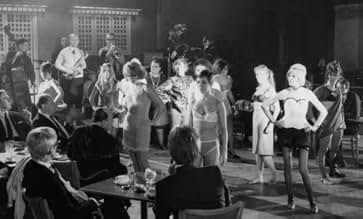
Figures appear and are gone - interrupted, overheard or obscured by something else. Because here are thousand of things squashed about space. Put togheter with alot of creativity, anger and passion. Three female actors tour with "Lysistrate", and in a forest there is a living room, in a cinema you throw eggs at Stalin, in a bar the shirts come off, on a street the BridalBrigade forms - and then napalm and serpentines on it. Despite all this commotion Mai Zetterling actually manages to stay steadfast on the directorial cotroll.
Men rule and the world burns, and it is 1968. Men ruled and the world burned 411 BC as well, when Aristophanes wrote his play. To end the 20-year war between Athens and Sparta, Lysistrate makes women swear to deny men sex.
The theater group heads north. "Lysistrate" is supposed to make people discuss, but no one understands what it is about. World peace and equal conditions are good, but what you want most of all is a sofa group.
The only mistake is that Zetterling makes a big cluster caused in a cinematographic array of clichés and pre-art that leaves one largely untouched. It may be that pre-art is a stylistic grip in "The Girls", a way of playfully mixing imagination and reality. But most of the time it is an optional, unintentional parody or superficial image experiment. Nevertheless, its provocative content, its bold and playful form, its humor and warmth, has made it something of a cult.
Due to the death of the actor and director Gunnel Lindblom, I got the chance to see this movie free on SVT.
Figures appear and are gone - interrupted, overheard or obscured by something else. Because here are thousand of things squashed about space. Put togheter with alot of creativity, anger and passion. Three female actors tour with "Lysistrate", and in a forest there is a living room, in a cinema you throw eggs at Stalin, in a bar the shirts come off, on a street the BridalBrigade forms - and then napalm and serpentines on it. Despite all this commotion Mai Zetterling actually manages to stay steadfast on the directorial cotroll.
Men rule and the world burns, and it is 1968. Men ruled and the world burned 411 BC as well, when Aristophanes wrote his play. To end the 20-year war between Athens and Sparta, Lysistrate makes women swear to deny men sex.
The theater group heads north. "Lysistrate" is supposed to make people discuss, but no one understands what it is about. World peace and equal conditions are good, but what you want most of all is a sofa group.
The only mistake is that Zetterling makes a big cluster caused in a cinematographic array of clichés and pre-art that leaves one largely untouched. It may be that pre-art is a stylistic grip in "The Girls", a way of playfully mixing imagination and reality. But most of the time it is an optional, unintentional parody or superficial image experiment. Nevertheless, its provocative content, its bold and playful form, its humor and warmth, has made it something of a cult.
Due to the death of the actor and director Gunnel Lindblom, I got the chance to see this movie free on SVT.
Among The Problems With Modernizing LYSISTRATA....
Harriet Andersson, Bibi Andersson, and Gunnel Lindblom go on tour with LYSISTRATA and become radicalized into political agency by the play and the reactions -- or lack of reactions -- to it.
Mai Zetterling's film disappeared from the theaters after three weeks of awful receipts. The critics -- men, of course -- didn't care for this tale of how these women's real lives bonded with their stage lives to create a third life, part dream, part hallucination, with the men reduced to indistinguishable, impotent actors driven simply by their lusts for sex and dull normality.
The movie has gained respect over the years, with feminists acclaiming it. But were the critics of the time so wrong? Aristophanes' play has often often attracted the attention of modern writers and producers. They've made modern-dress novels, and plays and movies, and they seem to have a uniformly poor reception. Perhaps the attraction of the source material to Ms Zetterling was it was one of the few works of classic literature in which women had agency. Whereas Aristophanes intended this as mockery of the new, more democratic spirit of Athens that he so despised, offering peace as so obvious that even women could see it, and men being such brutes that they'd do anything for sexual release. He was not making an argument for extending the franchise to women; he wanted a return to the Good Old Days, when aristocrats with names like Aristophanes were in charge.
Perhaps the failing here is Ms Zetterling's honesty. Like Spike Jones, in his gloss on the play, CHI-RAQ, she points out the hypocrisy of the class she argues for, their cowardice in refusing to accept responsibility. That's one of the risks of satire. Once you've offended everyone, there aren't going to be many fans.
Mai Zetterling's film disappeared from the theaters after three weeks of awful receipts. The critics -- men, of course -- didn't care for this tale of how these women's real lives bonded with their stage lives to create a third life, part dream, part hallucination, with the men reduced to indistinguishable, impotent actors driven simply by their lusts for sex and dull normality.
The movie has gained respect over the years, with feminists acclaiming it. But were the critics of the time so wrong? Aristophanes' play has often often attracted the attention of modern writers and producers. They've made modern-dress novels, and plays and movies, and they seem to have a uniformly poor reception. Perhaps the attraction of the source material to Ms Zetterling was it was one of the few works of classic literature in which women had agency. Whereas Aristophanes intended this as mockery of the new, more democratic spirit of Athens that he so despised, offering peace as so obvious that even women could see it, and men being such brutes that they'd do anything for sexual release. He was not making an argument for extending the franchise to women; he wanted a return to the Good Old Days, when aristocrats with names like Aristophanes were in charge.
Perhaps the failing here is Ms Zetterling's honesty. Like Spike Jones, in his gloss on the play, CHI-RAQ, she points out the hypocrisy of the class she argues for, their cowardice in refusing to accept responsibility. That's one of the risks of satire. Once you've offended everyone, there aren't going to be many fans.
Relevance to terrorist attack on New York
I've just seen this film today, 19 Sept., and couldn't help but think of the New York terrorist attack. I read a letter to the editor about the attack and it said that if women were ruling the world the attacks would never have happened. However, this prescient film shows that that ain't necessarily so.
What's so good about this film is the fair treatment it gives of women, showing their frivolous and silly side as well as the struggle to deal with their roles in their world. I liked the fight between the women, and the pathetic attempt Liz made to stir her audience into speaking, without any thought for who it was she addressed.
Thirty-three years after it was made, the film is relevant and moving.
What's so good about this film is the fair treatment it gives of women, showing their frivolous and silly side as well as the struggle to deal with their roles in their world. I liked the fight between the women, and the pathetic attempt Liz made to stir her audience into speaking, without any thought for who it was she addressed.
Thirty-three years after it was made, the film is relevant and moving.
The best Swedish film!
This has become my favourite Swedish film. I've seen i t many times. At first I thought it would be gloomy and depressing in a Bergman way. It wasn't. It's a funny, spirited and inventive film.
It's nice to see that even swedes were caught up in the sixties and felt the charge of new ways of thinking and being. New ideas about social behavior, youth and womens place in society were taken up in "the Girls". It's refreshingly shown and not preachy. There's a lot of humour in it and the men get to say their opinions about women too so it's not one-sided.
Some reviewers here have commented on it as being dated. It is a product of it's time but some of the subjects it takes up are timeless. How much should a woman have to compromise with the male point of view? I think this is still a touchy subject. The film was controversial when it was released. It's not a traditional movie with a straight plot so some people might find it too unconventional. But, there are three great performances by some of the best Swedish actresses ever: Bibi Andersson, Harriet Andersson and Gunnel Lindblom who are all so delightfully energetic, lively and beautiful. They show different sides being a woman.
The film is very much a 1968 film but it's worth seeing for the great black and white photography, to see Sweden in the sixties, for the actors and for the imaginative direction by Mai Zetterling. I love it!
It's nice to see that even swedes were caught up in the sixties and felt the charge of new ways of thinking and being. New ideas about social behavior, youth and womens place in society were taken up in "the Girls". It's refreshingly shown and not preachy. There's a lot of humour in it and the men get to say their opinions about women too so it's not one-sided.
Some reviewers here have commented on it as being dated. It is a product of it's time but some of the subjects it takes up are timeless. How much should a woman have to compromise with the male point of view? I think this is still a touchy subject. The film was controversial when it was released. It's not a traditional movie with a straight plot so some people might find it too unconventional. But, there are three great performances by some of the best Swedish actresses ever: Bibi Andersson, Harriet Andersson and Gunnel Lindblom who are all so delightfully energetic, lively and beautiful. They show different sides being a woman.
The film is very much a 1968 film but it's worth seeing for the great black and white photography, to see Sweden in the sixties, for the actors and for the imaginative direction by Mai Zetterling. I love it!
Dated film with some great surreal scenes
I believe this movie represents how it felt to be an out-spoken feminist in the 60s. The people you were preaching to weren't listening, the people you were preaching against were laughing of you. It must have been a terrible struggle, and this movie portrays this in an interesting manner.
However, while feminism movement is still going strong (and rightfully so), this movie does not hold up as that relevant any more. The feminist struggle was different back then than now, and while some of the problems are the same, the "war" (as they call it in the film) is different, making this movie feel as dated as it is.
The highlights of the movie are some of the surreal scenes. I believe this is the only movie with a chase scene where a snowmobile is chasing a kicksled.
So, I would say watch this if you are interested in either feminism in cinema, or the situation of the feminists in the 60s and 70s. Or if you are interested in (swedish) film history, as this release caused some controversy. But if you are a casual moviegoer that (amazingly) stumbles upon this, you probably will not be too happy.
However, while feminism movement is still going strong (and rightfully so), this movie does not hold up as that relevant any more. The feminist struggle was different back then than now, and while some of the problems are the same, the "war" (as they call it in the film) is different, making this movie feel as dated as it is.
The highlights of the movie are some of the surreal scenes. I believe this is the only movie with a chase scene where a snowmobile is chasing a kicksled.
So, I would say watch this if you are interested in either feminism in cinema, or the situation of the feminists in the 60s and 70s. Or if you are interested in (swedish) film history, as this release caused some controversy. But if you are a casual moviegoer that (amazingly) stumbles upon this, you probably will not be too happy.


Did you know
- TriviaUnderwent a digital restoration from the original 35mm negative in 2016 by the Swedish Film Institute.
- Quotes
TV Reporter: Could you tell us more precisely what it's about?
Gunilla: Well, it's rather hard to explain. It's about how things stand... now.
Liz Lindstrand: To be a bit more precise, it's about... women and war.
Marianne: I thought it was about girls and boys.
- ConnectionsFeatured in Stjärnbilder (1996)
- How long is The Girls?Powered by Alexa
Details
- Runtime
- 1h 40m(100 min)
- Color
- Sound mix
- Aspect ratio
- 1.66 : 1
Contribute to this page
Suggest an edit or add missing content