
A woman causes a group of assassins to face their greatest challenge.A woman causes a group of assassins to face their greatest challenge.A woman causes a group of assassins to face their greatest challenge.
- Awards
- 2 nominations total

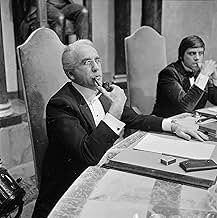


Curd Jürgens
- Gen. von Pinck
- (as Curt Jurgens)


John Abineri
- Police Inspector
- (uncredited)
John Adams
- French President
- (uncredited)

Jonathan Adams
- French President
- (uncredited)
6.43.9K
1
2
3
4
5
6
7
8
9
10
Featured reviews
Frothy Fun
After reading the other comments here, I wonder if these folks saw the same movie. This film is a lot of fun, a touch on the slap-stick side and it isn't supposed to be Bond OR the Pink Panther. Maybe the problem is generational??? Those of us who grew up in the far away and ancient times learned that there didn't have to be an action sequence every thirty seconds, lots of overt sex and toilet humor. These things are what seem to "make" a movie today and it's why a lot of people of my generation a) don't go to a lot of films today and b) really worry about the ones who think the named qualities are what make a movie "good". Oh, well. Every generation has to grow up. When they do, maybe they will find that The Assassination Bureau really is the laugh riot while The American Pies and What About Marys are noted to be rather--well--gross.
Holds up well over time
This charming film, made when Oliver Reed and Diana Rigg were at the height of their appeal, is what they used to call a "romp", when it wasn't considered to be a putdown. Reed, as Ivan, born and bred to lead an international group of highly-placed assassins, is hired by would-be reporter Sonia (Rigg) to have his group kill him, and realizing that his house badly needs some cleaning out, Ivan accepts the commission. The rest is a whirlwind tour of Europe, taking out substantial portions of the terrain as they go, avoiding bungled attempts on his life as he tries to track down the traitors who would turn the Bureau into a political machine. The dialogue is refreshingly devoid of political correctness, but maintains a firm respect between the unlikely couple as they go from bickering rivalry to bickering fondness. Guest villains include Clive Revill as a gluttonous Italian, and sad stories include the accidental demise of Roger Delgado (Dr. Who, the first Master) while on location. Much worth the time and effort, although sadly almost never seen on TV, and abysmally represented in video release.
Jack London - An American Original With a "Jules Verne" Problem
Jack London was a phenomenal writer, who came up from poverty and turned out some amazing books. These include (but are not limited to) THE SEA WOLF, WHITE FANG, THE CALL OF THE WILD. London is usually brushed aside today as a "kids" author. The same idiocy that relegates Jules Verne to be a writer for children and ignores his savage comments on politics affects London. After you are encouraged (about eighth grade) to read THE CALL OF THE WILD, you are told that London is always writing about man and animals in Alaska in the Gold Rush of 1898, with an occasional look at an exciting sea story.
Actually he's sharper than that: THE CALL OF THE WILD and WHITE FANG were his attempts to tell a story from an animals' point of view. THE SEA WOLF is his attempt to attack the prevalent socio-economic doctrine of the day (1900): Social Darwinism, as practiced by Captain Wolf Larsen. He wrote one of the first good novels about America under a dictatorship: THE IRON HEEL. He discussed his early life in MARTIN EDEN. He discussed his alcoholism in his book JOHN BARLEYCORN. He was the first American novelist of real international stature to embrace socialism! A reporter as well as writer, his experiences watching the Japanese government prevent him from carrying out his job during the Russo - Japanese War turned him into a perpetually hostile critic of Japan's goals in the Pacific (although, to be fair to the Japanese, London did show some racism here).
Keeping this in mind, one realizes that THE ASSASSINATION BUREAU, LTD. has to be tackled differently from say THE CALL OF THE WILD or the short story TO BUILD A FIRE. London is looking with jaundice eye at the political system that had ruled Europe (and most of the world) since 1815 or so. It was oppressive and uneven, and even in the United States (probably the best major power to live in in terms of opportunity and social mobility) it was still badly flawed.
Assassination had become a serious tool for trying to influence European affairs from 1881 to 1910 (when the novel was begun by London). Tsar Alexander II of Russia was blown to bits in 1881 by a Nihilist group called "The People's Will". Although it was captured and most of its members hanged, others copied it. Assassinations continued in Russia up to 1911 including Interior Grand Duke Serge in 1904,Minister Von Phleve in 1905, and Prime Minister Peter Stolypin in 1911. Elsewhere the other states suffered. Presidents Garfield and McKinley were assassinated in 1881 and 1901 (the latter by a self-proclaimed anarchist). President Sadi Carnot of France was stabbed to death in a public parade in 1894, in the middle of a series of anarchist attacks (including a bombing at the Chambre of Deputies). Empress Elisabeth of Austria-Hungary, King Umberto I of Italy, the Prime Minister of Spain, King Carlos III of Portugal, were all killed. So were Lord Frederick Cavendish and Thomas Burke by Irish nationalists in Phoenix Park in 1882. Many smaller public figures were killed as well. The topic of an "assassination bureau" was timely - especially as some of these victims fit what the bureau decided: were the targets worthy of being assassinated.
Of course not all of them were (Empress Elisabeth for example). But London's vision was not totally flawed. It was just that being a realist he knew that the "pure" idea of the bureau would be corrupted sooner or later. So his plot involves the head of this international bureau being offered a huge reward if he orders his own assassination. Note that Oliver Reed's character is a Russian, as though the author knew who was most likely to be the head of an assassination group.
Probably due to other commitments London never finished the novel. Robert L. Fish, a successful mystery novelist, wrote a completion which was rather amusing. I tend to believe that was an error - London was seldom an amusing writer. The film treats the moral issue as a joke, and uses the characters as caricatures of the nations they represent (the doleful Russian, the gluttonous and sexually active Italian, the pragmatic Frenchmen who runs a bordello too, the English newspaper tycoon). These characters need good performers, and Philippe Noiret is on target as the bordello owner/assassin leader); and (although not Italian) Clive Revill is quite good as the Italian. The Russian (it's not Reed) is doleful, but hardly memorable. As for Lord Bostwick, Telly Savalas is not convincing as an English aristocrat (one can't even imagine him as a Canadian transplant to England, like Spencer Tracy in EDWARD, MY SON). Curt Jurgens' German assassination leader, General Von Pinck (the name suggested, perhaps, by his handiness with a sword) is either sadistically high-spirited or vicious: no other characteristics there.
Diana Rigg, as the budding journalist who's first job is actually as a cats-paw for Savalas (her boss) is pretty good, but her performance as Vincent Price's daughter in THEATRE OF BLOOD was livelier. She seems determined to maintain her suffragette style dignity here no matter what. However it happens to work for the film. As for Reed, his straight villains were usually far better than his heroes. He appears to be too laid back at times. A bit more jittery behavior would have been better.
One final point: One minor character, an Austrian nobleman marked for death, is killed when he cuts into a large knock-wurst (that has a bomb in it). This gag probably is not original but it was reused in the television movie MORE WILD WILD WEST with Jonathan Winters as the victim.
Actually he's sharper than that: THE CALL OF THE WILD and WHITE FANG were his attempts to tell a story from an animals' point of view. THE SEA WOLF is his attempt to attack the prevalent socio-economic doctrine of the day (1900): Social Darwinism, as practiced by Captain Wolf Larsen. He wrote one of the first good novels about America under a dictatorship: THE IRON HEEL. He discussed his early life in MARTIN EDEN. He discussed his alcoholism in his book JOHN BARLEYCORN. He was the first American novelist of real international stature to embrace socialism! A reporter as well as writer, his experiences watching the Japanese government prevent him from carrying out his job during the Russo - Japanese War turned him into a perpetually hostile critic of Japan's goals in the Pacific (although, to be fair to the Japanese, London did show some racism here).
Keeping this in mind, one realizes that THE ASSASSINATION BUREAU, LTD. has to be tackled differently from say THE CALL OF THE WILD or the short story TO BUILD A FIRE. London is looking with jaundice eye at the political system that had ruled Europe (and most of the world) since 1815 or so. It was oppressive and uneven, and even in the United States (probably the best major power to live in in terms of opportunity and social mobility) it was still badly flawed.
Assassination had become a serious tool for trying to influence European affairs from 1881 to 1910 (when the novel was begun by London). Tsar Alexander II of Russia was blown to bits in 1881 by a Nihilist group called "The People's Will". Although it was captured and most of its members hanged, others copied it. Assassinations continued in Russia up to 1911 including Interior Grand Duke Serge in 1904,Minister Von Phleve in 1905, and Prime Minister Peter Stolypin in 1911. Elsewhere the other states suffered. Presidents Garfield and McKinley were assassinated in 1881 and 1901 (the latter by a self-proclaimed anarchist). President Sadi Carnot of France was stabbed to death in a public parade in 1894, in the middle of a series of anarchist attacks (including a bombing at the Chambre of Deputies). Empress Elisabeth of Austria-Hungary, King Umberto I of Italy, the Prime Minister of Spain, King Carlos III of Portugal, were all killed. So were Lord Frederick Cavendish and Thomas Burke by Irish nationalists in Phoenix Park in 1882. Many smaller public figures were killed as well. The topic of an "assassination bureau" was timely - especially as some of these victims fit what the bureau decided: were the targets worthy of being assassinated.
Of course not all of them were (Empress Elisabeth for example). But London's vision was not totally flawed. It was just that being a realist he knew that the "pure" idea of the bureau would be corrupted sooner or later. So his plot involves the head of this international bureau being offered a huge reward if he orders his own assassination. Note that Oliver Reed's character is a Russian, as though the author knew who was most likely to be the head of an assassination group.
Probably due to other commitments London never finished the novel. Robert L. Fish, a successful mystery novelist, wrote a completion which was rather amusing. I tend to believe that was an error - London was seldom an amusing writer. The film treats the moral issue as a joke, and uses the characters as caricatures of the nations they represent (the doleful Russian, the gluttonous and sexually active Italian, the pragmatic Frenchmen who runs a bordello too, the English newspaper tycoon). These characters need good performers, and Philippe Noiret is on target as the bordello owner/assassin leader); and (although not Italian) Clive Revill is quite good as the Italian. The Russian (it's not Reed) is doleful, but hardly memorable. As for Lord Bostwick, Telly Savalas is not convincing as an English aristocrat (one can't even imagine him as a Canadian transplant to England, like Spencer Tracy in EDWARD, MY SON). Curt Jurgens' German assassination leader, General Von Pinck (the name suggested, perhaps, by his handiness with a sword) is either sadistically high-spirited or vicious: no other characteristics there.
Diana Rigg, as the budding journalist who's first job is actually as a cats-paw for Savalas (her boss) is pretty good, but her performance as Vincent Price's daughter in THEATRE OF BLOOD was livelier. She seems determined to maintain her suffragette style dignity here no matter what. However it happens to work for the film. As for Reed, his straight villains were usually far better than his heroes. He appears to be too laid back at times. A bit more jittery behavior would have been better.
One final point: One minor character, an Austrian nobleman marked for death, is killed when he cuts into a large knock-wurst (that has a bomb in it). This gag probably is not original but it was reused in the television movie MORE WILD WILD WEST with Jonathan Winters as the victim.
Life is a precious thing.
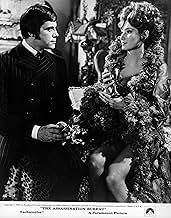
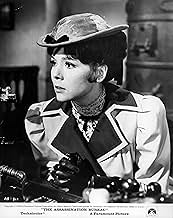
Diana Rigg plays Sonya Winter, a journalist with an agenda in the early 20th century who contacts the title murder-for-hire organization, wanting someone dead. The young boss (Oliver Reed) is initially aghast when she reveals that it is HE whom she wants dead, but his shock turns to intrigue when he realizes that a good cat-and-mouse game between him and his associates could be good for weeding out the incompetents. Then he learns that some of his associates are interested in politically motivated crimes.
Designed, produced, and scripted by Michael Relph, based on an idea in a novel began by Jack London and finished by Robert L. Fish, "The Assassination Bureau" is an agreeably daft time waster. It has a great, classic sense of farce for a while, and is quite lively and humorous at first. Only in the second half does it lose some momentum and get more bogged down in plot.
But this has such an engaging, eclectic international cast that it ends up as a very watchable bit of nonsense. It's a treat to see Reed give such a *fun* performance, and Rigg is his match as the feisty woman who's gotten in over her head. Also making appearances are Telly Savalas, Curd Jurgens, Philippe Noiret, Warren Mitchell, Beryl Reid, Clive Revill, Vernon Dobtcheff, Annabella Incontrera, Kenneth Griffith, Jess Conrad, and George Coulouris.
This *does* have a gleefully unpredictable quality, with Reeds' swashbuckling protagonist often unflappable in the face of danger.
"The Assassination Bureau" might be too silly for some folks, but I had a pretty good time with it. Yes, it's lightweight and forgettable in the end, and goes on a bit long, but is overall a genially tongue-in-cheek affair, and must viewing for fans of Rigg & Reed.
Seven out of 10.
Designed, produced, and scripted by Michael Relph, based on an idea in a novel began by Jack London and finished by Robert L. Fish, "The Assassination Bureau" is an agreeably daft time waster. It has a great, classic sense of farce for a while, and is quite lively and humorous at first. Only in the second half does it lose some momentum and get more bogged down in plot.
But this has such an engaging, eclectic international cast that it ends up as a very watchable bit of nonsense. It's a treat to see Reed give such a *fun* performance, and Rigg is his match as the feisty woman who's gotten in over her head. Also making appearances are Telly Savalas, Curd Jurgens, Philippe Noiret, Warren Mitchell, Beryl Reid, Clive Revill, Vernon Dobtcheff, Annabella Incontrera, Kenneth Griffith, Jess Conrad, and George Coulouris.
This *does* have a gleefully unpredictable quality, with Reeds' swashbuckling protagonist often unflappable in the face of danger.
"The Assassination Bureau" might be too silly for some folks, but I had a pretty good time with it. Yes, it's lightweight and forgettable in the end, and goes on a bit long, but is overall a genially tongue-in-cheek affair, and must viewing for fans of Rigg & Reed.
Seven out of 10.
Worth watching for Reed and Rigg
This film is an enjoyable enough lightweight romp, with an array of locations and actors that is perhaps excessive.
Oliver Reed is suavely bucaneering as the main protaganist, while the other main star, Diana Rigg of Avengers fame, does a very well-judged comic performance as the feminist journalist in 1910. It's a shame she didn't appear in more films. No other actors get much of a chance to shine, as there are far too many minor characters.
The writing is OK; you get the feeling that there should be more laughs than there are. Still, it's an enjoyable enough way to spend an hour and a half.
Rating:- *** (out of *****)
Oliver Reed is suavely bucaneering as the main protaganist, while the other main star, Diana Rigg of Avengers fame, does a very well-judged comic performance as the feminist journalist in 1910. It's a shame she didn't appear in more films. No other actors get much of a chance to shine, as there are far too many minor characters.
The writing is OK; you get the feeling that there should be more laughs than there are. Still, it's an enjoyable enough way to spend an hour and a half.
Rating:- *** (out of *****)


Did you know
- TriviaJack London's original novel was left markedly incomplete at the time of his death, and it was not until many decades later that the thriller-writer Robert L. Fish (also known as Robert L. Pike) finished it for publication, amidst much publicity. The novel is noticeably more serious in tone than this movie, although a New York Times review at the time called it "delightfully ridiculous."
- GoofsIn the scene about 40-45 minutes in where Lord Bostwick visits General Van Pinck whilst the latter is at fencing practice, there's a map of Europe on the wall. Although this film ostensibly takes place before World War I, the map is of post-Versailles Europe, c.1925-1939.
- Quotes
Miss Winter: With your ideas, I'm surprised you're shocked at the thought of war.
Ivan Dragomiloff: Not at all. It's purely a matter of business. How can we charge our sort of prices with everybody happily killing each other for a shilling a day?
- How long is The Assassination Bureau?Powered by Alexa
Details
- Release date
- Country of origin
- Languages
- Also known as
- El sindicato del crimen
- Filming locations
- Cliveden House, Taplow, Buckinghamshire, England, UK(Lord Bostwick riding in the woods towards Ruthenia)
- Production company
- See more company credits at IMDbPro
Contribute to this page
Suggest an edit or add missing content