IMDb RATING
7.7/10
8.2K
YOUR RATING

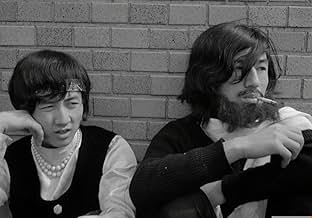
The trials and tribulations of Eddie and other transvestites in Japan.The trials and tribulations of Eddie and other transvestites in Japan.The trials and tribulations of Eddie and other transvestites in Japan.

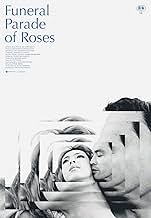
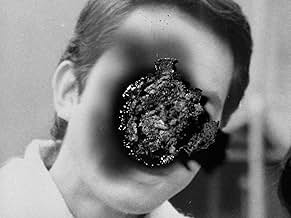

- Director
- Writer
- All cast & crew
- Production, box office & more at IMDbPro
7.78.1K
1
2
3
4
5
6
7
8
9
10
Featured reviews
10NateManD
Disturbing but important work of gay world cinema!
"Funeral Parade of Roses" is an underrated unknown work of Japanese gay cinema. It was one of Stanly Kubric's favorite films, and it had a significant influence on the the style of "A Clockwork Orange". The film deals with Japanese drag queens, including the clubs, rivalry and their sex lives. In an Oedipus fashion, except reversed, the main character kills his mother so he can have relations with his father. Director Toshio Matsumato seemed to be way ahead of his time for his portrayal of sexuality and violence on screen. Also in a Bergman like fashion, actors are interviewed so the audience realizes it's only a movie.(and a twisted one at that) The film has many hallucinatory scenes, and who could forget the drag queens using urinals. There's also a weird fight scene between the two drag queens, and when they yell comic bubbles pop out of their mouths. Thank God this movie is in black & white! It's very brutal, disturbing and violent at times; so watch with caution. "Funeral Parade of Roses", is simply shocking and brilliant!
Odd, interesting Japanese avant-garde film
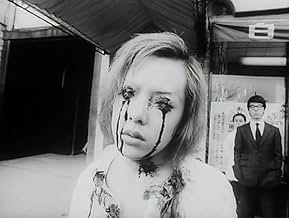
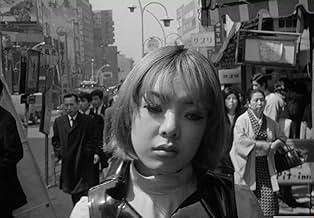
I am not a fan of avent-garde films, which I find are often pretentious and silly, but I enjoyed "Funeral Parade of Roses", primarily because I found the main character "Eddie" (played by Shinnosuke Ikehata aka "Peter") fascinating. The film is a non-linear composite of drama and documentary like vérité punctuated by abstract inclusions (jump cuts to stills, substitution splices, etc), some of which are more effective than others. Supposedly, Kubrick drew inspiration for "A Clockwork Orange" (1971) from this film and there are certainly some similarities (at one point Eddie looks straight at the camera through up cast eyes in a scene that reminded me of the iconic opening shot of "Alex" in Kubrick's film). Lacking much of a plot, "Funeral Parade of Roses" primarily peers into Tokyo's gay scene and follows Eddie, a transvestite 'bar girl' as he moves amoungst his friends (including pretentious auteur 'Guevara') in hopes of luring boss Gonda (Yoshio Tsuchiya) from rival, and bar 'Madame', Leda (Osamu Ogasawara), perhaps becoming 'Madame' himself. The black-and white cinematography is lovely, the characters intriguing and photogenic and the direction, for the most part, excellent (the interminable toking scene not withstanding). While the film is nonlinear, there is a traditional 'climactic' sequence at the end that is well worth waiting for and explains many of the references to the film being an Oedipal myth. Not to everybody's tastes but well worth trying out.
Funeral Parade of Roses
An unsettling and astonishing Japanese film that introduced me to the Japanese New Wave movement.
"Funeral Parade of Roses," like many of the best works of art, defies description or categorization. It dives into the Japanese gay sub-culture of the 1960s, and specifically young gay men who dress and act like women. It blurs the line between fact and fiction; at times, the actors in the movie become actors in a movie within the movie, and the movie itself becomes a documentary about the making of a movie about gay Japanese youths. If you can follow that sentence, then you're on the way to having the right sensibility to enjoy this film.
It's a shocking movie too, going places most other films at the time, and certainly few American movies, would dare. The only big American movie I can think of from that time period that comes even close to tackling subjects that general audiences would find equally unsavory is "Midnight Cowboy," and this film makes that one look like a Doris Day romp in comparison.
Grade: A
"Funeral Parade of Roses," like many of the best works of art, defies description or categorization. It dives into the Japanese gay sub-culture of the 1960s, and specifically young gay men who dress and act like women. It blurs the line between fact and fiction; at times, the actors in the movie become actors in a movie within the movie, and the movie itself becomes a documentary about the making of a movie about gay Japanese youths. If you can follow that sentence, then you're on the way to having the right sensibility to enjoy this film.
It's a shocking movie too, going places most other films at the time, and certainly few American movies, would dare. The only big American movie I can think of from that time period that comes even close to tackling subjects that general audiences would find equally unsavory is "Midnight Cowboy," and this film makes that one look like a Doris Day romp in comparison.
Grade: A
clean? :-) fun
If you really are looking for a good time in a movie theatre - watch this movie ! It has been said that some of Kubrick's visual and sonic ideas for "Clockwork Orange" were inspired by this movie; after having seen it, i'm more than convinced that this is true.
This movie offers a lot of cinematic ideas and it uses surprising ways to make a point within a story.
What is the reason that films with a spirit and mood like that have vanished from the screen ? Have the politics in the movie industry really become so strict ? This movie watched nowadays has (but maybe had always) a subversive feel to it, why is that ?
It definitely offers something different and therefore would be very welcome in movie theatres and videostores around the world to free us from all the uninspired formula movies.
This movie offers a lot of cinematic ideas and it uses surprising ways to make a point within a story.
What is the reason that films with a spirit and mood like that have vanished from the screen ? Have the politics in the movie industry really become so strict ? This movie watched nowadays has (but maybe had always) a subversive feel to it, why is that ?
It definitely offers something different and therefore would be very welcome in movie theatres and videostores around the world to free us from all the uninspired formula movies.
Daring and unique
A pretty unique film, one which represents transvestite characters in an adaptation of a classical Greek story, executed in a new wave film style. It's a lot, and there were times while watching it that I thought director Toshio Matsumoto was trying to do just a little too much. If you're wondering a bit during silly scenes like the joint being passed around, or what the point of all those butts are, one sporting a protruding rose, well, I would just say 'bare' with it, because it pulls together well over the back half. The lead character, Eddie (short for Oedipus, get it?), is striking, and frankly I thought Peter was a big part of what made the film successful.
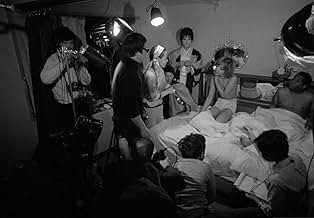
The film felt a little close to making this culture a part of a carnival, e.g. with fight scenes given to us in fast motion and with circus music, and when the interviewer asks questions of characters/actors in condescending ways. There are gay sex scenes which seems quite daring for the period, though Matsumoto seems to want to reassure us that nothing's actually happening by suddenly showing the film crew around the actors, and how the whole thing is just being simulated. I worried a little bit that the culture was just being used for shock value along with the new wave style, and compounded by the perversion of the original story.
However, overall I think we see a sympathetic humanization here, something that's pretty amazing for 1969. The characters suffer the pangs of love and jealousy as anyone else would, and also hardships growing up that are all their own. Masks and mirrors play a big role in the film, but what I loved was that while these characters are wearing masks maybe to conceal their inner demons and the pain in their lives, they're not wearing them or pretending to be something they're not by dressing as women. Ironically, we see that they are being true to themselves, and in that sense, wearing less of a mask by doing so. The best moments for me were in the candid, honest replies to the interview questions, and I wish there would have been more of this. The imagery at the end is also especially powerful, and seems to amplify the isolation of this poor young man from the society around him, who simply gape in astonishment.
The film felt a little close to making this culture a part of a carnival, e.g. with fight scenes given to us in fast motion and with circus music, and when the interviewer asks questions of characters/actors in condescending ways. There are gay sex scenes which seems quite daring for the period, though Matsumoto seems to want to reassure us that nothing's actually happening by suddenly showing the film crew around the actors, and how the whole thing is just being simulated. I worried a little bit that the culture was just being used for shock value along with the new wave style, and compounded by the perversion of the original story.
However, overall I think we see a sympathetic humanization here, something that's pretty amazing for 1969. The characters suffer the pangs of love and jealousy as anyone else would, and also hardships growing up that are all their own. Masks and mirrors play a big role in the film, but what I loved was that while these characters are wearing masks maybe to conceal their inner demons and the pain in their lives, they're not wearing them or pretending to be something they're not by dressing as women. Ironically, we see that they are being true to themselves, and in that sense, wearing less of a mask by doing so. The best moments for me were in the candid, honest replies to the interview questions, and I wish there would have been more of this. The imagery at the end is also especially powerful, and seems to amplify the isolation of this poor young man from the society around him, who simply gape in astonishment.


Did you know
- TriviaFuneral Parade of Roses (1969) gave Stanley Kubrick several visual and aural inspirations for his adaptation of A Clockwork Orange (1971).
- GoofsAll entries contain spoilers
- ConnectionsEdited from Ecstasis (1969)
- SoundtracksO du lieber Augustin
- How long is Funeral Parade of Roses?Powered by Alexa
Details
- Release date
- Country of origin
- Languages
- Also known as
- Funeral Procession of Roses
- Filming locations
- Production companies
- See more company credits at IMDbPro
Box office
- Gross worldwide
- $1,114
- Runtime
- 1h 45m(105 min)
- Color
- Sound mix
- Aspect ratio
- 1.37 : 1
Contribute to this page
Suggest an edit or add missing content