
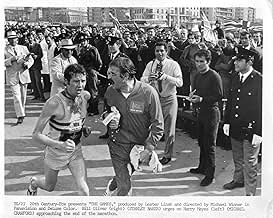
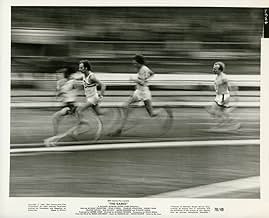
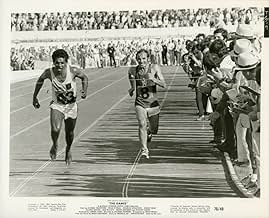
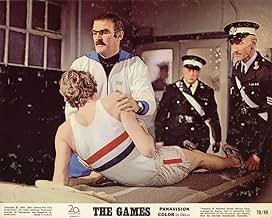
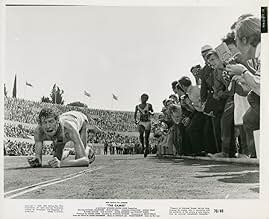
Four marathon runners (one from England, one from the U.S., a Czechoslovakian, and an Australian Aborigine) prepare to run in the Olympic games. The film follows each one and shows what thei... Read allFour marathon runners (one from England, one from the U.S., a Czechoslovakian, and an Australian Aborigine) prepare to run in the Olympic games. The film follows each one and shows what their motivations are for running in the games.Four marathon runners (one from England, one from the U.S., a Czechoslovakian, and an Australian Aborigine) prepare to run in the Olympic games. The film follows each one and shows what their motivations are for running in the games.


- Director
- Writers
- All cast & crew
- Production, box office & more at IMDbPro
6.1533
1
2
3
4
5
6
7
8
9
10
Featured reviews
Not a winner
Michael Winner made a lot of rather variable films before he found his true vocation as a restaurant critic.This one is prime ham.It is rather difficult to take seriously for one minute.With scrawny Aznavour and Crawford looking like they couldn't go 100 yards. A athletics is not my sport and the same goes for Winner.
Fairly Interesting Movie
This is a pretty decent film on one of my favorite subjects, the Olympics. This film pretty much takes its inspration from several real figures in Olympic history (Abebe Bikila, Dorondo Pietri and Emil Zatopek) and uses their stories as the basis of this film. Its just too bad that this film is rarely, if ever, shown on television anymore because it does show what motivates someone to run in the marathon and what it takes to complete it.
Winner Directs Baker (Two Great Brits)
In 1970, between working with Oliver Reed in Swinging Sixties flicks and Charles Bronson in exploitation crime, a mainstream Michael Winner directed THE GAMES, centering on a group of worldwide runners training for the Rome Olympics... but the trainers are the most intriguing characters...
In particular Stanley Baker, at this point a British veteran actor (who always looked older than he actually was), as a former running champion with a limp so serious he never lets the viewer forget...
Which takes the kind of energy that's completely lacking in the extremely miscast Michael Crawford as a milkman turned record-breaking sprinter (randomly romancing ingenue Elaine Taylor), whose lightweight acting chops seems more befitting the quirky comedies he was used to...
Although his scenes with Baker are pretty good because the tough coach makes every scene count... As does the Australian Aborigine's own trainer, more of a promoter, in get-rich-quick-schemer (and kangaroo poacher) Jeremy Kemp, as offbeat-crooked as Baker is headstrong-intense...
Meanwhile Ryan O'Neal's American runner hardly has a coach at all... A pill-popping womanizer with a breezy (albeit also miscast) sex symbol appeal, he seems like part of another movie altogether....
In fact every participant's individual story from THE GAMES (including an aged Frenchman seeking a comeback) feels underdeveloped since director Winner, using a barrage of that era's zoom shots and choppy edits, has to stuff them all inside a single 100-minute sports programmer that passes the time decently...
But could have been better if Stanley Baker only had another runner/actor to train, and more time to do so.
In particular Stanley Baker, at this point a British veteran actor (who always looked older than he actually was), as a former running champion with a limp so serious he never lets the viewer forget...
Which takes the kind of energy that's completely lacking in the extremely miscast Michael Crawford as a milkman turned record-breaking sprinter (randomly romancing ingenue Elaine Taylor), whose lightweight acting chops seems more befitting the quirky comedies he was used to...
Although his scenes with Baker are pretty good because the tough coach makes every scene count... As does the Australian Aborigine's own trainer, more of a promoter, in get-rich-quick-schemer (and kangaroo poacher) Jeremy Kemp, as offbeat-crooked as Baker is headstrong-intense...
Meanwhile Ryan O'Neal's American runner hardly has a coach at all... A pill-popping womanizer with a breezy (albeit also miscast) sex symbol appeal, he seems like part of another movie altogether....
In fact every participant's individual story from THE GAMES (including an aged Frenchman seeking a comeback) feels underdeveloped since director Winner, using a barrage of that era's zoom shots and choppy edits, has to stuff them all inside a single 100-minute sports programmer that passes the time decently...
But could have been better if Stanley Baker only had another runner/actor to train, and more time to do so.
i just love movies
bringing stories together in a movie is an art form and this is an excellent painting, micheal winner where did it all go wrong? crawford, baker and o neal are never better and charles aznavour? i have not seen this film for 20 years but long for the day to see it again does anyone know how?
Will the real amateur please stand up!
This Michael winner movie from 1970 is not that well known, probably because it was overshadowed by his 'revenge for hire ' films later in the 1970's and 80's. Its about the Olympic games in Rome with particular attention to the marathon. You can still enjoy this if you are not a avid track and field follower because it's got an interesting cast, however, if you are it's a real treat.
We are introduced to Scott Reynolds an American played by Ryan O'Neal a jock (a jock is a term in the USA for a male college student who is good at sports, and is popular with the women) who is boastful and likes to burn the candle at both ends. Over the other side of the Atlantic there is Harry Hayes a milkman by trade who likes to run and is encouraged to join an athletics club. Although he is slightly gawky and awkward (you can see traits of Frank Spencer a character Michael Crawford was to play in a BBC sitcom a few years later)also likes the ladies and a drink too is trained by his obsessive coach Bill Oliver played by Stanley Baker. Oliver is a former marathon star who is bitter that his running career came to a halt prematurely is an army man whose training methods are brutal and expectations so unrealistic that he actually comes across as a madman. Consequently, because of his intensity he steals the scenes when he is on camera.
Sunny is the Australian runner who likes to run in barefoot is encouraged by his mentor a bookie played by Jeremy Kemp. Lastly, there is Pavel Vendik the commie played by Charles Aznevour, a devoted family man and former world record holder whose best running days are probably behind him but is encouraged to come out of retirement to show whose political system is superior. Although this is a request from the party, you can't refuse unless you want to spend some time in a gulag.
One really interesting feature is that the main characters of the movie don't have much dialog or time with each other and although they do compete in other meetings,Vendik and Hayes once and Reynolds and Sunny once too,they only all come together in the movie finale in Rome. This provides two important factors. Firstly, its not too heavy on either character and quickly moves on to the other runners which keeps up the interest, secondly, it provides some great cinematography, from England, Australia, Czechoslovakia, Tokyo and the final country Italy where they all meet in the Marathon. The character development is good as it shows the cultural differences between each runner, their background and what motivates them to run and compete .
Also Michael winner was on to something with this depiction of an Olympic games. People often talk about "it's not the winning but the participation", and a get together of all nations in the world for peace and harmony, ---- diplomacy using sport. However,we all know that this is totally false, the reality is political and commercial interests ride roughshod over this conception. The marathon in this Olympics could not be moved to later on in the day when the temperature and humidity would not be so much of a problem for the athletes because it would conflict what was in the best interest of the US TV companies with their audience and advertising revenue. That's not hard to believe!
The importance of winning above anything else was paramount. Because the USSR and the USA used the Olympics to score political points both tried to get around the professional barrier to get the edge. To start with the Soviet Union and it's eastern bloc allies used the games as a way of competing with the west's capitalistic system. State run athletic programs, full time athletes and state sponsored drug taking, were part and parcel with the communist nations. Also in the USA, colleges provided athletic and sport scholarship programs for students which provided top notch facilities. However, many of them had very little academic reason for being there. This was a way for the US to get around professionalism too. Although performance enhancing drugs were not encouraged by the US administrators, according to Scot David Jenkins a former 400m Olympic contender who trained in the USA, he claimed that it was rife in American sports too. He should know, because not only did he use them but he spent time in a federal pen for illegally smuggling them and distributing them in the US after he retired from running. Providing you were not getting paid a salary or were not financially enriching yourself your were technically an amateur!
None of this was really in the spirit of amateur sports which the Olympics was meant to be. Contrast this with British runner Hayes who is a milkman and had to train after work in an athletics club, this truly typified the amateur spirit of athletics in the UK back then. Under the circumstances it's amazing that Great Britain was able to dominate middle distance running from the late 1970's through the late 1980's until it all really went professional. The British probably got good practice running after trains and buses, neither which ever ran on time!!
Also, the Olympics were the an opportunity for athletes and nations to make their petty political points. From the banning of South Africa from participation right up to the early 1990's the Olympics were riddled with political boycotts and demonstrations. Politics and sport don't mix who are you trying to kid! Michael winner was years ahead of his time with this and clearly saw what was coming!
Check this movie,it's great to see some of the support cast who went on to bigger and better things (particular attention to Ryan O'Neals former wife as the prize in the 'chug a lug' drinking contest!)
We are introduced to Scott Reynolds an American played by Ryan O'Neal a jock (a jock is a term in the USA for a male college student who is good at sports, and is popular with the women) who is boastful and likes to burn the candle at both ends. Over the other side of the Atlantic there is Harry Hayes a milkman by trade who likes to run and is encouraged to join an athletics club. Although he is slightly gawky and awkward (you can see traits of Frank Spencer a character Michael Crawford was to play in a BBC sitcom a few years later)also likes the ladies and a drink too is trained by his obsessive coach Bill Oliver played by Stanley Baker. Oliver is a former marathon star who is bitter that his running career came to a halt prematurely is an army man whose training methods are brutal and expectations so unrealistic that he actually comes across as a madman. Consequently, because of his intensity he steals the scenes when he is on camera.
Sunny is the Australian runner who likes to run in barefoot is encouraged by his mentor a bookie played by Jeremy Kemp. Lastly, there is Pavel Vendik the commie played by Charles Aznevour, a devoted family man and former world record holder whose best running days are probably behind him but is encouraged to come out of retirement to show whose political system is superior. Although this is a request from the party, you can't refuse unless you want to spend some time in a gulag.
One really interesting feature is that the main characters of the movie don't have much dialog or time with each other and although they do compete in other meetings,Vendik and Hayes once and Reynolds and Sunny once too,they only all come together in the movie finale in Rome. This provides two important factors. Firstly, its not too heavy on either character and quickly moves on to the other runners which keeps up the interest, secondly, it provides some great cinematography, from England, Australia, Czechoslovakia, Tokyo and the final country Italy where they all meet in the Marathon. The character development is good as it shows the cultural differences between each runner, their background and what motivates them to run and compete .
Also Michael winner was on to something with this depiction of an Olympic games. People often talk about "it's not the winning but the participation", and a get together of all nations in the world for peace and harmony, ---- diplomacy using sport. However,we all know that this is totally false, the reality is political and commercial interests ride roughshod over this conception. The marathon in this Olympics could not be moved to later on in the day when the temperature and humidity would not be so much of a problem for the athletes because it would conflict what was in the best interest of the US TV companies with their audience and advertising revenue. That's not hard to believe!
The importance of winning above anything else was paramount. Because the USSR and the USA used the Olympics to score political points both tried to get around the professional barrier to get the edge. To start with the Soviet Union and it's eastern bloc allies used the games as a way of competing with the west's capitalistic system. State run athletic programs, full time athletes and state sponsored drug taking, were part and parcel with the communist nations. Also in the USA, colleges provided athletic and sport scholarship programs for students which provided top notch facilities. However, many of them had very little academic reason for being there. This was a way for the US to get around professionalism too. Although performance enhancing drugs were not encouraged by the US administrators, according to Scot David Jenkins a former 400m Olympic contender who trained in the USA, he claimed that it was rife in American sports too. He should know, because not only did he use them but he spent time in a federal pen for illegally smuggling them and distributing them in the US after he retired from running. Providing you were not getting paid a salary or were not financially enriching yourself your were technically an amateur!
None of this was really in the spirit of amateur sports which the Olympics was meant to be. Contrast this with British runner Hayes who is a milkman and had to train after work in an athletics club, this truly typified the amateur spirit of athletics in the UK back then. Under the circumstances it's amazing that Great Britain was able to dominate middle distance running from the late 1970's through the late 1980's until it all really went professional. The British probably got good practice running after trains and buses, neither which ever ran on time!!
Also, the Olympics were the an opportunity for athletes and nations to make their petty political points. From the banning of South Africa from participation right up to the early 1990's the Olympics were riddled with political boycotts and demonstrations. Politics and sport don't mix who are you trying to kid! Michael winner was years ahead of his time with this and clearly saw what was coming!
Check this movie,it's great to see some of the support cast who went on to bigger and better things (particular attention to Ryan O'Neals former wife as the prize in the 'chug a lug' drinking contest!)


Did you know
- TriviaA then-unknown Sir Elton John sang the Francis Lai and Hal Shaper-penned "From Denver to L.A." as part of the film's soundtrack, which was issued in the U.S. by Viking Records (LPS-105). He was so little-known at that point, that he was credited on the label as "Elton Johns". The label planned to issue the song as a single (VIK-1010, backed with "Warm Summer Rain" by The Barbara Moore Singers), and promotional copies were pressed, but John, who first hit stardom towards the end of 1970, had the record withdrawn before commercial copies could be pressed. Upon his reaching superstar status, promotional copies of the "From Denver to L.A." single have become prized collector's items and an interesting curio in John's recorded catalogue.
- GoofsAt once stage during a particularly twisty and narrow part of the race on Rome's streets, the pace vehicle is forced to go so slow that it forces leader Hayes almost to a standstill to avoid colliding with it.
- ConnectionsReferenced in Vsechnopárty: Episode dated 14 April 2017 (2017)
- How long is The Games?Powered by Alexa
Details
- Release date
- Country of origin
- Language
- Also known as
- Bitmeyen yarış
- Filming locations
- Copenhagen, Denmark(kine weekly 16/11/1968)
- Production company
- See more company credits at IMDbPro
- Runtime
- 1h 40m(100 min)
- Color
- Aspect ratio
- 2.35 : 1
Contribute to this page
Suggest an edit or add missing content