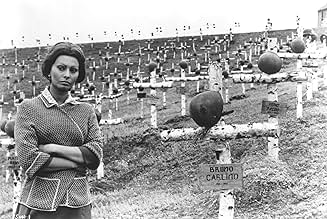
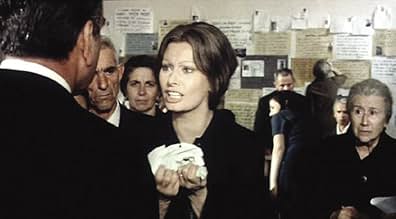
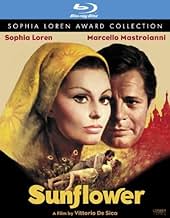
An Italian woman conducts a desperate search for her husband, a soldier considered missing in action in Russia during WWII.An Italian woman conducts a desperate search for her husband, a soldier considered missing in action in Russia during WWII.An Italian woman conducts a desperate search for her husband, a soldier considered missing in action in Russia during WWII.
- Director
- Writers
- Stars
- Nominated for 1 Oscar
- 1 win & 2 nominations total
Lyudmila Saveleva
- Mascia
- (as Ljudmila Saveljeva)
Nadya Serednichenko
- Contadina russa
- (as Nadja Cerednicenko)
Gunars Cilinskis
- Funzionario russo
- (as Gunnar Zilinskij)
Carlo Ponti Jr.
- Giovanna's Baby
- (uncredited)
Mariya Sapozhnikova
- Passerby
- (uncredited)
- Director
- Writers
- All cast & crew
- Production, box office & more at IMDbPro
7.34.9K
1
2
3
4
5
6
7
8
9
10
Featured reviews
Fatalism of War
Vittorio de Sica achieved a remarkable feat in this eye-catching 1970 production, bringing together Americans and Soviets, in the midst of the Cold War, in the co-production of a Franco-Italian film.
From the Americans he got a memorable soundtrack, written and directed by Henry Mancini and nominated for an Oscar. From the Soviets he received the footage from Mosfilm, directed by Andrey Konchalovskiy, as well as the actress Ludmila Saveleva.
The script by Tonino Guerra and Cesare Zavattini has everything it needs to work, but the film gets lost somewhere in between so many attributes.
The story is basic and excessively melodramatic. The soundtrack is beautiful but quickly becomes cloying. The footage of the sunflower fields and the cemeteries of Russian combatants is powerful and eloquent, but inconsequential. This is, after all, a story of the living, not the dead. Only the final notes of the fatalism of war, which determines people's fates, far beyond their individual will, remain to give the film any meaning.
But it is not enough. A final result clearly less than the sum of its parts.
From the Americans he got a memorable soundtrack, written and directed by Henry Mancini and nominated for an Oscar. From the Soviets he received the footage from Mosfilm, directed by Andrey Konchalovskiy, as well as the actress Ludmila Saveleva.
The script by Tonino Guerra and Cesare Zavattini has everything it needs to work, but the film gets lost somewhere in between so many attributes.
The story is basic and excessively melodramatic. The soundtrack is beautiful but quickly becomes cloying. The footage of the sunflower fields and the cemeteries of Russian combatants is powerful and eloquent, but inconsequential. This is, after all, a story of the living, not the dead. Only the final notes of the fatalism of war, which determines people's fates, far beyond their individual will, remain to give the film any meaning.
But it is not enough. A final result clearly less than the sum of its parts.
Love, Hope, Truth and Renounce
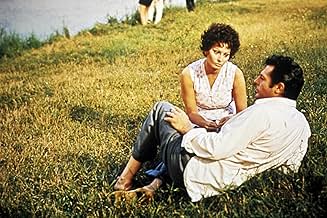
In Naples, in World War II, the local Giovanna (Sophia Loren) has a torrid love affair with the soldier Antonio (Marcello Mastroianni), who is ready to embark to Africa. Giovanna proposes him to get married with her to get a leave of twelve days; then Antonio pretends that he is insane and he is sent to an asylum. However, the doctors discover the farce and they give the option to Antonio to go to the Russian front as volunteer instead of being sued. When Antonio is missing in action in Russia, Giovanna does not accept that he is dead. Years after the end of the war, Giovanna travels to Russia with a picture of Antonio to seek him out in the countryside. When she finds a lead in a village, her hope becomes disappointment with truth about his disappearance.
"I Girasoli" is one of the most famous romances of cinema and discloses a beautiful story of love, hope, truth and renounce. Vittorio De Sica explores the chemistry between Sophia Loren and Marcello Mastroianni to the best, supported by a magnificent cinematography and the wonderful soundtrack of Henry Mancini, which certainly is among the most beautiful ones of the cinema history. The screenplay uses much ellipsis, and my remarks are the lack of dates, leaving the viewer without any reference of how many years have passed; further, the dialogs in Russian that are not translated. My vote is eight.
Title (Brazil): "Os Girassóis da Rússia" ("The Russia's Sunflowers")
"I Girasoli" is one of the most famous romances of cinema and discloses a beautiful story of love, hope, truth and renounce. Vittorio De Sica explores the chemistry between Sophia Loren and Marcello Mastroianni to the best, supported by a magnificent cinematography and the wonderful soundtrack of Henry Mancini, which certainly is among the most beautiful ones of the cinema history. The screenplay uses much ellipsis, and my remarks are the lack of dates, leaving the viewer without any reference of how many years have passed; further, the dialogs in Russian that are not translated. My vote is eight.
Title (Brazil): "Os Girassóis da Rússia" ("The Russia's Sunflowers")
Una donna alla ricerca dell' amore perduto.
"I Girasoli" is certainly one of the best romantic stories in an honest and pure setting in Italy and Russia. It is a dramatic love story of Antonio and Giovana wanting to stay together in the war. The impossibility to hold on to the newly found and sweetest happiness becomes inevitable in the destructive war, where Anoinio is found half frozen by a Russian woman. The accent lies in finding love in warm sunny Italy and loosing this in the freezing cold war thousands of miles away. Although in this new other world there is love too, it is never the same as before. At the end the search for the lost love is completed and in vain when life has changed there lives irreversibly. Un impossibile ritorno al passato.
touched my heart
You know the plot.
Sunflower was Vittorio De Sica's last film. It was dismissed by the critics as hopelessly maudlin melodrama. But anyone who cares enough to be reading this no doubt knows the humanity he crafted into every frame, and the beauty and sadness of life it evokes.
Henry Mancini's theme song is, IMVHO, the very best he ever wrote. I'm reduced to tears every time I hear it. Yet it seems Mancini himself treated as a lesser child. His daughter recorded it to lyrics better left forgotten.
Sunflower was Vittorio De Sica's last film. It was dismissed by the critics as hopelessly maudlin melodrama. But anyone who cares enough to be reading this no doubt knows the humanity he crafted into every frame, and the beauty and sadness of life it evokes.
Henry Mancini's theme song is, IMVHO, the very best he ever wrote. I'm reduced to tears every time I hear it. Yet it seems Mancini himself treated as a lesser child. His daughter recorded it to lyrics better left forgotten.
a memorable sophia and marcello one-of-a-kind classic film!
I went to a san francisco theatre to see this film along with my mother when I was a teenager in the 60's. It was in english and I loved it so much I saw it twice. I never forgot it, and although it was never shown again, I was told by someone a few years ago, that it was featured on one of the cable channels, and unfortunately I must have missed it. I don't think its ever been shown since. In my humble opinion, this classic movie depicting love, war, passion, separation, hope, and tears should be rated right up there along with Dr. Zhivago, Casablanca, In Love and War, and many other great films of all time. It's a pity that this movie "Sunflower" is nowhere to be found on video or better yet DVD in the english version in the U.S. I did purchase it on video in Italian, and even though I am fluent in Italian and can understand it, others in my household cannot. Can somebody PLEASE see that it gets some recognition, and becomes a familiar movie and available here in the U.S.A.?
Did you know
- TriviaThe child of Giovanna (Sophia Loren) in this film was actually Loren's from her partnership with producer Carlo Ponti.
- GoofsMascia tells Giovanna that when she found Antonio, he was hurt so badly that he had forgotten everything, including his own name. If that's true, then how did Mascia know his name was Antonio?
- ConnectionsEdited into Marcello, una vita dolce (2006)
- How long is Sunflower?Powered by Alexa
Details
- Release date
- Countries of origin
- Languages
- Also known as
- Suncokreti
- Filming locations
- Production companies
- See more company credits at IMDbPro
- Runtime
- 1h 47m(107 min)
- Sound mix
- Aspect ratio
- 1.85 : 1
Contribute to this page
Suggest an edit or add missing content