

The World War II phase of the career of controversial American general George S. Patton.The World War II phase of the career of controversial American general George S. Patton.The World War II phase of the career of controversial American general George S. Patton.
- Won 7 Oscars
- 25 wins & 8 nominations total

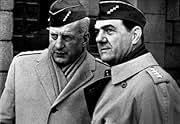


Carey Loftin
- General Bradley's Driver
- (as Cary Loftin)


Pat Zurica
- First Lieutenant Alexander Stiller
- (as Patrick J. Zurica)


Richard Münch
- Colonel General Alfred Jodl
- (as Richard Muench)


7.9113.2K
1
2
3
4
5
6
7
8
9
10
Summary
Reviewers say 'Patton' is acclaimed for George C. Scott's compelling performance as General George S. Patton, highlighting his complexity. The film is lauded for its epic scope, Franklin J. Schaffner's direction, and powerful war sequences. However, some critics find it lacking in secondary character development and note its lengthy runtime. Historical accuracy is debated, with concerns over anachronisms and creative liberties. Despite these issues, 'Patton' is recognized as a pivotal war film, offering profound insights into leadership and the intricacies of war.
Featured reviews
"Old Blood and Guts" valued courage and resolve above all
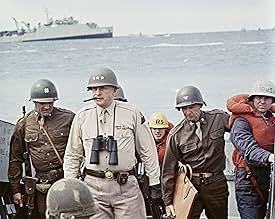
RELEASED IN 1970 and directed by Franklin J. Schaffner, "Patton" stars George C. Scott as the charismatic general during his WWII campaigns in North Africa and Sicily, as well as France & Germany following the Normandy invasion. After the invasion of Sicily, Patton was reprimanded for slapping a cowardly soldier suffering battle fatigue (in real life it was two soldiers on separate occasions in the course of eight days in August, 1943). The fiery general was removed from command for eleven months while his junior in age and rank, Omar Bradley (Karl Malden), was selected to command the First United States Army for the invasion of Normandy.
Meanwhile, Patton was assigned to London as a decoy to deceive the Germans in a sham operation called Fortitude. The ruse was successful because the German High Command respected Patton more than any other Allied commander and deemed him crucial to any plan to invade mainland Europe. Immediately following the successful invasion, he was put in command of the Third Army in the final Allied thrust against Germany where the headstrong general, once again, proved his mettle as his forces favored speed and aggressive offensive action.
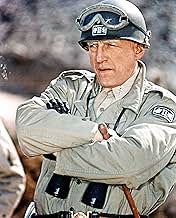
Patton was an interesting character who maintained a flashy larger-than-life image in order to encourage his troops; and he didn't hesitate to get his hands dirty with them. While other officers tried to blend-in with the troops on the battlefield, Patton brazenly displayed his rank insignia. He was a romantic who valued bravery and tenacity above all. All this is effectively conveyed in this ambitious war flick. It's interesting to observe the North African and European theaters of the war from the standpoint of the Allied generals, mostly Patton and Bradley, rather than the typical perspective of the infantry.
THE FILM WAS WRITTEN by Francis Ford Coppola with additional material from Edmund H. North (based on the factual accounts of Ladislas Farago & Omar N. Bradley). It runs 172 minutes and was shot in Spain, Algeria, Morocco, Crete and England, with the opening speech filmed at Bob Hope Patriotic Hall in Los Angeles.
GRADE: A-
Meanwhile, Patton was assigned to London as a decoy to deceive the Germans in a sham operation called Fortitude. The ruse was successful because the German High Command respected Patton more than any other Allied commander and deemed him crucial to any plan to invade mainland Europe. Immediately following the successful invasion, he was put in command of the Third Army in the final Allied thrust against Germany where the headstrong general, once again, proved his mettle as his forces favored speed and aggressive offensive action.
Patton was an interesting character who maintained a flashy larger-than-life image in order to encourage his troops; and he didn't hesitate to get his hands dirty with them. While other officers tried to blend-in with the troops on the battlefield, Patton brazenly displayed his rank insignia. He was a romantic who valued bravery and tenacity above all. All this is effectively conveyed in this ambitious war flick. It's interesting to observe the North African and European theaters of the war from the standpoint of the Allied generals, mostly Patton and Bradley, rather than the typical perspective of the infantry.
THE FILM WAS WRITTEN by Francis Ford Coppola with additional material from Edmund H. North (based on the factual accounts of Ladislas Farago & Omar N. Bradley). It runs 172 minutes and was shot in Spain, Algeria, Morocco, Crete and England, with the opening speech filmed at Bob Hope Patriotic Hall in Los Angeles.
GRADE: A-
10nabor7
The Classic War Movie
Not much can be said of this movie that already hasn't been said. It captures the war, the man, and the conflict of the two. I thought the movie was very nicely tied together and I thought the reflections of Patton on the past was very necessary. Patton believed in reincarnation so in looking back at historical battles you can see how Patton developed his strategy. He was a student of great leaders and commanders and the movie developed that thought really well. The movie presented the characters, the actual war history, and the Germans extremely well and it is no wonder this movie received the awards it did. After watching this movie over and over again, I'm convinced that no one could have played Patton any better than George C. Scott. You can tell from the movie that he put everything he had into the character. My father-in-law was an officer under Patton in the 3rd. Army and has said over and again how realistic the movie is. I would recommend this movie to anyone looking for an excellent re-telling of WWII history.
Favorite war film . . .
. . . and it's not even about the war. There's no wall to wall action. In fact, World War II is merely the setting a backdrop so to speak and the battles are all downplayed in favor of giving the audience a glimpse into the brilliance (or insanity) of the historically significant character, Patton. From the script on up, everything plays out wonderfully to bring the famous general to life on screen, and after watching George C. Scott deliver his Oscar-worthy performance, I find it hard to believe there were a number of actors on the list above his name.
George C. Scott's performance of Patton is one I consider the greatest given of any war film. Patton is a champion for freedom while sometimes equally as much of a tyrant as the ones he's trying to put down, he's a monster and a hero, and neither he nor the filmmakers give a damn about political correctness. I found the character to be an overly harsh prick, myself, but in some strange way, very likeable and sympathetic, and when watching the movie again I don't look at the screen and say, `Hey, there's George C. Scott.' Instead it's, `Hey, there's Patton.' Not very many film characters have a personality strong enough to overtake the actor playing them. I appreciate that depth and that degree of realism, this attention to detail on the parts of Scott and Schaffner.
Schaffner surprised me by somehow managing to capture my interest on a subject matter I'd ordinarily write off as too silly (Planet of the Apes); two years later, he applied that same technical know how, craft, and intelligent storytelling towards a film whose subject appeals to me from the get go, and once again I'm impressed. There are some great war films out today; however, Schaffner's take pursued the most unique perspective in all realms, and captured my imagination with such ease . . . I can't help but come back to it over other war films.
And I have to comment on the score, which is not only one of my favorite Goldsmith scores but also one of my favorite war-film scores. Jerry Goldsmith matched point for point the brilliance of Franklin Schaffner's vision, the depth of George C. Scott's performance, and somehow managed to captured the essence of both musically. A good music score is one that tells the story of the film in its own unique voice. Goldsmith's score has such a prominent voice in the experience of Patton, that to remove it would be the equivalent of removing Schaffner's direction or George C. Scott.
Lastly, how accurate is the film? Not a clue, and even if it is completely false, I don't care. I've never been about writing history papers based on cinema experiences. All I know for certain is that Patton is a very entertaining and well balanced movie that holds up very well thirty years later, and it's a film that can be admired for its craft.
George C. Scott's performance of Patton is one I consider the greatest given of any war film. Patton is a champion for freedom while sometimes equally as much of a tyrant as the ones he's trying to put down, he's a monster and a hero, and neither he nor the filmmakers give a damn about political correctness. I found the character to be an overly harsh prick, myself, but in some strange way, very likeable and sympathetic, and when watching the movie again I don't look at the screen and say, `Hey, there's George C. Scott.' Instead it's, `Hey, there's Patton.' Not very many film characters have a personality strong enough to overtake the actor playing them. I appreciate that depth and that degree of realism, this attention to detail on the parts of Scott and Schaffner.
Schaffner surprised me by somehow managing to capture my interest on a subject matter I'd ordinarily write off as too silly (Planet of the Apes); two years later, he applied that same technical know how, craft, and intelligent storytelling towards a film whose subject appeals to me from the get go, and once again I'm impressed. There are some great war films out today; however, Schaffner's take pursued the most unique perspective in all realms, and captured my imagination with such ease . . . I can't help but come back to it over other war films.
And I have to comment on the score, which is not only one of my favorite Goldsmith scores but also one of my favorite war-film scores. Jerry Goldsmith matched point for point the brilliance of Franklin Schaffner's vision, the depth of George C. Scott's performance, and somehow managed to captured the essence of both musically. A good music score is one that tells the story of the film in its own unique voice. Goldsmith's score has such a prominent voice in the experience of Patton, that to remove it would be the equivalent of removing Schaffner's direction or George C. Scott.
Lastly, how accurate is the film? Not a clue, and even if it is completely false, I don't care. I've never been about writing history papers based on cinema experiences. All I know for certain is that Patton is a very entertaining and well balanced movie that holds up very well thirty years later, and it's a film that can be admired for its craft.
Viewed in Context
PATTON was truly a shock to the system when it was released. The United States was still in the thick of the Vietnam war, and the country was extremely polarized between the hawks and the doves. Then along comes Patton, with a portrayal of a rebellious General who was always being put in his place by the establishment - even though he was, of course, a major establishment figure (generals aren't usually the most liberal or progressive types). Eisenhower (unseen) and the media are portrayed as unsympathetic to the maverick Patton, who is so single-minded in his determination to defeat the Germans you have to root for him, despite his boorish behavior.
And that is why Patton works - you have an unambiguous war against and unambiguous evil - Nazi Germany. Whereas Vietnam might have been a tough conflict for even its supporters to explain, World War Two was quite simple - we were the good guys, and they WERE the bad guys. And so you COULD root for the US Army and Patton without feeling a tinge of guilt.
Also superb in the film is everyman Karl Malden as General Omar Bradley, providing the stable and workmanlike leader (and one who rises quicker in the ranks due to it) to Patton's egomaniac.
And Yes, George C. Scott delivers a career-defining performance that is one for the books. Could Brando or Telly Savalas have pulled off the role as well? I don't think so - it was just tailor made for Scott.
And that is why Patton works - you have an unambiguous war against and unambiguous evil - Nazi Germany. Whereas Vietnam might have been a tough conflict for even its supporters to explain, World War Two was quite simple - we were the good guys, and they WERE the bad guys. And so you COULD root for the US Army and Patton without feeling a tinge of guilt.
Also superb in the film is everyman Karl Malden as General Omar Bradley, providing the stable and workmanlike leader (and one who rises quicker in the ranks due to it) to Patton's egomaniac.
And Yes, George C. Scott delivers a career-defining performance that is one for the books. Could Brando or Telly Savalas have pulled off the role as well? I don't think so - it was just tailor made for Scott.
Scott Delivers Memorable Performance
This is a long but interesting character study of a real-life person: General George S. Patton, who also was a real "character." Gen. Patton was one of the most famous military men of World War II, a super gung-ho leader who admittedly had an intense passion for battle.
How much of this story is fact and how much is fiction, I don't know. Knowing Hollywood and knowing when this was made - during the heyday of the anti-war (Vietnam) movement - I have my suspicions, but for the sake of the review, I will assume all of this is true.Whatever political bias a filmmaker might have, Patton made for a good movie subject anyway and the story is interesting all the way, thanks to the acting of George C. Scott, who was astounding as Patton and gives one of the more memorable performances ever by an actor.
Not only is Scott's acting superb, the widescreen photography is also good. Thank goodness DVDs came out so films like this could be seen in the aspect in which they were filmed. I can't imagine viewing this on formatted-to-TV images. I think much of this movie was filmed in Spain.
I think the filmmakers also did a nice job of not overdoing the action scenes. When overdone, violence can get boring. The explosions and machine-gun fire was realistic, especially for a film that is now 36 years old.
Going back to what's true and what isn't, if it was then Patton was a poor excuse for a Christian, which he claims to be here. For one thing, Christians don't believe in re-incarnation at Patton claims he did in the film. There are other comments, too, which shed a poor light on his "religion," something Hollywood loves to point out.
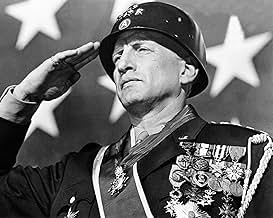
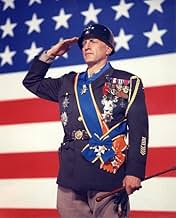
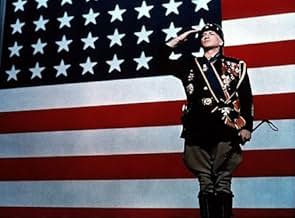
Nonetheless, if you enjoy character studies, this is one of the best. Patton's opening 6-minute speech before this huge American flag is a famous scene in movie history. That, and the rest of his performance and this movie in general, is one you won't forget.
How much of this story is fact and how much is fiction, I don't know. Knowing Hollywood and knowing when this was made - during the heyday of the anti-war (Vietnam) movement - I have my suspicions, but for the sake of the review, I will assume all of this is true.Whatever political bias a filmmaker might have, Patton made for a good movie subject anyway and the story is interesting all the way, thanks to the acting of George C. Scott, who was astounding as Patton and gives one of the more memorable performances ever by an actor.
Not only is Scott's acting superb, the widescreen photography is also good. Thank goodness DVDs came out so films like this could be seen in the aspect in which they were filmed. I can't imagine viewing this on formatted-to-TV images. I think much of this movie was filmed in Spain.
I think the filmmakers also did a nice job of not overdoing the action scenes. When overdone, violence can get boring. The explosions and machine-gun fire was realistic, especially for a film that is now 36 years old.
Going back to what's true and what isn't, if it was then Patton was a poor excuse for a Christian, which he claims to be here. For one thing, Christians don't believe in re-incarnation at Patton claims he did in the film. There are other comments, too, which shed a poor light on his "religion," something Hollywood loves to point out.
Nonetheless, if you enjoy character studies, this is one of the best. Patton's opening 6-minute speech before this huge American flag is a famous scene in movie history. That, and the rest of his performance and this movie in general, is one you won't forget.
Oscars Best Picture Winners, Ranked
Oscars Best Picture Winners, Ranked
See the complete list of Oscars Best Picture winners, ranked by IMDb ratings.


Did you know
- TriviaThe movie begins without showing the 20th Century-Fox logo, or any other indication that the film is starting. At military bases across the US theater owners reported that soldiers in the audience would often stand up and snap to attention when they heard the movie's opening line ("Ten-hut!"), assuming it to be a real call to attention.
- GoofsContrary to the way it's portrayed in the film, the controversy over George S. Patton's Knutsford speech was not over his having insulted the Russians (in fact, the Army quickly revised the initial transcript of his remarks to reflect that he had mentioned them). It had to do with his talk of "ruling the world" after the war - members of Congress said he had no business as a general commenting on post-war political affairs, while others objected to the notion of the US, Britain or anyone else "ruling the world."
- Crazy creditsOne of the very, very few Twentieth Century-Fox films in which that company's logo is not shown at all, beginning or end. The film simply begins with the opening speech, and the opening Fox logo is replaced with an in-credit text-only notice after the speech. However, recent television showings have added the logo (not on DVD prints), and the addition is obviously spliced in from another piece of film.
- Alternate versionsThe Italian version is approximately 20 minutes shorter and removes all scenes set in the German Military HQ and/or showing German officers: although the credits still include the names of German performers, like Karl Michael Vogler as Marshall Rommel, their characters never appear onscreen in the Italian release.
- ConnectionsEdited into Fireball Forward (1972)
- SoundtracksTo the Colors
(uncredited)
Traditional bugle call used in lieu of the National Anthem. Played at the opening scene.
Details
- Release date
- Country of origin
- Official site
- Languages
- Also known as
- Patton: A Salute to a Rebel
- Filming locations
- Cabo de Gata, Almería, Andalucía, Spain(desert scenes)
- Production company
- See more company credits at IMDbPro
Box office
- Budget
- $12,000,000 (estimated)
- Gross US & Canada
- $61,749,765
- Gross worldwide
- $61,749,765
- Runtime
- 2h 52m(172 min)
- Color
- Aspect ratio
- 2.20 : 1
Contribute to this page
Suggest an edit or add missing content