IMDb RATING
6.5/10
11K
YOUR RATING


A musician is stalked by an unknown homicidal maniac, who blackmails him for the accidental killing of another stalker.A musician is stalked by an unknown homicidal maniac, who blackmails him for the accidental killing of another stalker.A musician is stalked by an unknown homicidal maniac, who blackmails him for the accidental killing of another stalker.

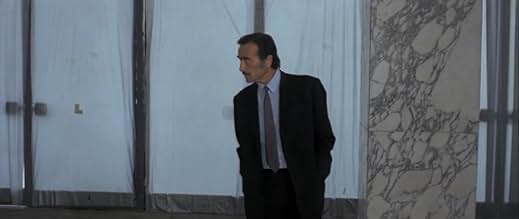



Jean-Pierre Marielle
- Gianni Arrosio
- (as Jean Pierre Marielle)


Laura Troschel
- Maria
- (as Costanza Spada)


6.510.9K
1
2
3
4
5
6
7
8
9
10
Featured reviews
One of Argento's WEIRDEST. Definitely NOT one of his worst!
"Four Flies On Grey Velvet" is surely an odd, truly bizarre film, even by Dario Argento standards. In my opinion however, it most definitely is not a bad film, much less one of Argento's worst. Much of what is said about the film, by critics and fans alike, seems (to me) to wrongly condemn it. I definitely can understand why one might be frustrated by this film, but I don't believe that's a reason to reject it completely. Some may feel the acting and/or story isn't all that good. I would respectfully disagree. I feel the acting is strange and aloof, but I believe that it works in favor of the film; and the story is confusing, but that is typical for an Argento film, and as a viewer, I appreciate not being handed all of the answers on a platter. Perhaps what repels many viewers is consistently being displaced espacially within the film context; that is to say one (the viewer and/or the characters) doesn't necessarily always know where one is within the "reality" of the film or how one got there. Here, in what is perhaps Argento's most abstract film to date, the director makes some very bold, disarming choices with editing; choices I believe serve a greater purpose and add chillingly to the effectiveness of the film. For instance, the sequence in which the protagonist (Michael Brandon) is driving to the office of a private investigator. Shots of him driving in his car to the office are quickly intercut with gliding POV shots approaching the office building, going up the stairs, nearing the office door. The effect is that of feeling as if he is literally driving up the stairs and down the hallway to the office door, creating a tense and strangely humorous sequence of events. This editing technique, prevalent throughout the film, is surely a forceful presence and I suppose could turn off some viewers. Regardless of the editing, the atmosphere and visual punch of the film is pure Argento, albeit an Argento who was still developing his technique and discovering his style. There are many beautiful and stunning visuals to be appreciated, including the violent, shocking ending sequence and a very creepy chase scene in an otherworldly city park. My favorite visual flourish in this film is the reoccuring nightmare had by the protagonist, in which a Middle Eastern execution is taking place in a bleached out desert dreamscape; thoroughly chilling. A frantic, highly enjoyable score from the master Ennio Morricone adds greatly to the proceedings as well. I really like this film, despite whatever flaws it may have, and have but one question for anyone who thinks "Four Flies On Grey Velvet" is (one of) Argento's worst... "Have you seen "The Five Days Of Milan" or his "Phantom of The Opera"?
Definitely not for everyone's tastes, but a certain must for any Argento fan, Euro-horror fan, or anyone who just really wants to be daring and see something totally different.
Definitely not for everyone's tastes, but a certain must for any Argento fan, Euro-horror fan, or anyone who just really wants to be daring and see something totally different.
Bravura filmmaking
Deluxe giallo from writer-director Dario Argento, with a presentation so stylish it threatens to overwhelm the plot. Dedicated husband and drummer for a rock band angrily confronts a mysterious man who's been following him; they scuffle and the stranger ends up stabbed with his own knife. No one is around to help the shaken musician, but there is one witness: a person in costume with a camera. This isn't a blackmailer--they don't want money--but the musician is quickly taunted with photos and notes...and soon, the people closest to him start dropping like flies. Argento shows an uncanny grasp of character here, and his roster of victims and suspects is delicious (there's also a scripture-quoting con-man who acts as a lookout, a terrified postman afraid of delivering the mail and a gay gumshoe hired by the protagonist who hasn't solved one case in his last 87!). Argento is a cinematic madman; his screenplay might not hold up under close scrutiny, but it's hard to nitpick with the small details when the end results are this tantalizing. *** from ****
Argento in His Prime
A musician (Michael Brandon) is stalked by an unknown killer who's blackmailing him for an accidental killing of another stalker. But is everything what it appears to be?
The film opens with a great shot of drums from overhead and a beating heart, knowing that Argento is in the middle of his most stylistic period. Even the man with white gloves and disturbingly childish mask taking photographs is classic Argento.
I liked the concept of the images burned on to the retina, and I enjoyed the humor of having a character named "God" and the "Hallelujah" chorus. This being the last Ennio Morricone score in an Argento film was not lost on me, as the musical style shifted greatly after this one. (Not necessarily in a bad way -- Goblin and Simonetti are incredible.)
I was surprised to see homosexuality being so openly discussed in a film from this year. Maybe in Italy it was more acceptable than in America? Either way, an interesting addition.
The film opens with a great shot of drums from overhead and a beating heart, knowing that Argento is in the middle of his most stylistic period. Even the man with white gloves and disturbingly childish mask taking photographs is classic Argento.
I liked the concept of the images burned on to the retina, and I enjoyed the humor of having a character named "God" and the "Hallelujah" chorus. This being the last Ennio Morricone score in an Argento film was not lost on me, as the musical style shifted greatly after this one. (Not necessarily in a bad way -- Goblin and Simonetti are incredible.)
I was surprised to see homosexuality being so openly discussed in a film from this year. Maybe in Italy it was more acceptable than in America? Either way, an interesting addition.
Rare And Quite Different Argento-Giallo
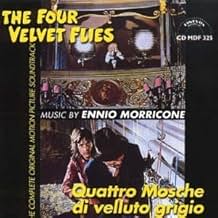
"4 mosche di velluto grigio" aka. "Four Flies on Grey Velvet" is the last film in Dario Argento's animal trilogy, which also includes the brilliant "Bird With The Crystal Plumage" (1970) and the very stylish "Cat o' Nine Tails" (1971). This is certainly Argento's oddest film, and also by far the least widely known of his Gialli. While certainly not one of Argento's masterpieces, this strange, and highly interesting flick is nonetheless more than worth tracking down, for a variety of reasons.
When rock drummer Roberto (Michael Brandon) wants to take a guy to task who has been following him for days, the guy threatens him with a knife, and in the subsequent scuffle, Roberto accidentally stabs the guy to death. The incident is photographed by a masked psychopath, who subsequently begins to stalk Roberto and people close to him... Sounds like the beginning of a typical Giallo, but, apart from the typical formula of a mystery killer, murders from the killer's perspective, etc., this film differs from Argento's other Gialli in a variety of aspects. This is partly a very comedic Giallo, that, in some parts even features absurd slapstick humor. Several characters are purely satirical, such as a (very) gay private eye, or a sarcastic writer who likes narrating bizarre short stories. Another supporting role is played by none other than the ass-kicking cult actor/comedian Bud Spencer! The superb score by maestro Ennio Morricone is one more reason to watch this film. Dario Argento is one of my all-time favorite directors, and while "For Flies On Grey Velvet" is certainly not one of his highlights, it is definitely a weird and highly recommendable film that my fellow Italian Horror fans should not miss!
When rock drummer Roberto (Michael Brandon) wants to take a guy to task who has been following him for days, the guy threatens him with a knife, and in the subsequent scuffle, Roberto accidentally stabs the guy to death. The incident is photographed by a masked psychopath, who subsequently begins to stalk Roberto and people close to him... Sounds like the beginning of a typical Giallo, but, apart from the typical formula of a mystery killer, murders from the killer's perspective, etc., this film differs from Argento's other Gialli in a variety of aspects. This is partly a very comedic Giallo, that, in some parts even features absurd slapstick humor. Several characters are purely satirical, such as a (very) gay private eye, or a sarcastic writer who likes narrating bizarre short stories. Another supporting role is played by none other than the ass-kicking cult actor/comedian Bud Spencer! The superb score by maestro Ennio Morricone is one more reason to watch this film. Dario Argento is one of my all-time favorite directors, and while "For Flies On Grey Velvet" is certainly not one of his highlights, it is definitely a weird and highly recommendable film that my fellow Italian Horror fans should not miss!
Glad to Be Grey
As with the previous two entries in the unofficial Animal Trilogy, Four Flies on Grey Velvet is short on explicit gore but brimming with atmosphere and artistic ingenuity, with set-piece murders primed and mined for maximum tension. It was with this film that Argento began to cement his particular style and is something of a crucible for future ideas. The murder of Roberto's maid in a local park foreshadows John Saxon's fate in Tenebre, and with its sudden lapses in time and attempted escape through the cobwebbed space between two buildings (to a soundtrack of whispers and sighs) it also sows seeds that would flourish in Suspiria. Other visual motifs (crimson curtains, extreme close-ups, inanimate objects suddenly wielded by a seemingly maniacal camera) would be repeated or re-jigged in Deep Red, Phenomena and Opera.
Argento's original intention was to have a gay protagonist and though the character of Roberto is still open to such a reading - his victimisation being as a result of a fear of being outed (as a murderer) has obvious correlations (note also Brandon's shaggy mane v Farmer's gamine crop or the rather tame bathtub scene with Francine Racette which sees Roberto playfully seducing his mirror image) - the more overt references are passed to Jean-Pierre Marielle, who brings immense likability to a small role and whose swish factor is tempered by a steely determination to finally cracking a case. A frosty Farmer acquits herself well, though Brandon is merely okay. Argento's fascination with weird science (here ludicrous by design but ingenious in execution) gives the film its animal-themed title, and the finale boasts one of his greatest sequences - a stunning, slow-motion shot of a car impacting with the back of a lorry, which marries chillingly beautiful aesthetics to Hollywood folklore, scored with Morricone's haunting "Come un Madrigale".
Four Flies is a solid giallo and an important entry in the Director's canon which bears repeated viewing, blurring gender roles and sexual identity, adding subtext and hit and miss humour, asylum flashbacks, well-executed deaths and a recurring nightmare in the form of a sun-bleached, public beheading - the significance of which turns out to be twofold. It also has in spades what a good Argento giallo conveys like no other, that chilling feeling of something wholly alien on the loose in human form.
Argento's original intention was to have a gay protagonist and though the character of Roberto is still open to such a reading - his victimisation being as a result of a fear of being outed (as a murderer) has obvious correlations (note also Brandon's shaggy mane v Farmer's gamine crop or the rather tame bathtub scene with Francine Racette which sees Roberto playfully seducing his mirror image) - the more overt references are passed to Jean-Pierre Marielle, who brings immense likability to a small role and whose swish factor is tempered by a steely determination to finally cracking a case. A frosty Farmer acquits herself well, though Brandon is merely okay. Argento's fascination with weird science (here ludicrous by design but ingenious in execution) gives the film its animal-themed title, and the finale boasts one of his greatest sequences - a stunning, slow-motion shot of a car impacting with the back of a lorry, which marries chillingly beautiful aesthetics to Hollywood folklore, scored with Morricone's haunting "Come un Madrigale".
Four Flies is a solid giallo and an important entry in the Director's canon which bears repeated viewing, blurring gender roles and sexual identity, adding subtext and hit and miss humour, asylum flashbacks, well-executed deaths and a recurring nightmare in the form of a sun-bleached, public beheading - the significance of which turns out to be twofold. It also has in spades what a good Argento giallo conveys like no other, that chilling feeling of something wholly alien on the loose in human form.


Did you know
- TriviaDario Argento's usual collaborator Ennio Morricone scored the film, but had a major argument with Argento over some tracks Argento didn't want in it. As a result, the director and Morricone would not work together again until 1996, and the rock group Goblin would eventually become Argento's regular composers.
- GoofsDuring the scene where Nina is shooting Roberto, her dubbing inexplicably goes in and out of English and Italian repeatedly, though she has never spoken Italian before this scene.
- Quotes
Roberto Tobias: Well, it's a bit risky, and, and I don't...
Gianni Arrosio: Ah, yeah. And you're thinking this fairy will jump on a chair and scream bloody murder if he sees a mouse, right?
Roberto Tobias: Yes, that's what I thought.
Gianni Arrosio: Oh, you heterosexuals! I don't suppose you've ever had a homosexual experience?
Roberto Tobias: Let's just forget it, man.
- Crazy creditsYou have just seen Four Flies on Grey Velvet.
- Alternate versionsThe original U.S theatrical release was cut mainly for pacing as well as shortening the tub love scene and a decapitation for a PG rating.
- ConnectionsFeatured in Dario Argento's World of Horror (1985)
Details
- Release date
- Countries of origin
- Language
- Also known as
- 4 Flies on Grey Velvet
- Filming locations
- Milan, Lombardia, Italy(subway scenes)
- Production companies
- See more company credits at IMDbPro
Contribute to this page
Suggest an edit or add missing content