
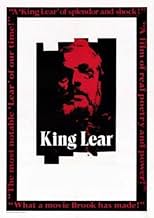
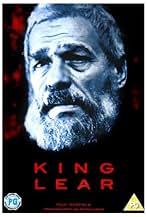
King Lear divides his kingdom among his daughters, giving great importance to their protestations of love for him. When Cordelia refuses to idly flatter the old man, he banishes her and turn... Read allKing Lear divides his kingdom among his daughters, giving great importance to their protestations of love for him. When Cordelia refuses to idly flatter the old man, he banishes her and turns for support to his remaining daughters.King Lear divides his kingdom among his daughters, giving great importance to their protestations of love for him. When Cordelia refuses to idly flatter the old man, he banishes her and turns for support to his remaining daughters.
- Director
- Writers
- Stars
- Awards
- 2 wins & 1 nomination total


- Director
- Writers
- All cast & crew
- Production, box office & more at IMDbPro
7.21K
1
2
3
4
5
6
7
8
9
10
Featured reviews
A great king and a foolish old man
Protagonists for William Shakespeare's plays run the gamut of age. From teenagers Romeo&Juliet to the ancient King Lear. Shakespeare was an ardent
observer of mankind at all ages.
I've often wondered if Shakespeare got the germ of an idea for Lear when in his lifetime he saw Emperor Charles V who had a lot of Europe and a lot of the new world under his control. Politics of the time dictated he divide his empire and half went to his son who became Philip II of Spain and the other half went to brother Maximilian of Austria. Charles died in a monastery 2 years later.
It might have been better for Lear if he had locked himself up in a monastery and stayed there. But he was a tired old man and he had daughters instead of suns. Two daughters flatter the old guy and they get two halves of the kingdom. The third doesn't play that game and he cuts her off.
Then instead of staying in a monastery, the daughters and their husbands make it real clear to Lear that his advice and counsel aren't needed or wanted. Quite a shock coming from his 'faithless' children.
Peter Brook directed and also augmented Shakespeare's plot with some of his own ideas. More than Bard purists denounced the production, but as I remember they fit into the play structure nicely.
Brook also shot the film on the bleak and craggy shores of the Danish coastline. You can hardly tell this is a color film. But that also fit in well with the bleak and moody atmosphere of the play itself.
One undeniable asset this King Lear has is Paul Scofield in the title role. He is nothing short of superb in the title role and he underplays a lot more than either Laurence Olivier or Orson Welles in the same part. His closeups tell a great deal of the story.
This is not the best King Lear, but for Paul Scofield fans an absolute must.
I've often wondered if Shakespeare got the germ of an idea for Lear when in his lifetime he saw Emperor Charles V who had a lot of Europe and a lot of the new world under his control. Politics of the time dictated he divide his empire and half went to his son who became Philip II of Spain and the other half went to brother Maximilian of Austria. Charles died in a monastery 2 years later.
It might have been better for Lear if he had locked himself up in a monastery and stayed there. But he was a tired old man and he had daughters instead of suns. Two daughters flatter the old guy and they get two halves of the kingdom. The third doesn't play that game and he cuts her off.
Then instead of staying in a monastery, the daughters and their husbands make it real clear to Lear that his advice and counsel aren't needed or wanted. Quite a shock coming from his 'faithless' children.
Peter Brook directed and also augmented Shakespeare's plot with some of his own ideas. More than Bard purists denounced the production, but as I remember they fit into the play structure nicely.
Brook also shot the film on the bleak and craggy shores of the Danish coastline. You can hardly tell this is a color film. But that also fit in well with the bleak and moody atmosphere of the play itself.
One undeniable asset this King Lear has is Paul Scofield in the title role. He is nothing short of superb in the title role and he underplays a lot more than either Laurence Olivier or Orson Welles in the same part. His closeups tell a great deal of the story.
This is not the best King Lear, but for Paul Scofield fans an absolute must.
a house in a hurricane
in a moment of irony that could occur only in cinema, the definitive version of Shakespeare's 'king Lear' is Kurosawa akira's 1985 'ran'. only Kurosawa - at the end of his own career and looking back at at a century of blindness socially and politically, that dragged his culture through the horrors of the Tojo regime and the second world war - could grasp the essential insight of Shakespeare's vision of political perversion arising from simple but fundamental personal mistakes in judgment.
brook, of course, doesn't go after that. in fact, the issues just noted have been missed just about entirely by every American and British version of the play i've seen, even Laurence Olivier's farewell performance on television just before he died.
so when we come to brook's film, we have to let go of the hope that this will be the 'ur-Lear' that we seem to have misplaced in the west ever since the Elizabethan era.
in fact, let's let go of Shakespeare completely, here - this is a peter brook film, and brook is actually after something fundamentally cinematic - but not necessarily Shakespearean.
brook's film is a relentless portrayal of the world turned upside down. the most memorable quality of the film - and it stuck to me for many years - is the camera work, that gets unsteadier and more rapidly cut as the film goes on, until the audience feels trapped inside a house in a hurricane - and one that's quickly falling apart.
to find some ground in this visual catastrophe, the audience will desperately grab onto Shakespeare's words or the fine performances by the wonderful cast - but be warned - that's not really going to help much, and it's not supposed to.
brook, who made his name by approaching theatrical stage performances in a rather daring visual style, clearly wanted to see how far he could push the medium - the audience will have to decide whether he's successful - but the effort itself is worthy of respect.
brook, of course, doesn't go after that. in fact, the issues just noted have been missed just about entirely by every American and British version of the play i've seen, even Laurence Olivier's farewell performance on television just before he died.
so when we come to brook's film, we have to let go of the hope that this will be the 'ur-Lear' that we seem to have misplaced in the west ever since the Elizabethan era.
in fact, let's let go of Shakespeare completely, here - this is a peter brook film, and brook is actually after something fundamentally cinematic - but not necessarily Shakespearean.
brook's film is a relentless portrayal of the world turned upside down. the most memorable quality of the film - and it stuck to me for many years - is the camera work, that gets unsteadier and more rapidly cut as the film goes on, until the audience feels trapped inside a house in a hurricane - and one that's quickly falling apart.
to find some ground in this visual catastrophe, the audience will desperately grab onto Shakespeare's words or the fine performances by the wonderful cast - but be warned - that's not really going to help much, and it's not supposed to.
brook, who made his name by approaching theatrical stage performances in a rather daring visual style, clearly wanted to see how far he could push the medium - the audience will have to decide whether he's successful - but the effort itself is worthy of respect.
Naked apocalyptic King Lear
Peter Brook has the knack of making his stagings completely his own while at the same time enhancing the character of the play. Thus in "Carmen" he turns it into something of a chamber play, and here in King Lear he stresses the primitivism of the play turning into almost something like a documentary of the dark ages. In especially the first part including the storm he is entirely successful, in spite of the rather experimental expressionism,and the realism of the primitive middle age settings in a landscape of only moors and snows, not a tree in the whole film, is effectively impressing. The actors are superb throughout, and Paul Scofield renders a very interesting interpretation of the old man losing himself with occasional magnificent outbursts of powerful rage. The play is shortened, of course, you can't put all of a Shakespeare play into a film, (I believe the only successful attempt at that was Kenneth Branagh's "Hamlet" and very commendable as such,) while here the text abbreviations unfortunately suffer, the cuts being so obvious. Another flaw is that the articulation is not very good - it was fashionable in the end of the 60s to allow actors to talk on stage like as if they talked naturally, but theatre can't do without rhetoric; and especially with a language like this, which is the very essence of the play, you can't trifle with it, every word has to be pronounced distinctly, or it isn't Shakespeare.
Towards the end the direction gets more sloppy, the intensity loses its grip, while the apocalyptic battle scenes crown the direction. The austere scenery throughout I believe will be what you most will remember of this film adaptation, which couldn't be more impressive, while I think I would prefer the Russian version from about the same time as more convincingly Shakespearian. Since many years I have been waiting for an opportunity to see the Laurence Olivier version from 1983.
Towards the end the direction gets more sloppy, the intensity loses its grip, while the apocalyptic battle scenes crown the direction. The austere scenery throughout I believe will be what you most will remember of this film adaptation, which couldn't be more impressive, while I think I would prefer the Russian version from about the same time as more convincingly Shakespearian. Since many years I have been waiting for an opportunity to see the Laurence Olivier version from 1983.
Tempo, TEMPO!!!!
What's good: Alan Webb's Gloucester and Jack MacGowran's Fool both threaten to steal the picture. Webb is immensely touching in his attempted suicide, but then, I have trouble thinking of a bad Gloucester. Cyril Cusack as Albany and Tom Fleming as Kent should also be praised, and Patrick Magee is creepy as ever as Cornwall.
Henning Kristiansen's cinematography is stunning, rendering Jutland in winter the most inhospitable Learscape ever, and this is the same fellow who shot the lush "Babette's Feast" in the same general location! When Lear and friends are outside being battered by the storm, we see the ungrateful villains inside basking in the warmth of a gigantic roaring fireplace. The visual contrast has never been greater. When Poor Tom's cold, he's really cold in real snow, not just clasping himself and shivering on cue.
Peter Brook's productions often involve wholesale cuts and rearrangements, plus hefty doses of non-authorial content. Yes, this Lear is cut to the bone, the style owes much to Bergman, Beckett, Brecht, etc.
The criminal waste is that Paul Scofield was a major Lear of his generation, and it's gutted here. His magnificent voice is thinned out to a thread, and much of the time the character is distant, veiled and under-energized. His disintegration arouses pity, but no audience involvement. We watch him die from a million miles away, and lose more than we gain with this application of alienation technique.
By the same token, Irene Worth's whispered Goneril is not the volcano we want. For example, she is incapable of expressing lust for Edmund, and that's a crucial omission, not in the text, but in the performance. Two fine actors are caught at considerably less than their best, giving the director what he wanted.
The energy level all around is a bit low, which kills much of what remains of Shakespeare's language, but what really hurts is the leaden pace. Considering half the play is missing, we start slowly, and after Gloucester hits the beach, grind to a complete halt. Entropy is total. Even with the text gutted and filleted, the last half hour of the film feels longer than many complete plays.
For DVD versions with complete texts, don't overlook Jonathan Miller's neurologically-informed production for the BBC with Michael Hordern and Brenda Blethyn. The more mainstream, star-studded Olivier video is an automatic choice for many.
However, another abbreviated version directed by Peter Brook features perhaps the best reading of Shakespeare's Lear of them all, from Orson Welles. This 90-minute condensation from the early days of live television also features Alan Badel, Beatrice Straight and Micheal MacLiammoir. First you must get past the resourceful but limited visuals, two cameras in a single studio running the whole play live without a break. The reward is that no one, no one does Lear's poetry more clearly, simply, powerfully and beautifully than Orson Welles.
Henning Kristiansen's cinematography is stunning, rendering Jutland in winter the most inhospitable Learscape ever, and this is the same fellow who shot the lush "Babette's Feast" in the same general location! When Lear and friends are outside being battered by the storm, we see the ungrateful villains inside basking in the warmth of a gigantic roaring fireplace. The visual contrast has never been greater. When Poor Tom's cold, he's really cold in real snow, not just clasping himself and shivering on cue.
Peter Brook's productions often involve wholesale cuts and rearrangements, plus hefty doses of non-authorial content. Yes, this Lear is cut to the bone, the style owes much to Bergman, Beckett, Brecht, etc.
The criminal waste is that Paul Scofield was a major Lear of his generation, and it's gutted here. His magnificent voice is thinned out to a thread, and much of the time the character is distant, veiled and under-energized. His disintegration arouses pity, but no audience involvement. We watch him die from a million miles away, and lose more than we gain with this application of alienation technique.
By the same token, Irene Worth's whispered Goneril is not the volcano we want. For example, she is incapable of expressing lust for Edmund, and that's a crucial omission, not in the text, but in the performance. Two fine actors are caught at considerably less than their best, giving the director what he wanted.
The energy level all around is a bit low, which kills much of what remains of Shakespeare's language, but what really hurts is the leaden pace. Considering half the play is missing, we start slowly, and after Gloucester hits the beach, grind to a complete halt. Entropy is total. Even with the text gutted and filleted, the last half hour of the film feels longer than many complete plays.
For DVD versions with complete texts, don't overlook Jonathan Miller's neurologically-informed production for the BBC with Michael Hordern and Brenda Blethyn. The more mainstream, star-studded Olivier video is an automatic choice for many.
However, another abbreviated version directed by Peter Brook features perhaps the best reading of Shakespeare's Lear of them all, from Orson Welles. This 90-minute condensation from the early days of live television also features Alan Badel, Beatrice Straight and Micheal MacLiammoir. First you must get past the resourceful but limited visuals, two cameras in a single studio running the whole play live without a break. The reward is that no one, no one does Lear's poetry more clearly, simply, powerfully and beautifully than Orson Welles.
Exceptional
Peter Brook's film is a very bleak and barbaric interpretation of King Lear. He does a great job directing and whilst some of his experimentation doesn't pay off (such as very strange zooming with Kent at the beginning), when it does pay off it is fantastic (such as Lear's monologues)


Did you know
- TriviaBrook based this production on ideas expressed by Polish theater critic Jan Kott in the book "Shakespeare, Our Contemporary".
- Crazy creditsNot only is there no music in the film, but there are no "ambient sounds" at all during the opening credits, giving the impression that they were filmed using no soundtrack whatsoever.
- ConnectionsFeatured in Shakespeare: Rise of a Genius: Episode #1.3 (2023)
- How long is King Lear?Powered by Alexa
Details
- Runtime
- 2h 17m(137 min)
- Color
- Sound mix
- Aspect ratio
- 1.66 : 1
Contribute to this page
Suggest an edit or add missing content