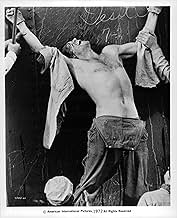
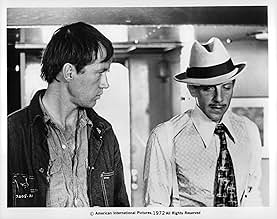
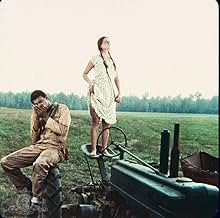
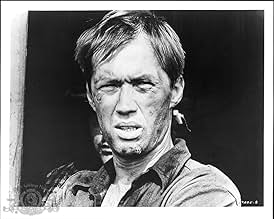
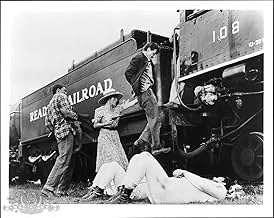
During the Great Depression, a union leader and a young woman become criminals to exact revenge on the management of a railroad.During the Great Depression, a union leader and a young woman become criminals to exact revenge on the management of a railroad.During the Great Depression, a union leader and a young woman become criminals to exact revenge on the management of a railroad.
- Director
- Writers
- Stars
- Awards
- 1 nomination total
David Osterhout
- McIver #2
- (as David R. Osterhout)
Grahame Pratt
- Emeric Pressburger
- (credit only)
'Chicken' Holleman
- M. Powell
- (credit only)
Harry Northup
- Harvey Hall
- (as Harry Northrup)
Jerry Cortez
- Sheriff
- (uncredited)
Louie Elias
- Boxcar Tough
- (uncredited)
Michael Fitzgerald
- Apple Peeler
- (uncredited)
Gura Lashlee
- Hobo
- (uncredited)
Gerald Raines
- Train Engineer
- (uncredited)
- Director
- Writers
- All cast & crew
- Production, box office & more at IMDbPro
6.012K
1
2
3
4
5
6
7
8
9
10
Featured reviews
Corman gangster mama movie done by Scorcese in a different mode
Early, solid film from Scorcese with Hershey as the heroine, who along with Carradine leads a pack of hoods who begin as communists and progress to bigger and bigger crimes -- something of a variation on Corman's "Machine Gun Kelly." Carradine and Hershey give good, but not outstanding, performances. The direction is somewhat showy and involves a lot of movement, typical of Scorcese's more evolved style as well. Roughly follows the mold set by previous AIP gangster mama flicks, with the step up on the violence meter each succeeding film seemed to demand.
Interesting also that this is the only Corman/AIP collaboration I can remember seeing from this period of time (72) when Corman's independent operations were becoming more successful all the time (w/ the nurse movies and stewardess epics cleaning up at the box office). I can only think that they saw it as a continuation of such a successful collaboration that it was impossible to resist getting together again one more time (though Corman claims to have been so absolutely disgusted by their treatment of his epic "Gasssssss" that he would no longer work with them after 1970). Anyone with information on how this collaboration took place will make me very grateful by forwarding this information to me.
The film that led to Mean Streets
Rumor has it Martin Scorsese showed this film, his second, to John Cassavetes, who labeled the movie "sh*t" and suggested Marty work on more personal projects in the future. This advice prompted Scorsese to direct Mean Streets, the first of his many masterpieces. Boxcar Bertha is not one of them, but it isn't as bad as Cassavetes stated, either. It's an average B-movie of the kind Roger Corman would offer to his students (Marty among them).
Plotwise this picture has a more defined structure than Who's That Knocking at My Door: the setting is small-town America, the Great Depression is far from over, and a young girl named Bertha (Barbara Hershey) joins union leader "Big Bill" (David Carradine) in a violent protest against the people who are managing a railroad. When things turn ugly, the two lovers are forced to run for their lives, while still hoping they will prevail.
Hardly an original story (it's essentially the poor man's Bonnie & Clyde), but Scorsese does his best in making it appealing to audiences, shooting in beautiful countryside locations and obtaining strong performances from Hershey (who would later play Mary Magdalene in The Last Temptation of Christ) and Carradine, most notably in a sex scene that, according to everyone involved, was not faked.
Beyond that, though, it is obvious Cassavetes had a point: there is nothing that gives Boxcar Bertha that unique Scorsese feel. He just did his job without finding anything in the script he could connect to; even the religious iconography used in the bloody climax seems to have been tucked in for no particular reason.
Still, the film is enjoyable and worth seeing, even just as the product of a young filmmaker still shaping into the master he was to become.
Plotwise this picture has a more defined structure than Who's That Knocking at My Door: the setting is small-town America, the Great Depression is far from over, and a young girl named Bertha (Barbara Hershey) joins union leader "Big Bill" (David Carradine) in a violent protest against the people who are managing a railroad. When things turn ugly, the two lovers are forced to run for their lives, while still hoping they will prevail.
Hardly an original story (it's essentially the poor man's Bonnie & Clyde), but Scorsese does his best in making it appealing to audiences, shooting in beautiful countryside locations and obtaining strong performances from Hershey (who would later play Mary Magdalene in The Last Temptation of Christ) and Carradine, most notably in a sex scene that, according to everyone involved, was not faked.
Beyond that, though, it is obvious Cassavetes had a point: there is nothing that gives Boxcar Bertha that unique Scorsese feel. He just did his job without finding anything in the script he could connect to; even the religious iconography used in the bloody climax seems to have been tucked in for no particular reason.
Still, the film is enjoyable and worth seeing, even just as the product of a young filmmaker still shaping into the master he was to become.
The worlds of Corman and Scorsese collide, and the results? Pretty damn good!
Roger Corman's indirect influence on the 70s movie renaissance is often overlooked. Many of that decade's key players served their apprenticeships on Corman's quickies. Directors like Coppola, Bogdanovich, Bartel and Demme, and actors like Nicholson, Hopper, Fonda, Dern, Stanton, and even De Niro.
Add Martin Scorsese to that list. 'Boxcar Bertha', his movie directly before the breakthrough 'Mean Streets', may not display his talent in full, but it is a surprisingly well shot and acted, and is an above average b-grade movie with a lot of entertainment value.
Like similar Corman productions from this period ('Bloody Mama', 'Dillinger', 'Big Bad Mama') it is a Depression era look at flamboyant criminals. An exploitation movie for sure, but exploitation with style and class. Barbara Hershey (who would reunite with Scorsese in seriously underrated 'The Last Temptation Of Christ') plays the title role, but the real star of the movie is her then real life partner David Carradine ('Kung Fu', 'Death Race 2000'), who gives a strong, charismatic performance. The supporting cast includes blaxploitation legend Bernie Casey ('Cleopatra Jones',etc.), Carradine's veteran character actor father John, and Scorsese/Ferrara regular Victor Argo ('Taxi Driver', 'King Of New York').
'Boxcar Bertha' is by no means one of Scorsese's greatest achievements, but it is nothing to be embarrassed about either. Check it out sometime. It's much better than you would think.
Add Martin Scorsese to that list. 'Boxcar Bertha', his movie directly before the breakthrough 'Mean Streets', may not display his talent in full, but it is a surprisingly well shot and acted, and is an above average b-grade movie with a lot of entertainment value.
Like similar Corman productions from this period ('Bloody Mama', 'Dillinger', 'Big Bad Mama') it is a Depression era look at flamboyant criminals. An exploitation movie for sure, but exploitation with style and class. Barbara Hershey (who would reunite with Scorsese in seriously underrated 'The Last Temptation Of Christ') plays the title role, but the real star of the movie is her then real life partner David Carradine ('Kung Fu', 'Death Race 2000'), who gives a strong, charismatic performance. The supporting cast includes blaxploitation legend Bernie Casey ('Cleopatra Jones',etc.), Carradine's veteran character actor father John, and Scorsese/Ferrara regular Victor Argo ('Taxi Driver', 'King Of New York').
'Boxcar Bertha' is by no means one of Scorsese's greatest achievements, but it is nothing to be embarrassed about either. Check it out sometime. It's much better than you would think.
Classic Scorsese
This was Martin Scorsese's second full-length feature film and it is a decent one. It's about a young girl in the 1930's who meets and falls in love with a union organizer, who also happens to be a thief. Together, they form a small gang and begin robbing trains as well as anything else they can get their hands on. The fun soon turns to fright when they become fugitives and are hunted down by law enforcement officers. There's action and entertainment but not a movie that you would expect from Martin Scorsese. It has none of his trade marks whatsoever. But do realize that this was one of his first films and try to respect that. I do.
It's not all bad
Boxcar Bertha is a fine film and entertaining at times. It supposedly tells a "true story" but I doubt we can be expected to believe every word of it. Nor should we. This is clearly the "fictionalization" version.
All the same; that doesn't make it any better. There are some good scenes here and there and a few good lines and one or two great stunts and effects.
But at the end of the day it has to be s pass for me. Not Scorsese at his best, but does show him as an up and coming director as he developed his style. So for that reason it can be counted as a historical record but nothing more.
All the same; that doesn't make it any better. There are some good scenes here and there and a few good lines and one or two great stunts and effects.
But at the end of the day it has to be s pass for me. Not Scorsese at his best, but does show him as an up and coming director as he developed his style. So for that reason it can be counted as a historical record but nothing more.
What Scorsese Film Ranks Highest on IMDb?
Cinema legend Martin Scorsese has directed some of the most acclaimed films of all time. See how IMDb users rank all of his feature films as director.
Did you know
- TriviaAfter he finished this film, Martin Scorsese screened it for John Cassavetes. Cassavetes, after seeing it, hugged Scorsese and said, "Marty, you've just spent a whole year of your life making a piece of shit. It's a good picture, but you're better than the people who make this kind of movie. Don't get hooked into the exploitation market, just try and do something different." Scorsese's next film was Mean Streets (1973).
- GoofsThe currency shown in the film is all modern, post 1960s, with modern banking money bands.
- Quotes
Boxcar Bertha: Pay no attention to that man behind the curtain.
- Crazy creditsOpening Statement: The following events are adapted from the true experiences of Boxcar Bertha Thompson, as related in the book "Sister of the Road"
- Alternate versionsThe restored 2020 version added a 12 seconds shot introducing the party around the 58th minute.
- ConnectionsFeatured in The Directors: The Films of Roger Corman (1999)
- How long is Boxcar Bertha?Powered by Alexa
Details
Box office
- Budget
- $600,000 (estimated)
- Gross worldwide
- $6,443
- Runtime
- 1h 28m(88 min)
- Color
- Aspect ratio
- 1.85 : 1
Contribute to this page
Suggest an edit or add missing content