

At a media-swamped party to celebrate his 70th birthday and screen his avant-garde film-in-progress, a legendary but jaded Hollywood director is faced both with voracious fans and unsettling... Read allAt a media-swamped party to celebrate his 70th birthday and screen his avant-garde film-in-progress, a legendary but jaded Hollywood director is faced both with voracious fans and unsettling questions about what became of his lead actor.At a media-swamped party to celebrate his 70th birthday and screen his avant-garde film-in-progress, a legendary but jaded Hollywood director is faced both with voracious fans and unsettling questions about what became of his lead actor.
- Awards
- 9 wins & 8 nominations total




- John Dale
- (as Bob Random)


- Director
- Writers
- All cast & crew
- Production, box office & more at IMDbPro
Featured reviews
Disappointing
Written and directed by the great Orson Welles, this movie has taken nearly 50 years to be released. Welles started shooting it in 1970 and by his death in 1985 it had not been released. Production issues and politics prevented this. Now, in 2018, Netflix has released it. Being a huge fan of Orson Welles, the thought of seeing his long-dormant final film released was an exciting one.
However, the final product is quite disappointing. It looks and feels unfinished, a mashup of random scenes. While watching I thought that this was due to the film being in an unedited state when Welles died and it was edited to the final version after his death. Turns out the final version had already been edited by Welles, so we can't blame Netflix's production team.
The film-within-a-film element was initially intriguing but is ultimately confusing. What is part of Hannaford's film and what is Welles's film? Are the pretentious, trippy, hippy sequences and the gratuitous nudity and sex scenes Welles trying to appeal to early-70s arty audiences or his take on the pretentiousness of modern movies?
I would like to think that one of the themes of the movie is the pretentiousness of Hollywood, so will give Welles the benefit of the doubt on the content. However, it does become a jarring, disconcerting experience when you have seemingly-gratuitous scenes like those thrown randomly into the movie.
This said, it is not all bad. Welles's take on Hollywood, its movies and the pretentiousness of the times is well directed (if, indeed, that was his aim. It's so difficult to tell). The mystery surrounding John Dale adds intrigue. The story of JJ Hannaford is interesting and John Huston is perfect in the role. He pretty much just had to play himself!
Even here, however, Welles overeggs the pudding. I would have been more engaged in the Hannaford story if there weren't so many scenes that added nothing to plot or character development. So many scenes that just take up space and so much long, pointless dialogue. There's no momentum to the movie at all and the ending is a damp squib.
Worth the Ride
Wonderful cast, with standout performances from Huston and Foster. Some of the the dialogue appeared improvised, and the energy was highly-charged. The upbeat jazz score by Michel Legrand was terrific. Overall, I enjoyed this wild ride. Even so, I wonder what would have happened if Welles would have had the funds to personally helm this film into full fruition? Did he genuinely intend for this film to be finished by someone else? What would have happened if it had been retained as a lengthy, experimental journey?
exhausting and somewhat perplexing, with moments of brilliance
It wasn't until 2020 that I learned the film had actually been pulled together and released.
The cinema-verite style is explained as the result of pulling together footage from various documentarians and journalists video. The film begins with various hangers on of a famous director traveling to his party while elsewhere an investor is watching footage from his current, unfinished film.
This is actually the weakest part of the movie. The individual scenes are confusing and the way they are intercut with the film-within-a-film just add to the confusion. Apparently Welles had rough-cut about half the movie by the time he died, and my suspicion is this first part was not part of that rough cut, since it's weaker. Just a guess.
The film-within-a-film seems to be a parody of trippy, avant-garde, 60s filmmaking. I take it as Welles' portrayal of an old director past his glory days trying to create something hip.
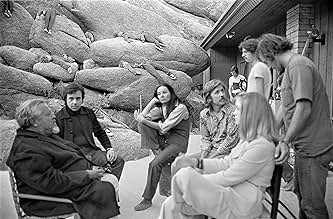
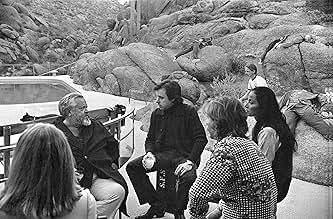
The movie gets its footing when the director's party starts. There is a lot of striking B&W footage cut in and John Huston as the director is a powerful force. The party is to screen his movie, such as it is, and while it is essentially a plotless bit of nonsense with tons of gratuitous nudity, it does have some striking imagery, such as a scene set in slatted shadows and another involving a beaded necklace.
The surrounding film doesn't have much story. It's mainly about the director charming or dueling with various characters who want something from him. Things are hinted but rarely spelled out.
Welles was a genius, so even his worst movies, like Mr. Arkadin, are splashed with brilliance. Other Side of the Wind has a remarkable style and is generally fascinating, but it's not always satisfying and the film-within-a-film takes up more time than it probably should have.
If you're a fan of Orson Welles, or just a fan of cinema, this is a must-see. Yes, the movie would have been more impressive if it had been released in the early 70s, when it was filmed, but even today in a world full of found-footage movies this is still remarkable.
A Master's Last Stand.
Worth seeing, if you like O.W. a bit and aren't afraid of nonconventional movie-making.
In comparison to Fellinis movie, 'The Other Side of the Wind' is equally carnvalesque, more deconstructivist - individual roles seem to disolve or fade into each other in the more - more prone to abandon narrative structure, less cheerful, but ultimately more bitter. Whereas Fellini -- through Mastroianni -- seems to comment his own shortfalls as an artist and his faustian, sexual desire with a mischievous, but upbeat wink in the end, the narrator's final epigramm as well as the title of Welles' last movie seems to suggest a more macbethian philosophy: it was all a story full of sound and fury, signifying nothing, and the acclaimed director is nothing but the other side of the wind, blowing in a conversation.


Did you know
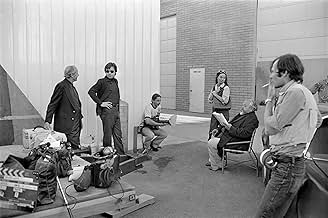
- TriviaThe movie was filmed between 1970 and 1976, with editing continuing into the 1980s. When Orson Welles died in October 1985, he left behind nearly 100 hours of footage and a work print consisting of assemblies and a few edited scenes.
- GoofsIn one confrontational scene, Brooks Otterlake is simultaneously Peter Bogdanovich and Rich Little.
- Quotes
[last lines]
Jake Hannaford: Who knows, maybe you can stare too hard at something, huh? Drain out the virtue, suck out the living juice. You shoot the great places and the pretty people... All those girls and boys. Shoot 'em dead.
- Crazy creditsAfter the end credits, Hannaford's voice is heard saying "Cut"
- SoundtracksLes Délinquants
Written and performed by Michel Legrand
Published by WB Music Corp. o/b/o Productions,
Michel Legrand + Editions Royalty
Courtesy of Decca Records France
Under license from Universal Music Enterprises
- How long is The Other Side of the Wind?Powered by Alexa
Details
- Release date
- Countries of origin
- Official site
- Languages
- Also known as
- Phía Bên Kia Cơn Gió
- Filming locations
- Production companies
- See more company credits at IMDbPro
- Runtime
- 2h 2m(122 min)
- Color
- Sound mix