IMDb RATING
6.5/10
4.1K
YOUR RATING

Godard examines the structure of movies, relationships and revolutions through the life of a couple in Paris.Godard examines the structure of movies, relationships and revolutions through the life of a couple in Paris.Godard examines the structure of movies, relationships and revolutions through the life of a couple in Paris.
- Directors
- Writers
- Stars
- Awards
- 1 win total


Louis Bugette
- Georges
- (as Bugette)
Yves Gabrielli
- Léon
- (as Yves Gabrieli)


- Directors
- Writers
- All cast & crew
- Production, box office & more at IMDbPro
6.54K
1
2
3
4
5
6
7
8
9
10
Featured reviews
Formalist elements, politics and above all ennui
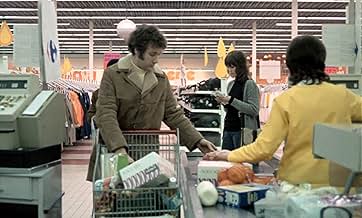
From the first credit sequence, Godard captures a realistic storyline in a formalistic fashion. Although these two schools are commonly combined, in Tout va bien they frequently contrast. From the credits at the start the viewer is introduced to the process of making a film, the sound of the clapperboard is followed by an unidentified hand signing off the costs of the film, normally invisible to an audience. The formalism is not particularly abstract but more utilitarian, whether the personal views of the workers are being recorded or two storeys of the factory are shown simultaneously, the viewer is constantly reminded of the artificiality of what is being put in front of the camera in these scenes. In addition to the formalistic shooting, there are strong elements within the storyline that detract from the seriousness of the situation. The comedy with the factory owner's desperate search for a toilet and the prescribed pattern of two lovers falling out and getting back together damage the credibility of the documentary-style scenes. With these constant reminders, it is hard to treat any of the action as real or serious; the revolution in the supermarket seems childish and futile, especially as it takes such a long time for the dreary process of shopping to be converted into a vibrant revolution; the chanting by the strikers also seems unnaturally orchestrated and weak. Symbolism is understated but the blue in the sausage factory seems important as every surface is being painted. In film this colour is associated with subdued emotions, it isn't a fiery colour of revolution but a cool, stable colour, even at its most vivid. Other recurring symbols might include the police, who are labeled as fascists and so on, dressed in black overcoats, dehumanised, until one policeman is turned from pursuer into pursued, again perhaps a comic moment and one that could be stretched to symbolise the brief glory of Mai '68. In general though, the large numbers of police imply a zero-tolerance approach to dissenters that coincides with the small numbers who turn out to demonstrate showing the trend to abandon the picket line in favour of earning a living.
Godard has his main character speak directly to the camera of the feeling of dejection and missed opportunities that followed Mai '68. The candid expressions and the direct address give a warm, honest feel to the character that encourages sympathy; we are expected to agree with what he says. Following Mai '68 a cross-section of society seemed to support widespread social change, workers felt that their voice would be heard and an enormous feeling of euphoric empowerment was experienced. Following those events, the C.G.T leadership as well as the communist party seemed to abandon the cause of the ouvriers taking up contradictory positions of passive acceptance. The issues that remained a problem went unresolved whilst the energy was gradually sapped out of those willing to protest until they became marginalised and unpopular. This is expressed by the loneliness of the strikers, the pettiness of the student rioters, and the way that when the rioters clash with the police they are inevitably outnumbered: society no longer has any time for them; they have become nothing more than a nuisance. This leads to the political leaning of the film. Aside from the fascist police, the right, exemplified by the factory owner are broadly ridiculed. Even the radio station where Jane Fonda works is clearly put in the wrong by the film. Sympathy is felt for the workers but they don't seem to have any particular ethos, certainly gauchistes aren't glorified in any sense. The only support politically seems to be given to the spontaneous and apparently anarchic students but there is no sense of moral resolution in their favour, on the contrary the ultimately inconsequential nature of their protest encourages the same cynicism that was reserved for the other political stances represented in the film. All this is contributes to the overall impression given off by the film, that of ennui. Many of the other comments posted have picked up on the boredom inspired by the film but I would differentiate between the two. Ennui being a French word, and one that has been explored by the greatest authors in French literature, it is not surprising that one of the greatest multimedia essayists in the world, who also happens to be French, should explore ennui in another medium. The difference between French ennui and English boredom is that ennui carries with it an enormous sense of frustration. The two C.G.T cronies are expressive of boredom as they wait for their spokesman to finish his lengthy speech; the censorship of Jane Fonda's character, the isolation of the factory strikers, the sleaziness of Yves Montand's rotting career, in fact the feeling of disinterest inspired by most of the scenes, these encompass ennui. If it can be assumed that Godard took the usual degree of care in making this film, then it must be the case that the drawn out shots in the factory and the supermarket that seemed to express ennui most clearly are deliberate. Whether this is sufficient defence for a film that flopped at the box-office is debateable. Nevertheless if Godard's intention was to portray a situation devoid of inspiration and where hope cannot extend beyond a fragile personal relationship, then his film has succeeded.
Godard has his main character speak directly to the camera of the feeling of dejection and missed opportunities that followed Mai '68. The candid expressions and the direct address give a warm, honest feel to the character that encourages sympathy; we are expected to agree with what he says. Following Mai '68 a cross-section of society seemed to support widespread social change, workers felt that their voice would be heard and an enormous feeling of euphoric empowerment was experienced. Following those events, the C.G.T leadership as well as the communist party seemed to abandon the cause of the ouvriers taking up contradictory positions of passive acceptance. The issues that remained a problem went unresolved whilst the energy was gradually sapped out of those willing to protest until they became marginalised and unpopular. This is expressed by the loneliness of the strikers, the pettiness of the student rioters, and the way that when the rioters clash with the police they are inevitably outnumbered: society no longer has any time for them; they have become nothing more than a nuisance. This leads to the political leaning of the film. Aside from the fascist police, the right, exemplified by the factory owner are broadly ridiculed. Even the radio station where Jane Fonda works is clearly put in the wrong by the film. Sympathy is felt for the workers but they don't seem to have any particular ethos, certainly gauchistes aren't glorified in any sense. The only support politically seems to be given to the spontaneous and apparently anarchic students but there is no sense of moral resolution in their favour, on the contrary the ultimately inconsequential nature of their protest encourages the same cynicism that was reserved for the other political stances represented in the film. All this is contributes to the overall impression given off by the film, that of ennui. Many of the other comments posted have picked up on the boredom inspired by the film but I would differentiate between the two. Ennui being a French word, and one that has been explored by the greatest authors in French literature, it is not surprising that one of the greatest multimedia essayists in the world, who also happens to be French, should explore ennui in another medium. The difference between French ennui and English boredom is that ennui carries with it an enormous sense of frustration. The two C.G.T cronies are expressive of boredom as they wait for their spokesman to finish his lengthy speech; the censorship of Jane Fonda's character, the isolation of the factory strikers, the sleaziness of Yves Montand's rotting career, in fact the feeling of disinterest inspired by most of the scenes, these encompass ennui. If it can be assumed that Godard took the usual degree of care in making this film, then it must be the case that the drawn out shots in the factory and the supermarket that seemed to express ennui most clearly are deliberate. Whether this is sufficient defence for a film that flopped at the box-office is debateable. Nevertheless if Godard's intention was to portray a situation devoid of inspiration and where hope cannot extend beyond a fragile personal relationship, then his film has succeeded.
a disarming cinematic hybrid of storytelling and agitprop
In the wake of May 1968 which effectually bookends the unrivaled movement of Nouvelle Vague, Godard founded Groupe Dziga Vertov (1968-1972), among which Maoist Jean-Pierre Gorin is a key figure, and TOUT VA BIEN is the most well-known works of the group's output, also heralds Godard's seminal transition from narrative tradition to a more essayistic, esoteric platform to which he has cleft ever since.
International star power swells in TOUT VA BIEN, Jane Fonda, freshly copping her first Oscar for KLUTE (1971), but subsequently...
keep reading my review on my blog: cinema omnivore, thanks!
International star power swells in TOUT VA BIEN, Jane Fonda, freshly copping her first Oscar for KLUTE (1971), but subsequently...
keep reading my review on my blog: cinema omnivore, thanks!
One of Godard's finest efforts.
I find that the films of Jean-Luc Godard rarely speak to me, but they do, such as Pierrot Le Fou, it really hits hard. Perhaps he's most effective when he talks about cinema itself. While Pierrot is most profoundly interesting through its debate about the arts, Tout Va Bien immediately addresses its own existence in its opening scene. It analyzes premise, storytelling, filmmaking and how they got the film made with how it cast two major stars in the lead roles. It's fascinatingly direct, almost confessional. With this abrasive and confrontational style in mind it charges full throttle into its politics of the French revolution in the late 60s as the lower and middle classes rebel against capitalism. While sometimes it can be a little too on-the-nose with its arguments as characters talk to the audience, Godard's point is undeniable and its very well demonstrated through the style. The highlight of the film is definitely the use of sets and colour. I love the stage-like sets where you can see into two floors and a dozen rooms. It categorizes the drama in a cartoonish way that satirizes the politics brilliantly while still retaining their power. Although this argument does interrupt the initial contrived story, it jumps back into it seamlessly making it work for the characters in an unexpectedly emotional way. Tout Va Bien is an incredible film and one of Godard's finest efforts. It lived up to my expectations and more.
9/10
9/10
Yet Another Strange One
Tout va bien (1972)
** (out of 4)
Jean-Luc Godard and Jea-Pierre Gorin directed this film about two directors (Godard, Gorin) who are trying to piece a film together, which is being played out by Jane Fonda and Yves Montand. Godard has been very hit and miss with me so this film here is somewhat in the middle. I really didn't hate this movie but at the same time I can't say that I was entertained by it either. I think there's some good ideas floating around here but I never felt like they were pulled together to make anything too interesting. I'm sure fans of the film will say there's a political message here and I'm sure there is somewhere but with all the madness going on I wasn't about to look for it. I think Montand is very good in his role but Fonda was a tad bit lacking and this is probably the biggest disappointment I've had with any of her films. I really enjoyed the sequence in the store and there's some very good moments scattered around but in the end this is just Godard being Godard and I wasn't going for it.
** (out of 4)
Jean-Luc Godard and Jea-Pierre Gorin directed this film about two directors (Godard, Gorin) who are trying to piece a film together, which is being played out by Jane Fonda and Yves Montand. Godard has been very hit and miss with me so this film here is somewhat in the middle. I really didn't hate this movie but at the same time I can't say that I was entertained by it either. I think there's some good ideas floating around here but I never felt like they were pulled together to make anything too interesting. I'm sure fans of the film will say there's a political message here and I'm sure there is somewhere but with all the madness going on I wasn't about to look for it. I think Montand is very good in his role but Fonda was a tad bit lacking and this is probably the biggest disappointment I've had with any of her films. I really enjoyed the sequence in the store and there's some very good moments scattered around but in the end this is just Godard being Godard and I wasn't going for it.
Deeply flawed but nonetheless important
After his four-year, self-imposed Maoist/nihilist "exile," Godard made a temporary -- albeit slight -- overture toward conventional commercial (or "bourgeois," as Godard called it) cinema by combining a leftist political essay with a dissection of human interaction. Alas, the film fails on both these levels; as a study of the male-female relationship, it is nowhere near "Contempt" and "Masculin-Feminin"; as a pure Maoist political tract, it is shallow and mind-numingly boring compared to "Le Gai Savior" and "Vladimir and Rosa." Nevertheless, "Tout va bien" is nonetheless important within Godard's extraordinary body of work, for it marked the beginning of the seven-year process in which his films would gradually shed their ultra-leftist leanings and move towards more universal, humanistic themes, a process that would ultimately cumulate in the excellent "Every Man For Himself." Even true Godard aficionados will be as bored as everyone else, but they should nonetheless go out of their way to secure a copy.


Did you know
- TriviaMost of the shots contain all the three colours of the French flag: blue, white and red.
- Quotes
Narrator: There'd be farmers who farm. Workers who work. And bourgeois who bourgeois.
- ConnectionsEdited into Bande-annonce de 'Tout va bien' (1972)
- SoundtracksIl y a du Soleil sur la France
Music by Eric Charden
Lyrics by Frank Thomas and Jean-Michel Rivat
Performed by Eric Charden and Stone
- How long is All's Well?Powered by Alexa
Details
- Release date
- Countries of origin
- Languages
- Also known as
- Everything's All Right
- Production companies
- See more company credits at IMDbPro
- Runtime
- 1h 35m(95 min)
- Sound mix
- Aspect ratio
- 1.66 : 1
Contribute to this page
Suggest an edit or add missing content