

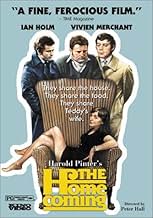
In a dreary North London flat, the site of perpetual psychological warfare, a philosophy professor visits his family after a nine-year absence, and introduces the four men, father, uncle, an... Read allIn a dreary North London flat, the site of perpetual psychological warfare, a philosophy professor visits his family after a nine-year absence, and introduces the four men, father, uncle, and two brothers, to his wife.In a dreary North London flat, the site of perpetual psychological warfare, a philosophy professor visits his family after a nine-year absence, and introduces the four men, father, uncle, and two brothers, to his wife.
- Nominated for 1 BAFTA Award
- 1 win & 1 nomination total





- Director
- Writer
- All cast & crew
- Production, box office & more at IMDbPro
Featured reviews
does it work as a film?
Probably As Good A Version Of Pinter's Play As You Are Likely To See
It's a fine adaptation of this one-set play, and director Peter Hall leaves it in that set - there is one shot where Miss Merchant steps onto the street for a walk. He does move the camera around for a constant variation in viewpoint. The actors, who include Cyril Cusack and Ian Holm (the role won his m a Tony) is superb.
I have some aesthetic issues with Pinter's works. Like Albee's WHO'S AFRAID OF VIRGINIA WOOLF? this is an exercise in revealing the ugly sides of people in a constant storm of abuse. The plot, therefore, consists of the revelation of character to the audience, rather than the more usual arc of character change. I also wonder - probably irrelevantly - about Pinter's home life. The IMDb claims that Pinter's family was close. Why then did he write plays about the miseries of being in a family?
I think that if you wish to see what it looks like when you grind five thousand feet of misery, this is a fine movie. Me, I think I'll watch a comedy.
What to do with a defective family
I wish that I could talk with the author of the comments more to get an understanding of his reaction to the film. For the first hour or so, I was thinking some of the same things about it. I slogged through what I thought was just going to be a lot of angry, repressed people in a rotten, emotionally poisoned family just to say that I had seen it.
At first I found it very irritating that people would sling words at each other with barbs of hatred attached. A lot of the dialog seemed stilted and somewhat like lectures. And the words and the emotions often had very little to do with each other. Eventually I realized that this was just fleshing out the characters. It even seemed like a substitute for conversation by people that had completely forgotten how to communicate with each other.
During the last thirty minutes or so we've been given a tour of what five different people will do when immersed in an aquarium devoid of the oxygen of any sort of positive emotional bonds. What Pinter seems to be doing is taking five possible approaches and carrying them to their extremes. Although the possible ways that each character could have developed are endless, the thrust of each is representative: sex, violence, and shut-down.
I found myself most fascinated with trying to guess what Teddy was thinking and feeling. I imagined mostly bottled rage, but perhaps instead, relief at leaving it all behind. In a way Ruth's character was the most fascinating because she had only tangentially been exposed to the family by marrying into it. But by the end of the play, she had developed a complete, and for her, necessary response to her environment.
To the author of "My mind parasites must be dead", I hope that it had no resonance with you because your family life bore no resemblance to the play. For most of the rest of us, there was probably a lot too much of "oh, yeah", "unh-huh", "yep", "been there, done that", "that's just like my uncle/brother/dad/me." Painful but cathartic.
Harold Pinter's play of ugly psychological warfare within a family proves to be excellent movie material
At first the dialogue in Harold Pinter's play, little changed for this American Film Theatre production, seems arbitrarily elliptical and the characters' behavior perversely unmotivated, but the thing is so compelling that we realize there must be something more. There is a mad method to the characters' madness. The actors know what their characters are up to. Pinter knows what they're up to. They just don't hand us all the answers on a platter. Maybe Pinter is saying something about families and maybe he's saying something about women, but I think he simply created a set of very real characters and let them do their thing without bothering with a lot of explanations.
The director, Peter Hall, does a good job at staying out of the play's way. His camera does a few clumsy things that draw attention to itself, but mainly he gives the play the space to be what it is. This movie proves yet again that the confined space of a play can often be an advantage on the screen and doesn't necessarily need to be opened up.
An engrossing version of Pinter's disturbing play
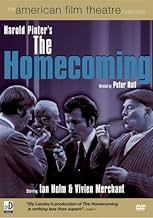
Ely Landau's American Film Theater production of Harold Pinter's The Homecoming, directed by Peter Hall, has just been released on DVD as part of a retrospective of the AFT's two years of outstanding film versions of selected plays. An engrossing rendition of Pinter's disturbing play, The Homecoming is brilliant in its malevolent and macabre humor and the performances are first rate. On the surface it is a depiction of a slightly mad family in which two brothers lust over a third brother's wife. Underneath it is a surreal caricature of domestic life that focuses on the dark impulses that lie beneath the thin veneer of civility. In Pinter's view, what passes for authentic behavior is merely a cover for the irrational and the play demonstrates how power and memory can be used as tools of control. As in all of Pinter's work, the dialogue is razor sharp and often over the top, consisting of verbal thrusts and parries, ridicules, strategies, mutual warfare, and maneuvering for position.
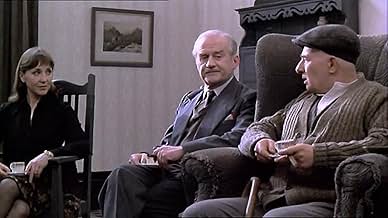
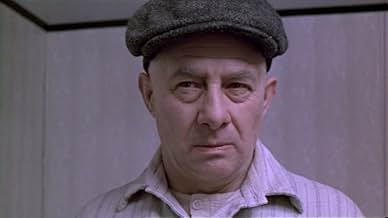
Set in an older but spacious house in North London, the men prowl around each other like animals ready for the kill. Their mother Jessie is dead. The remaining family consists of two brothers, their father and uncle. Max (Paul Rogers), the menacing, slightly demented but still roaring old patriarch is a retired butcher with an acid tongue. His brother, Sam, a chauffeur is an unmarried man in his sixties and something of a dandy. The brothers are both working class louts. Lenny, delightfully performed by a dapper Ian Holm, is a sleazy pimp and borderline criminal, while Joey (Terence Rigby) is a demolitions expert and would-be boxer who spends most of his spare time training at the local gym.
The equilibrium is disturbed when the oldest brother Teddy (Michael Jayston), a Professor of Philosophy, arrives with Ruth, his wife of nine years Ruth (Pinter's wife at the time, Vivien Merchant) in London to visit the family she has never met. The focus of the hostility is now focused on the young couple and the father unleashes one tirade after another, calling Ruth a slut and a whore. From the beginning there is tension in the relationship between Teddy and Ruth and they both seem uncomfortable. The dialogue between family members is filled with comic touches and the characters use threats, intimidation, and power games to gain advantage over each other.
Even Ruth, a woman who has been exploited successfully plays off one brother against the other and both against her husband. Rationality becomes less and less apparent as the play progresses with the two younger brothers making passes at Ruth in front of her bewildered and strangely passive husband. Teddy only watches as Ruth joins with his brothers, perhaps because he realizes that on the deepest level he has been separate from her for years. The Homecoming is a work that does not yield to immediate deciphering and has given critics much to chew on for thirty-nine years. Pinter's plays are not about psychological realism and the actions of his characters are not always coherent or rational. He moves easily from realism to surrealism, and it is often difficult to distinguish between the reality and the dream.
One critic said, "Like Buñuel, Pinter demonstrated that only a slight shift in perspective is needed to make human behavior appear insane, and showed how easily the veneer of 'civilization' can be swept aside in favor of something more revealing". The Homecoming can be looked at it in many ways and there is enough ambiguity to allow the audience to interpret it from their own frame of reference. As Pinter biographer Michael Billington notes, "You can never say with Pinter that one interpretation is wholly right or another wholly wrong. What you can say, with reasonable certainty, is that the play continues to get under our collective skins". It definitely got under mine but I loved every minute of it.


Did you know
- Quotes
Max: Mind you, she wasn't such a bad woman. Even though it made me sick just to look at her rotten stinking face, she wasn't such a bad bitch. I gave her the best bleeding years of my life, anyway.
Lenny: Plug it, will you, you stupid sod, I'm trying to read the paper.
Max: Listen! I'll chop your spine off, you talk to me like that! You understand? Talking to your lousy filthy father like that!
Lenny: You know what, you're getting demented.
- ConnectionsReferenced in Jake's Progress (1995)
- How long is The Homecoming?Powered by Alexa
Details
- Release date
- Countries of origin
- Language
- Also known as
- Harold Pinter's The Homecoming
- Filming locations
- Hackney, London, Greater London, England, UK(outside scenes)
- Production companies
- See more company credits at IMDbPro
- Runtime
- 1h 51m(111 min)
- Sound mix
- Aspect ratio
- 1.78 : 1