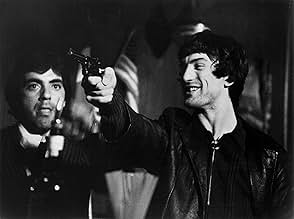
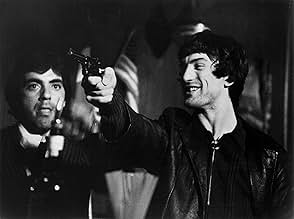
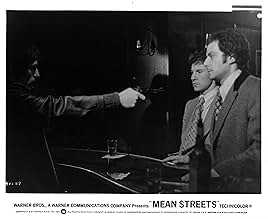
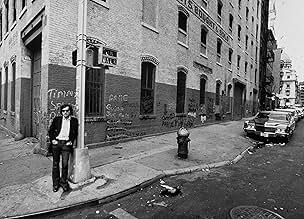
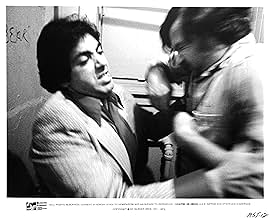
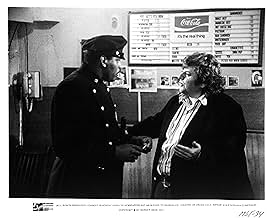
In New York City's Little Italy, a devoutly Catholic mobster must reconcile his desire for power, his feelings for his epileptic girlfriend, and his devotion to his troublesome friend.In New York City's Little Italy, a devoutly Catholic mobster must reconcile his desire for power, his feelings for his epileptic girlfriend, and his devotion to his troublesome friend.In New York City's Little Italy, a devoutly Catholic mobster must reconcile his desire for power, his feelings for his epileptic girlfriend, and his devotion to his troublesome friend.
- Director
- Writers
- Stars
- Awards
- 5 wins & 5 nominations total
Victor Argo
- Mario
- (as Vic Argo, Victor Argo)
Murray Moston
- Oscar
- (as Murray Mosten)
- Director
- Writers
- All cast & crew
- Production, box office & more at IMDbPro
7.2126.4K
1
2
3
4
5
6
7
8
9
10
Featured reviews
Robert deNiro makes one heckuva entrance here.
How can you endlessly watch a total screw-up borrow from the mob, annoy the only friend he has, and basically wreck his life without wanting to run away from it all? When the screw-up is played by young Robert DeNiro you are fascinated, you don't want to turn away. MEAN STREETS was not the debut of both Martin Scorcese or his stars Harvey Kietel and Robert deNiro. They struggled in the field for some time. This is the film that told the world, new head-honchos have arrived on the screen! MEAN STREETS tells of low-rent street hoods in Little Italy. Harvey Kietel plays the one hood whose a voice of reason, who doesn't mess up all the time, who is smart enough to avoid trouble. When DeNiro's Johnny Boy is first seen here, he is playing infantile tricks, and is telling his friend how he can't go in half the stores around him because he owes everybody money. Martin Scorcese uses a gritty documentary-shooting style to unfold his movie. It remains probably the best film of 1973 (But 1973 was not one of the best years for movies.)
A look at life in NY
'Mean Streets', the earliest Scorsese film people have heard of, is the result of an on-form film maker, telling a personal story.
One thing to immediately note about 'Mean Streets' is the performance of our two leads, Harvey Keitel and Robert De Niro, both looking young and are full of energy. They deliver the goods, big time. They are both so watchable and make up at least half of the movie's appeal. In fact, 'Mean Streets' is an inherently watchable movie overall, helped by some fine dialogue and Scorsese's trademark energetic and involving camera-work. The main draw is the antics of the characters and their relationships rather than a high-stakes narrative. Dramatic things happen but don't relate intrinsically to the central plot: that of De Niro's character Johnny Boy, his debts to clubs, bars and old pals along with his long-suffering buddy Charlie (Keitel).
In comparison to other Scorsese films (which is inevitably going to happen if this is not your first Scorsese), it is very low on scale and as mentioned before, low on stakes. This is no gangster epic or psychological portrait but simply a 2 hour window into the streets of New York. It is certainly worth watching.
One thing to immediately note about 'Mean Streets' is the performance of our two leads, Harvey Keitel and Robert De Niro, both looking young and are full of energy. They deliver the goods, big time. They are both so watchable and make up at least half of the movie's appeal. In fact, 'Mean Streets' is an inherently watchable movie overall, helped by some fine dialogue and Scorsese's trademark energetic and involving camera-work. The main draw is the antics of the characters and their relationships rather than a high-stakes narrative. Dramatic things happen but don't relate intrinsically to the central plot: that of De Niro's character Johnny Boy, his debts to clubs, bars and old pals along with his long-suffering buddy Charlie (Keitel).
In comparison to other Scorsese films (which is inevitably going to happen if this is not your first Scorsese), it is very low on scale and as mentioned before, low on stakes. This is no gangster epic or psychological portrait but simply a 2 hour window into the streets of New York. It is certainly worth watching.
The Scorsese Template
Scorsese's first film, the interesting catastrophe "Boxcar Bertha," marked his birth as a director, but it was with his second feature, "Mean Streets" that we witnessed the birth of an artist. Most of "Mean Streets" is slightly unfocused with a simplistic plot based around a lot of machismo grandstanding and long bouts of boring dialog (occasionally made interesting by DeNiro's off-kilter star-making turn as Johnny-Boy), with spats of visceral violence (far less gory here than in later Scorcese pics), and a visual bravado that seems slightly less disciplined but no less entertaining than your standard Scorsese crime flick.
Despite its drawbacks (mainly due to youth and inexperience), the template was set. The opening credits (done to the tune of "Be My Baby") suck you right into the film, and the rest of the movie is peppered with Scorsese's loving treatment of popular music that would later become one of his most endearing hallmarks. The basic premise featuring Harvey Keitel as Charlie (the young hood with a heart of gold and conflicted internally by the religion of the Church and the religion of the Streets), Robert DeNiro as Johnny-Boy (the equally loved and hated loose-canon brother figure), and Amy Robinson as Theresa (the woman our hero wants to put on a pedestal as a saint but often treats like a whore), is a trifecta of archetypes we see repeated again and again in Scorsese's films (most obviously in "Casino" with the DeNiro-Pesci-Stone characters, and most subversively in "The Last Temptation of Christ" with Jesus-Judas-Mary Magdalene). The religious iconography, the brotherhood of crooks, the attraction to the gangster lifestyle, the keen eye for depicting violence in artistic and startling ways...these are displayed here in "Mean Streets" in their rawest form.
Though flawed in many ways, "Mean Streets" set the stage and laid the the template for the type of film Scorsese would perfect seventeen years later with "Goodfellas." This heralded the arrival of a new talent and a new genre, and the world of film has thankfully never been the same.
Despite its drawbacks (mainly due to youth and inexperience), the template was set. The opening credits (done to the tune of "Be My Baby") suck you right into the film, and the rest of the movie is peppered with Scorsese's loving treatment of popular music that would later become one of his most endearing hallmarks. The basic premise featuring Harvey Keitel as Charlie (the young hood with a heart of gold and conflicted internally by the religion of the Church and the religion of the Streets), Robert DeNiro as Johnny-Boy (the equally loved and hated loose-canon brother figure), and Amy Robinson as Theresa (the woman our hero wants to put on a pedestal as a saint but often treats like a whore), is a trifecta of archetypes we see repeated again and again in Scorsese's films (most obviously in "Casino" with the DeNiro-Pesci-Stone characters, and most subversively in "The Last Temptation of Christ" with Jesus-Judas-Mary Magdalene). The religious iconography, the brotherhood of crooks, the attraction to the gangster lifestyle, the keen eye for depicting violence in artistic and startling ways...these are displayed here in "Mean Streets" in their rawest form.
Though flawed in many ways, "Mean Streets" set the stage and laid the the template for the type of film Scorsese would perfect seventeen years later with "Goodfellas." This heralded the arrival of a new talent and a new genre, and the world of film has thankfully never been the same.
This movie is not just a good movie - It also is the movie which helped form the foundation of Martin Scorsese's later pictures.
Mean Streets
Directed by Martin Scorsese (1973)
Mean Streets came out in 1973 after Scorsese almost had the script under development in a decade. This is one of his first personal movies, describing the raw environment in the streets of Little Italy in NYC. We follow Charlie in the leading role and the bunch of guys around him. The hustler Johnny Boy owes a lot of money to the loan shark Tony and doesn't make his payments to him. Charlie now tries to work out a deal with Tony and is trying to get Johnny Boy to pull himself together, even though this looks like an impossible mission.
Scorsese's first motion picture Who's That Knocking at My Door and Mean Streets have many resemblances and contain the typical trademarks that Scorsese is now well known for. He almost always makes a character study of the life of lonely men, who are trying to get the best out of their situation in the asphalt jungle. Hustling, working, drinking, taking drugs etc. are very typical things to do for the persons appearing in his movies.
Mean Streets is photographed mostly with a hand hold camera, which helps create a raw look that fits pretty good to this environment. Also the movie doesn't contain an actual score. Actually songs from the director's personal music collection do work as the background music. The plot is this picture is only secondary. This is like many of Scorsese's other movie primarily a character driven story with a raw environment description.
The movie marks the start of one of the greatest director/actor collaborations ever! The role of Johnny Boy was Robert De Niro's role in a Scorsese picture, and later on he went to bigger leading roles under the director, which gave them both the reputation that they have today. Also this is Harvey Keitel's second leading role in a Scorsese picture, but after this movie Keitel and De Niro kind switched roles (see Taxi Driver).
This movie is not just a good movie - It also is the movie which helped form the foundation of Martin Scorsese's later pictures.
8/10
- "I f*uck you right where you breathe"
Directed by Martin Scorsese (1973)
Mean Streets came out in 1973 after Scorsese almost had the script under development in a decade. This is one of his first personal movies, describing the raw environment in the streets of Little Italy in NYC. We follow Charlie in the leading role and the bunch of guys around him. The hustler Johnny Boy owes a lot of money to the loan shark Tony and doesn't make his payments to him. Charlie now tries to work out a deal with Tony and is trying to get Johnny Boy to pull himself together, even though this looks like an impossible mission.
Scorsese's first motion picture Who's That Knocking at My Door and Mean Streets have many resemblances and contain the typical trademarks that Scorsese is now well known for. He almost always makes a character study of the life of lonely men, who are trying to get the best out of their situation in the asphalt jungle. Hustling, working, drinking, taking drugs etc. are very typical things to do for the persons appearing in his movies.
Mean Streets is photographed mostly with a hand hold camera, which helps create a raw look that fits pretty good to this environment. Also the movie doesn't contain an actual score. Actually songs from the director's personal music collection do work as the background music. The plot is this picture is only secondary. This is like many of Scorsese's other movie primarily a character driven story with a raw environment description.
The movie marks the start of one of the greatest director/actor collaborations ever! The role of Johnny Boy was Robert De Niro's role in a Scorsese picture, and later on he went to bigger leading roles under the director, which gave them both the reputation that they have today. Also this is Harvey Keitel's second leading role in a Scorsese picture, but after this movie Keitel and De Niro kind switched roles (see Taxi Driver).
This movie is not just a good movie - It also is the movie which helped form the foundation of Martin Scorsese's later pictures.
8/10
Mean Streets
Both Robert De Niro and Harvey Keitel are fantastic in Mean streets. I'm not a huge Robert De Niro fan as every time i see him act, i just think to myself that he Robert De Niro trying to be somebody. This is not the case in mean Streets for me. Instead he plays a kid who is young and stupid named Johnny boy. His performance is brilliant and is most likely one of his best. Keitel plays Charlie who looks out for Johhny. The opening line of the film basically tells you everything you would want to know about Charlie.
The film is gritty and shot in a documentary style with several tracking shots being carried out hand held. It takes the film 45 minutes to give you a clear plot and a clear understanding on what going to unfold. The last 20 minutes is directed perfectly with a palpable sense of suspense and is clearly the best ending you can give to this film. One negative would be that in the first half there literally no set pieces . Not a lot happens but saying this you get a clear understanding and fully engaged with the characters which makes the last 20 minutes outstanding.
It not the best film that Scorese has ever made but it clear by watching this that Mean Streets was his main starting point to his successful career
The film is gritty and shot in a documentary style with several tracking shots being carried out hand held. It takes the film 45 minutes to give you a clear plot and a clear understanding on what going to unfold. The last 20 minutes is directed perfectly with a palpable sense of suspense and is clearly the best ending you can give to this film. One negative would be that in the first half there literally no set pieces . Not a lot happens but saying this you get a clear understanding and fully engaged with the characters which makes the last 20 minutes outstanding.
It not the best film that Scorese has ever made but it clear by watching this that Mean Streets was his main starting point to his successful career
What Scorsese Film Ranks Highest on IMDb?
Cinema legend Martin Scorsese has directed some of the most acclaimed films of all time. See how IMDb users rank all of his feature films as director.
Did you know
- TriviaTo really get inside Harvey Keitel's drunken scene, the camera was actually strapped to the actor while he swayed about, and under-cranked to give it a woozy, drunken feel.
- GoofsYou can see Robert De Niro's mic pack on his back when he gets up to walk to the window at Charlie's house after staying the night.
- Quotes
[first lines]
Voice in Charlie's Mind: You don't make up for your sins in church. You do it in the streets. You do it at home. The rest is bullshit, and you know it.
- Alternate versionsNBC edited 10 minutes from this film for its 1977 network television premiere.
- ConnectionsEdited into American Cinema: Film Noir (1995)
- SoundtracksJumpin' Jack Flash
Written by Mick Jagger (as M. Jagger), Keith Richards (as K. Richards) (uncredited)
By The Rolling Stones
Courtesy of ABKCO Records
- How long is Mean Streets?Powered by Alexa
Details
- Release date
- Country of origin
- Official site
- Languages
- Also known as
- Calles peligrosas
- Filming locations
- Production companies
- See more company credits at IMDbPro
Box office
- Budget
- $500,000 (estimated)
- Gross US & Canada
- $32,645
- Opening weekend US & Canada
- $32,645
- Mar 15, 1998
- Gross worldwide
- $61,676
- Runtime
- 1h 52m(112 min)
- Color
- Aspect ratio
- 1.85 : 1
Contribute to this page
Suggest an edit or add missing content