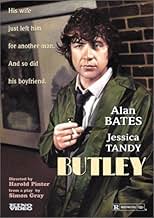
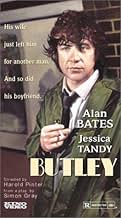
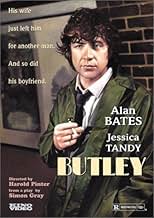
An English professor finds his life crumbling around him.An English professor finds his life crumbling around him.An English professor finds his life crumbling around him.
Jill Goldston
- Tube Passenger
- (uncredited)
Lindsay Ingram
- Female Student
- (uncredited)
Anthony Lang
- Tube Passenger
- (uncredited)
Patti Love
- Female Student
- (uncredited)
Belinda Low
- Female Student
- (uncredited)
Derrick O'Connor
- Irishman in pub
- (uncredited)
John Savident
- James
- (uncredited)
Susan Wooldridge
- Female Student
- (uncredited)
- Director
- Writer
- All cast & crew
- Production, box office & more at IMDbPro
6.7924
1
2
3
4
5
6
7
8
9
10
Featured reviews
The brilliance of Alan Bates, who was Simon Gray's "muse and alter-ego"
Simon Gray's extremely talky, darkly comic 1971 play is cinematized here, direct from the text, for television's American Film Theatre.
Doughy-faced and feckless-looking Alan Bates gives a bravura, nonstop performance as the eponymous sloppy, over-literate, misanthropic, washed-up English professor at the University of London. He is an unlikeable character, so there's no sympathizing with him; it's more like watching a train wreck.
But Bates inhabits the role fiercely, and makes him entertaining and lively -- and at times funny -- enough to hold our attention for the two-hour performance, 95% of which takes place in a single room. The room is Butley's office, which he shares with his longterm young lover Joey, now an assistant lecturer.
"Butley" feels a bit like Albee's "Who's Afraid of Virginia Woolf?", which was written nine years prior to Gray's play. Butley's verbal diatribes go for the jugular, but in allusive, literary or nursery-rhymey, uber-rhetorical, abstract, indirect, and bitterly sarcastic ways. It's a lot to pay attention to -- especially the literary quotes and allusions. And sometimes it's a bit much watching a man go through a slow meltdown in the guise of skewering anyone and everyone around him: Joey, his ex-wife, his students and colleagues, Joey's new love interest, and anyone who even tries to get close to or talk reason to him.
What seems like it might become unrelieved verbal cruelty is thankfully mitigated from time to time by the thoughtful, intelligent, gentle integrity of Joey (wonderfully played by Richard O'Callaghan, who, like Bates, originated his role), and by some real laugh-out-loud moments, and by a character or two who seem for a time to beat Butley at his own cruel mind games.
In the end, the play seems to come full circle metaphorically, giving the audience at least a sense of symmetry and unity and finally quietude before it closes. A worthwhile watch if you like cinematized plays or want more of the very impressive Alan Bates.
Doughy-faced and feckless-looking Alan Bates gives a bravura, nonstop performance as the eponymous sloppy, over-literate, misanthropic, washed-up English professor at the University of London. He is an unlikeable character, so there's no sympathizing with him; it's more like watching a train wreck.
But Bates inhabits the role fiercely, and makes him entertaining and lively -- and at times funny -- enough to hold our attention for the two-hour performance, 95% of which takes place in a single room. The room is Butley's office, which he shares with his longterm young lover Joey, now an assistant lecturer.
"Butley" feels a bit like Albee's "Who's Afraid of Virginia Woolf?", which was written nine years prior to Gray's play. Butley's verbal diatribes go for the jugular, but in allusive, literary or nursery-rhymey, uber-rhetorical, abstract, indirect, and bitterly sarcastic ways. It's a lot to pay attention to -- especially the literary quotes and allusions. And sometimes it's a bit much watching a man go through a slow meltdown in the guise of skewering anyone and everyone around him: Joey, his ex-wife, his students and colleagues, Joey's new love interest, and anyone who even tries to get close to or talk reason to him.
What seems like it might become unrelieved verbal cruelty is thankfully mitigated from time to time by the thoughtful, intelligent, gentle integrity of Joey (wonderfully played by Richard O'Callaghan, who, like Bates, originated his role), and by some real laugh-out-loud moments, and by a character or two who seem for a time to beat Butley at his own cruel mind games.
In the end, the play seems to come full circle metaphorically, giving the audience at least a sense of symmetry and unity and finally quietude before it closes. A worthwhile watch if you like cinematized plays or want more of the very impressive Alan Bates.
Just the best.
When I first saw this film, Ben Butley fascinated me (my cousin, who saw it with me, hated him). I've seen the film many times since then--I bought the video before I had a VCR to play it on--and it remains my favorite movie. And Alan Bates remains my favorite actor, although he's not at all like Butley. I wouldn't recommend the film to everybody, because it's a filmed play, totally in one room, all talk. Ah, but what talk, what dynamics between characters, what vicious game-playing and ruthlessness and humor. Simon Gray's never written a better play.
10B24
Bates at his best
The late Alan Bates had many "bests" (if one may be permitted to say so)because of the constant intensity he brought to every role. He made acting something of a physical sport. In this case, his neurotic Butley uses language as a fencer's epee, yielding nothing to putative antagonists in the tight confines of an English department office in a major university as the camera follows him doggedly thrusting and parrying without pause. I especially liked the puns and double entendres (obviously). This sort of thing is not for everyone, of course, and I do not blame the viewer who is easily bored by such verbal jousting.
Did I mention the superb camera work? It is a tour de force to take a stage play like this one and make it come alive on film. Great acting and great direction would be lost without due attention to the medium, and this one has it par excellence. As depressing as the theme may be, and as unlikeable the fictional characters, this production succeeds in demonstrating just how powerful a film can be in spite of itself. It reminded me instantly of "Who's Afraid of Virginia Woolf" in that regard. And it is uncanny in its recognition of all the unhappy details found in any college English department office.
The nicest touch, of course, was in making Butley a T. S. Eliot specialist, with a photo of the lugubrious poet pinned to the wall. Much comic relief if one knows how to spot it.
Did I mention the superb camera work? It is a tour de force to take a stage play like this one and make it come alive on film. Great acting and great direction would be lost without due attention to the medium, and this one has it par excellence. As depressing as the theme may be, and as unlikeable the fictional characters, this production succeeds in demonstrating just how powerful a film can be in spite of itself. It reminded me instantly of "Who's Afraid of Virginia Woolf" in that regard. And it is uncanny in its recognition of all the unhappy details found in any college English department office.
The nicest touch, of course, was in making Butley a T. S. Eliot specialist, with a photo of the lugubrious poet pinned to the wall. Much comic relief if one knows how to spot it.
Battling Bates
Harold Pinter's film version of Simon Grey's play allows full reign to Pinter's playfully sinister sense of humour in this sardonic tale of academic office politics with Alan Bates playing the original bull in a china shop.
Watching him compulsively winding people up you desperately just keep wanting him to quit. And despite forever getting one final chance (SLIGHT SPOILER COMING:) he never does.
An Exercise In Bile
This American Film Theater presentation of Simon Gray's play about a bisexual professor of English whose life is in full collapse is a wordy affair. Alan Bates, in the title role, talks almost nonstop.... or perhaps I should say that he speaks. Harold Pinter directed this production like a stage play, and the performances are theatrical.
I found it impossible to work up any sympathy for Bates' character, who seems to have sabotaged his life through bad choices. Likely that was Gray's point. He taught at Queen Mary College for a quarter of a century, and this looks like an illustration of the irony that the in-fighting in academia is so vicious because the stakes are so small. Of course, these are people fighting for their lives, but they don't seem to care much for those lives, just in scoring hateful points off each other. In any case, I found the show as unpleasant as the self-absorbed characters.
Did you know
- TriviaFilm direction debut and sole film direction credit for Harold Pinter.
- Quotes
Ben Butley: I'm a one-woman man, and I've had mine, thank God.
- How long is Butley?Powered by Alexa
Details
- Runtime
- 1h 34m(94 min)
- Sound mix
- Aspect ratio
- 1.85 : 1
Contribute to this page
Suggest an edit or add missing content