
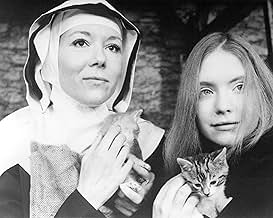
A well-to-do London businesswoman gives up her comfortable life, including the man who loves her, to become a cloistered Benedictine nun.A well-to-do London businesswoman gives up her comfortable life, including the man who loves her, to become a cloistered Benedictine nun.A well-to-do London businesswoman gives up her comfortable life, including the man who loves her, to become a cloistered Benedictine nun.
- Nominated for 1 Primetime Emmy
- 1 nomination total




Fanny Rowe
- Miss Bowman
- (as Frances Rowe)


Dearbhla Molloy
- Dame Beatrice
- (as Dervla Molloy)
Yasuko Nagazumi
- Mariko
- (as Yasuko Magazumi)


- Director
- Writers
- All cast & crew
- Production, box office & more at IMDbPro
7.8336
1
2
3
4
5
6
7
8
9
10
Featured reviews
But If You Haven't Read the Book . . .
I certainly can appreciate the previous review by the person who very capably compares the book to the movie. But I had not read the book when I first saw the movie years ago on the late show, and I still have not read it. What I have done is stop to watch the movie again and again every time I see that it is coming on. Freed from comparison, the movie is lovely. I have never felt the movie gives a good enough sense of the depth of emotion it seems (to me, at least) would be necessary to impel the main character to make the decision she makes to enter the convent; nonetheless, once the viewer accepts the fact of that decision, the rest of the movie is delightful. Rigg plays her role with clarity, thoughtfulness, circumspection, and elegance. The slow resolution of conflict within the cloistered community is gracefully marked. It is a masterful illustration of patience as virtue. The movie always leaves me with a sense of peace and, finally, joy, although I am not a religious person in the least. I recommend it highly.
Mixed feelings...
If I had never read the novel (and loved it), and if I had never lived the cloistered religious life (which I have), I would recommend this film without reserve.
My reservations are based on the following: Having lived in a cloister for over two years, I can tell you that, even in these post-Vatican II times, a postulant or novice would never be permitted to speak freely with another sister, especially an elder, without permission from her novice mistress. Recreations are not "free time", as depicted in the film; it is a daily get-together of the community as a whole, and it is encouraged that you converse in groups of at least three (you can talk to one other sister if you feel you have to, but certainly not for the whole recreation period). Also, silence being an essential and necessary aspect of contemplative monasticism, a sister, no matter what rank, would not sing out loud whenever and wherever she felt moved to do so, and especially not during work time. I could go on... but suffice it to say that this film is not an accurate depiction of cloistered life.
However, I do have positive feelings about this film. Even though it bears little resemblance in plot to the novel, it's still a good basic story in itself and is very well acted by an ensemble of wonderful actors. And, inaccurate of the life as it is, the film still evokes in me a nostalgic longing for the monastery, and I admit that I watch it for mainly that reason.
Oh, that the BBC would produce a mini-series of Godden's wonderful novel! That would be something to see. Godden was herself a Benedictine Oblate (lay persons connected by vows to a religious order), and her book is a loving and faithful tribute to Benedictine nuns everywhere.
My reservations are based on the following: Having lived in a cloister for over two years, I can tell you that, even in these post-Vatican II times, a postulant or novice would never be permitted to speak freely with another sister, especially an elder, without permission from her novice mistress. Recreations are not "free time", as depicted in the film; it is a daily get-together of the community as a whole, and it is encouraged that you converse in groups of at least three (you can talk to one other sister if you feel you have to, but certainly not for the whole recreation period). Also, silence being an essential and necessary aspect of contemplative monasticism, a sister, no matter what rank, would not sing out loud whenever and wherever she felt moved to do so, and especially not during work time. I could go on... but suffice it to say that this film is not an accurate depiction of cloistered life.
However, I do have positive feelings about this film. Even though it bears little resemblance in plot to the novel, it's still a good basic story in itself and is very well acted by an ensemble of wonderful actors. And, inaccurate of the life as it is, the film still evokes in me a nostalgic longing for the monastery, and I admit that I watch it for mainly that reason.
Oh, that the BBC would produce a mini-series of Godden's wonderful novel! That would be something to see. Godden was herself a Benedictine Oblate (lay persons connected by vows to a religious order), and her book is a loving and faithful tribute to Benedictine nuns everywhere.
Spiritual Conflict - Benedictine Style
Diana Rigg has always been one of my favourite actresses, going way back to 1960's "The Avengers" television series. I had originally seen this film when it was first released to American television in the 1970's, enjoyed it, and then as the years passed, and the film went out of distribution, forgot about it.
When "Brede" was reissued on VHS, I watched the movie again, and remembered how much I enjoyed it. Coincidentally, I managed to find a copy of Rumer Godden's novel, In This House of Brede and set down to read it. There are many plot differences between the novel and the film (I spent 200 pages reading waiting for the "movie" to start), but the central themes remain intact - the quest for individual spirituality, grief, loneliness, the questioning of one's personal decisions, jealousy, envy, discipline, and most importantly, love.
The character of Dame Phillipa (Diana Rigg) is one who feels deeply, but builds up very thick walls for her own protection. What impressed me most about Rigg's performance is that she manages to express her pain, grief, and inner turmoil while holding back the tears... just as I imagine Dame Phillipa would.
Dame Agnes (Pamela Brown) is extraordinary. (Having gone to a Catholic grade school run by Benedictine nuns, I can assure you that there are a few like Dame Agnes out there!) She reminds me very much of Gladys Cooper's character, Sister Maria Therese in The Song of Bernadette. She is of the "old school", resisting change, new ideas, people of worldly experience, and terribly jealous of Dame Phillipa. In the final reel, we do understand what makes Dame Agnes tick, and with that realisation, we can forgive her uncharitable behaviour.
My complaints about the film are few. It looks very much like a dated made-for-tv film from the 1970's today. The music score, which is a symphonic-pop amalgamation, does not hold up well and is at times intrusive. There was also much left out of the book when it was transformed into the screenplay that could have been filmed with an additional 30-40 minutes running time.
The beauties of this film far outweigh its shortcomings. After viewing it, I suggest you find a copy of the novel (if you can, it's currently out of print in the United States) and enjoy the author's original, and more extensive story.
When "Brede" was reissued on VHS, I watched the movie again, and remembered how much I enjoyed it. Coincidentally, I managed to find a copy of Rumer Godden's novel, In This House of Brede and set down to read it. There are many plot differences between the novel and the film (I spent 200 pages reading waiting for the "movie" to start), but the central themes remain intact - the quest for individual spirituality, grief, loneliness, the questioning of one's personal decisions, jealousy, envy, discipline, and most importantly, love.
The character of Dame Phillipa (Diana Rigg) is one who feels deeply, but builds up very thick walls for her own protection. What impressed me most about Rigg's performance is that she manages to express her pain, grief, and inner turmoil while holding back the tears... just as I imagine Dame Phillipa would.
Dame Agnes (Pamela Brown) is extraordinary. (Having gone to a Catholic grade school run by Benedictine nuns, I can assure you that there are a few like Dame Agnes out there!) She reminds me very much of Gladys Cooper's character, Sister Maria Therese in The Song of Bernadette. She is of the "old school", resisting change, new ideas, people of worldly experience, and terribly jealous of Dame Phillipa. In the final reel, we do understand what makes Dame Agnes tick, and with that realisation, we can forgive her uncharitable behaviour.
My complaints about the film are few. It looks very much like a dated made-for-tv film from the 1970's today. The music score, which is a symphonic-pop amalgamation, does not hold up well and is at times intrusive. There was also much left out of the book when it was transformed into the screenplay that could have been filmed with an additional 30-40 minutes running time.
The beauties of this film far outweigh its shortcomings. After viewing it, I suggest you find a copy of the novel (if you can, it's currently out of print in the United States) and enjoy the author's original, and more extensive story.
10andrewjv
A Wonderful Depiction of Benedictine Life
As a former Benedictine monk of 15 years who has visited many cloistered Benedictine monasteries of enclosed women religious, this movie is a wonderful depiction of the the rituals and formation of nuns in Benedictine monasteries. The ceremonies are very accurately depicted and there is none of that silly nun-sense (no pun intended!) that is often depicted in Hollywood versions of movies about nuns. I highly recommend this film and the books as well! The music and the chant are also wonderful.
Does anyone know what Abbey was used for the filming of the movie?
The copy of the movie that I have does not have the credits at the end so I can not figure out where it was filmed.
Does anyone know what Abbey was used for the filming of the movie?
The copy of the movie that I have does not have the credits at the end so I can not figure out where it was filmed.
Somewhat irritating to one who knows the book well
In This House of Brede is just about my favorite Rumer Godden novel. However, this adaptation shows the limitations made-for-TV movies labor under better than any other example I could name.
Granted, it's hard to take a 369 page novel spanning more than 20 years and boil it down to something that can be turned into 90 minutes of film. The secret in doing it right is not what you leave, but what you take away and why. In this case, a better job could have been done.
All right; I can see why the whole Duranski subplot went away. It's too hard to film and despite what it reveals about the nuns and their interactions, and how secular people interact with the religious, it does not really advance the plot. Likewise the subplot of Lady Abbess's pectoral cross; it does not really advance the main plot line. Ditto the whole Vatican-II-changes subplot. However, the writer and director did not stop there. In my opinion, deleting the entire Sister Kazuko-Dame Colette plot line was a major mistake; it reduces the entire Japanese novitiate subplot almost to a device. It makes me wonder if the screenwriter missed the whole point of the novel.
The core of the book is about conflicts. Conflicts of self, of want versus duty; conflicts between people; conflicts between the secular and the sacred. Very little of that came through in the final version. Indeed, many of the conflicts were eliminated by the transmogrification of characters. McTurk is gone, with some of his wisdom and understanding grafted onto Sir Richard. Dame Maura is completely eliminated; that was a bad move. The cloying, annoying Dame Veronica has likewise vanished, and with her the conflict between the fluff she writes and the weighty substance of Dame Agnes's work. Dame Agnes herself has been fused with Mother Mistress Emily Lovell in one of the odder recharacterizations I've even seen in a movie, with the result that her edge (Dame Agnes's trademark) is thoroughly blunted. We see the Scallons (Dame Johanna's parents in the movie, Dame Cecily's in the book) only for moments, scarcely long enough to figure out who they are, but not long enough for us to understand why Dame Johanna ended up as she is and where she is. Larry Bannerman, of all the minor characters, is the only one whose part actually illuminated one of the major characters and pointed up best the real conflicts of the religious life as opposed to the secular; far better even than the compare-and-contrast of Philippa Talbot versus Dame Philippa of Brede Abbey.
The best thing about this TV movie is that it points out the crying need for a theatrical feature to be made from this book. It cries for a director with clear vision and a fresco big enough to paint not merely the major portraits, but the miniatures around the edges and in the background. Oh, this 1975 version stands on its own; but it has the same sort of choppiness Cuaron brought to Harry Potter and the Prisoner of Azkhaban, and that does not serve the novel at all well. It requires a slower, more deliberate pace - and above all, a budget big enough that characters do not have to be combined to their detriment, and at least a couple of the plot lines that had to be cut, to be restored.
Even with all these grumbles, there are worse ways to spend an evening than in the company of the nuns of Brede. It's not a bad little movie when all is said and done; it is simply one that could, and should, be done better on the large screen.
Granted, it's hard to take a 369 page novel spanning more than 20 years and boil it down to something that can be turned into 90 minutes of film. The secret in doing it right is not what you leave, but what you take away and why. In this case, a better job could have been done.
All right; I can see why the whole Duranski subplot went away. It's too hard to film and despite what it reveals about the nuns and their interactions, and how secular people interact with the religious, it does not really advance the plot. Likewise the subplot of Lady Abbess's pectoral cross; it does not really advance the main plot line. Ditto the whole Vatican-II-changes subplot. However, the writer and director did not stop there. In my opinion, deleting the entire Sister Kazuko-Dame Colette plot line was a major mistake; it reduces the entire Japanese novitiate subplot almost to a device. It makes me wonder if the screenwriter missed the whole point of the novel.
The core of the book is about conflicts. Conflicts of self, of want versus duty; conflicts between people; conflicts between the secular and the sacred. Very little of that came through in the final version. Indeed, many of the conflicts were eliminated by the transmogrification of characters. McTurk is gone, with some of his wisdom and understanding grafted onto Sir Richard. Dame Maura is completely eliminated; that was a bad move. The cloying, annoying Dame Veronica has likewise vanished, and with her the conflict between the fluff she writes and the weighty substance of Dame Agnes's work. Dame Agnes herself has been fused with Mother Mistress Emily Lovell in one of the odder recharacterizations I've even seen in a movie, with the result that her edge (Dame Agnes's trademark) is thoroughly blunted. We see the Scallons (Dame Johanna's parents in the movie, Dame Cecily's in the book) only for moments, scarcely long enough to figure out who they are, but not long enough for us to understand why Dame Johanna ended up as she is and where she is. Larry Bannerman, of all the minor characters, is the only one whose part actually illuminated one of the major characters and pointed up best the real conflicts of the religious life as opposed to the secular; far better even than the compare-and-contrast of Philippa Talbot versus Dame Philippa of Brede Abbey.
The best thing about this TV movie is that it points out the crying need for a theatrical feature to be made from this book. It cries for a director with clear vision and a fresco big enough to paint not merely the major portraits, but the miniatures around the edges and in the background. Oh, this 1975 version stands on its own; but it has the same sort of choppiness Cuaron brought to Harry Potter and the Prisoner of Azkhaban, and that does not serve the novel at all well. It requires a slower, more deliberate pace - and above all, a budget big enough that characters do not have to be combined to their detriment, and at least a couple of the plot lines that had to be cut, to be restored.
Even with all these grumbles, there are worse ways to spend an evening than in the company of the nuns of Brede. It's not a bad little movie when all is said and done; it is simply one that could, and should, be done better on the large screen.


Did you know
- TriviaDiana Rigg, Dennis Quilley and Nicholas Clay also appeared together in "Evil Under the Sun"
- ConnectionsFeatured in The 27th Annual Primetime Emmy Awards (1975)
Details
Contribute to this page
Suggest an edit or add missing content