

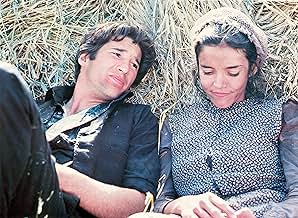
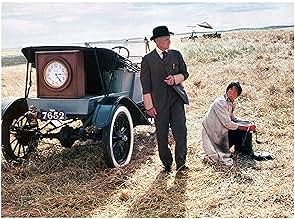
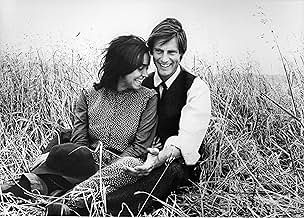
A hot-tempered farm laborer convinces the woman he loves to marry their rich but dying boss so that they can have a claim to his fortune.A hot-tempered farm laborer convinces the woman he loves to marry their rich but dying boss so that they can have a claim to his fortune.A hot-tempered farm laborer convinces the woman he loves to marry their rich but dying boss so that they can have a claim to his fortune.
- Won 1 Oscar
- 13 wins & 13 nominations total




Robert J. Wilke
- The Farm Foreman
- (as Robert Wilke)


Timothy Scott
- Harvest Hand
- (as Tim Scott)


Terrence Malick
- Mill Worker
- (uncredited)
- Director
- Writer
- All cast & crew
- Production, box office & more at IMDbPro
7.767.6K
1
2
3
4
5
6
7
8
9
10
Featured reviews
A Prairie story
This is gorgeous looking film very much filmed at dusk and dawn. A film misunderstood upon its time of release and only after Terrence Malick's subsequent films can you now understand what the writer- director was aiming at.
The fact that Malick's next film emerged 20 years later we understand this is a person who wants to tell his story by visuals. Actors talking is just secondary and those scenes end up on the cutting room floor.
Days of Heaven which was shot in 70mm always had a reputation for its Cinematography which won an Oscar.
Now we can marvel at it in our homes on widescreen high definition television. You can really have those close ups of those insects. It is also a surprisingly short film, coming in at just over 90 minutes.
The tale is slight, Gere is a hothead with a girlfriend that is pretending to be his sister and his actual younger sister. They get a job whilst fleeing from Chicago in a farm in Texas where the Farmer played by Sam Shepard takes a shine to the girlfriend and marries her. Gere is aware that the Framer only has a year to live.
Apparently the film took several years to be edited and the narration from the youngest sister had to be added to make the story flow. A similar device was used by Malick in 'The Thin Red Line.'
The film might be seen as slow and maybe hard to fathom because there is relative little dialogue but as mentioned you admire the visuals and at 90 minutes it is not as slow moving as you think.
A brave beautifully crafted film.
The fact that Malick's next film emerged 20 years later we understand this is a person who wants to tell his story by visuals. Actors talking is just secondary and those scenes end up on the cutting room floor.
Days of Heaven which was shot in 70mm always had a reputation for its Cinematography which won an Oscar.
Now we can marvel at it in our homes on widescreen high definition television. You can really have those close ups of those insects. It is also a surprisingly short film, coming in at just over 90 minutes.
The tale is slight, Gere is a hothead with a girlfriend that is pretending to be his sister and his actual younger sister. They get a job whilst fleeing from Chicago in a farm in Texas where the Farmer played by Sam Shepard takes a shine to the girlfriend and marries her. Gere is aware that the Framer only has a year to live.
Apparently the film took several years to be edited and the narration from the youngest sister had to be added to make the story flow. A similar device was used by Malick in 'The Thin Red Line.'
The film might be seen as slow and maybe hard to fathom because there is relative little dialogue but as mentioned you admire the visuals and at 90 minutes it is not as slow moving as you think.
A brave beautifully crafted film.
Quiet passion, quiet beauty
"Days of Heaven" is a beautiful film with fantastic panoramic cinematography. It's hard to say what it is about this film that captivated me from the start. I didn't expect to enjoy it when I read about the plot. Farm workers? How could that be interesting... But oh, the haunting, heavenly silence of the fields undulating in the wind, a silence not sundered by any garish music. Everything about this film is tangible, real, alive. The dialogue is sparse, believable, the bond between Bill and Abby is one of quiet passion that needs no dramatic proclamations to fuel it. And Sam Shepard's farmer is touching. I don't use that word very often, but I'll venture it here. I have watched this film now several times, and it is a delight each time when the farmer first sees Abby. This perhaps the strongest and most believable love triangle ever put to film, and in my opinion, the most compelling.
Up there with Casablanca & Citizen Kane
I can understand why Malick didn't make another movie after he made Days of Heaven. The film was panned by the majority of the critics who could only find the cinematography worthy of praise. However, Malick was hugely misunderstood by these dumb critics.
They complain that the film is ponderously slow. This was the intention. Malick used pause to convey that the characters think. Too many actors rattle off their lines without letting their characters think of them. It also conveys the slow pace of their lives.
Critics complain that the characters are too remote - one feels removed from them and can't get involved. Hello! It is narrated by a 13 yr old and is essentially her view of the events that transpired. Naturally she does not grasp most of the more adult moments between them and thus is herself removed from being fully involved in Bill and Abby's relationship and that is what has to come across.
Then Malick, in a moment of genius, allied the four main characters to the four elements; Earth, Air, Fire & Water. Bill is Fire - he is seen at first in front of the furnaces of a foundry where he works. We can see his temper is volatile. Abby is water - in the very first shot she is scavenging(?) by a stream and she is seen against the backdrop of the river. Linda is Earth - In her narration she says that she is close to the "Oith". The Farmer is Air - constantly tinkering with his weather vane, and his fields of wheat are often seen waving in the wind.
All in all a severely mies-judged film and the critics owe Malick a huge apology. The work is pure genius!
They complain that the film is ponderously slow. This was the intention. Malick used pause to convey that the characters think. Too many actors rattle off their lines without letting their characters think of them. It also conveys the slow pace of their lives.
Critics complain that the characters are too remote - one feels removed from them and can't get involved. Hello! It is narrated by a 13 yr old and is essentially her view of the events that transpired. Naturally she does not grasp most of the more adult moments between them and thus is herself removed from being fully involved in Bill and Abby's relationship and that is what has to come across.
Then Malick, in a moment of genius, allied the four main characters to the four elements; Earth, Air, Fire & Water. Bill is Fire - he is seen at first in front of the furnaces of a foundry where he works. We can see his temper is volatile. Abby is water - in the very first shot she is scavenging(?) by a stream and she is seen against the backdrop of the river. Linda is Earth - In her narration she says that she is close to the "Oith". The Farmer is Air - constantly tinkering with his weather vane, and his fields of wheat are often seen waving in the wind.
All in all a severely mies-judged film and the critics owe Malick a huge apology. The work is pure genius!
Healing and Cathartic
Oh, I better come out and say it: I love Terrence Malick. I think he's one of the few filmmakers who has completely and utterly captured filmic form. "The Thin Red Line" was, to me, an astonishing experience; beautiful, horrific and the best movie of the 90s. "Badlands" is the best lovers-on-the-lam movie I've ever seen (it certainly makes "True Romance" look like a gimmicky fraud of a movie). Malick somehow manages to make everything seem painfully beautiful: his landscape, his actors, his dialogue. There's something always elegiac about his movies.
There's a picture of James Dean I saw from his youth -- a baseball team photo -- and the caption said something about how it captured his face, and in it, wisdom and sadness far beyond his years. That's what Malick does in his films and particularly in this film.
He must have been a fan of James Dean (probably one of the reasons he chose to make "Badlands," as a sort of homage), but not in the sense that coolness comes from a perfectly combed coiffure, a red leather jacket (which it wasn't -- it was a windbreaker) and a dark brood. There's a similar story here to that of "Giant," set on a farm with that remarkable house, two men and one girl. Only "Giant" didn't have a philosophizing and very strange little girl. It was also an overblown soap opera and while this film is, I guess, a melodrama, it certainly isn't melodramatic.
If Malick is anyone in the film, he's Sam Shapard; watching his love through a lens. Malick uses Manz as a sort of channel. If this is indeed some fashion of his own story, Malick tells us through her, with he visualized by Shepard, which is a somewhat brilliant approach. Manz is strangely philosophical; at once blunt and abstract. The story is obviously centered around her -- I don't see why this wouldn't be obvious -- but she's pushed into the background, commenting on the characters and informing us like God from above.
As always with Malick, his film is mesmerizing and hypnotic. I was surprised that the film was only a little over an hour-and-a-half. The great Ennio Morricone created a wonderful score for this film that seems to forebode impending doom. Unlike his more famous spaghetti western scores, it's never overly-flamboyant. And the cinematography, listed as belonging to Nestor Almendros, but well-known to be at least substantially contributed to by Haskell Wexler, is so much like an oil painting that it's just about liquid film. I'd be willing to pay a lot of money to see this one on the big screen.
It might seem obvious to state that this film is a transition between "Badlands" and "The Thin Red Line," after all it was the middle film. But this film has moments, especially in the finale, that are surprisingly close to that of "Badlands" and this is the film where Malick fully mastered his approach of lush, visual poetry told at a languid pace that never seems boring, since you're fully within the film;s grasp.
Pauline Kael said in her review that "the film is an empty Christmas tree: you can hang all your dumb metaphors on it." And Charles Taylor, always following Kael's lead (even from beyond the grave), said of Malick's two 1970s films, "Next to the work of Altman, Scorsese, Coppola, De Palma and Mazursky from that period, they're pallid jokes."
What never fails to get me furious is when someone viciously attacks a director, like Malick, for being self-indulgent. Of course it's self-indulgent, he's telling a story that means something to him and trying to share what he feels with us. Malick certainly isn't trying to alienate people, and if you are alienated by his films, well, don't watch them. Malick is a filmmaker like Kubrick, but more fluid and much less abrasive. I mean, if you're going to aggressively attack a filmmaker, aggressively attack someone who is aggressive on his side. Directors like Malick use abstractions to engage their audiences more fully than most. By leaving things -- often feelings -- open to interpretation, the film becomes more intimate.
Certainly one of the most enduring films from the 70s, this is a masterwork.
****
There's a picture of James Dean I saw from his youth -- a baseball team photo -- and the caption said something about how it captured his face, and in it, wisdom and sadness far beyond his years. That's what Malick does in his films and particularly in this film.
He must have been a fan of James Dean (probably one of the reasons he chose to make "Badlands," as a sort of homage), but not in the sense that coolness comes from a perfectly combed coiffure, a red leather jacket (which it wasn't -- it was a windbreaker) and a dark brood. There's a similar story here to that of "Giant," set on a farm with that remarkable house, two men and one girl. Only "Giant" didn't have a philosophizing and very strange little girl. It was also an overblown soap opera and while this film is, I guess, a melodrama, it certainly isn't melodramatic.
If Malick is anyone in the film, he's Sam Shapard; watching his love through a lens. Malick uses Manz as a sort of channel. If this is indeed some fashion of his own story, Malick tells us through her, with he visualized by Shepard, which is a somewhat brilliant approach. Manz is strangely philosophical; at once blunt and abstract. The story is obviously centered around her -- I don't see why this wouldn't be obvious -- but she's pushed into the background, commenting on the characters and informing us like God from above.
As always with Malick, his film is mesmerizing and hypnotic. I was surprised that the film was only a little over an hour-and-a-half. The great Ennio Morricone created a wonderful score for this film that seems to forebode impending doom. Unlike his more famous spaghetti western scores, it's never overly-flamboyant. And the cinematography, listed as belonging to Nestor Almendros, but well-known to be at least substantially contributed to by Haskell Wexler, is so much like an oil painting that it's just about liquid film. I'd be willing to pay a lot of money to see this one on the big screen.
It might seem obvious to state that this film is a transition between "Badlands" and "The Thin Red Line," after all it was the middle film. But this film has moments, especially in the finale, that are surprisingly close to that of "Badlands" and this is the film where Malick fully mastered his approach of lush, visual poetry told at a languid pace that never seems boring, since you're fully within the film;s grasp.
Pauline Kael said in her review that "the film is an empty Christmas tree: you can hang all your dumb metaphors on it." And Charles Taylor, always following Kael's lead (even from beyond the grave), said of Malick's two 1970s films, "Next to the work of Altman, Scorsese, Coppola, De Palma and Mazursky from that period, they're pallid jokes."
What never fails to get me furious is when someone viciously attacks a director, like Malick, for being self-indulgent. Of course it's self-indulgent, he's telling a story that means something to him and trying to share what he feels with us. Malick certainly isn't trying to alienate people, and if you are alienated by his films, well, don't watch them. Malick is a filmmaker like Kubrick, but more fluid and much less abrasive. I mean, if you're going to aggressively attack a filmmaker, aggressively attack someone who is aggressive on his side. Directors like Malick use abstractions to engage their audiences more fully than most. By leaving things -- often feelings -- open to interpretation, the film becomes more intimate.
Certainly one of the most enduring films from the 70s, this is a masterwork.
****
Full surprise within the American film universe.
This movie was a full and happy surprise for me. This man, Malick, stood twenty years out of business because he had to be, afterwards, after such a beautiful movie he couldn't and shouldn't return with any other thing shorter than this.
Days Of Heaven is absolutely perfect cinema, the plot is not important, Malick simply wants to fill your senses and he achieves it.
I haven't had the chance to watch it in a theatre, I was four years old at the time, I've watched it on television, and I understood immediately, this man is a hero for building up such a magnificent film in the United States, in Hollywood.
A true director builds a universe of his own, with its own "time flow" and dreams and that is what Malick achieved with this film, magic, sacral art. Some sequences are "almost" (a big almost) Tarkovskyand this is a big commendation.
Days Of Heaven is absolutely perfect cinema, the plot is not important, Malick simply wants to fill your senses and he achieves it.
I haven't had the chance to watch it in a theatre, I was four years old at the time, I've watched it on television, and I understood immediately, this man is a hero for building up such a magnificent film in the United States, in Hollywood.
A true director builds a universe of his own, with its own "time flow" and dreams and that is what Malick achieved with this film, magic, sacral art. Some sequences are "almost" (a big almost) Tarkovskyand this is a big commendation.


Did you know
- TriviaThe shot of locusts ascending to the sky was shot in reverse with the helicopter crew throwing peanut shells down, and actors walking backwards.
- GoofsTowards the end of the movie, Bill fires three shots from a double-barreled shotgun without reloading.
- SoundtracksEnderlin
Written and Performed by Leo Kottke
Used by permission of Overdrive Music A.S.C.A.P. Copyright 1978
- How long is Days of Heaven?Powered by Alexa
Details
- Release date
- Country of origin
- Languages
- Also known as
- Días de gloria
- Filming locations
- Lethbridge, Alberta, Canada(Lethbridge Viaduct High Level Railroad Bridge)
- Production company
- See more company credits at IMDbPro
Box office
- Budget
- $3,000,000 (estimated)
- Gross US & Canada
- $3,446,749
- Gross worldwide
- $3,492,997
- Runtime
- 1h 34m(94 min)
- Color
- Aspect ratio
- 1.85 : 1
Contribute to this page
Suggest an edit or add missing content