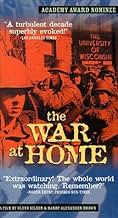
Interviews with people involved with and leading the Madison, Wisconsin area resistance to the Vietnam war.Interviews with people involved with and leading the Madison, Wisconsin area resistance to the Vietnam war.Interviews with people involved with and leading the Madison, Wisconsin area resistance to the Vietnam war.
- Nominated for 1 Oscar
- 3 nominations total
Spiro Agnew
- Self - White House Conference, Beside Connally
- (archive footage)
- (uncredited)
William Bablitch
- Self - Law Student, Observer
- (archive footage)
- (uncredited)
John Connally
- Self - White House Conference, Beside Agnew
- (archive footage)
- (uncredited)
Ngo Dinh Diem
- Self - with Nixon in Vietnam
- (archive footage)
- (uncredited)
John Ehrlichman
- Self - White House Conference
- (archive footage)
- (uncredited)
Dwight D. Eisenhower
- Self - Discusses Domino Theory
- (archive footage)
- (uncredited)
7.6310
1
2
3
4
5
6
7
8
9
10
Featured reviews
10mgoodlan
Recommended for students of the 60s
This is an excellent film for those who are interested in the 60s war resistance movement or who lived in the Madison, WI area during that time. It uses a great combination of interviews with the leaders, both student and other, of the time, and archival footage. A good reminder of a time when people took a stand for what they believed in.
Seeing the movie as part of a college class
In 1982, when I was a freshman at Edgewood College, I was in an Intro to Political Science; Jim Rowen was my teacher. It was an outstanding class and very influential on my political outlook. I began the class a Republican like my parents and family and at the end of the semester was a Democrat.
The movie was very informative and documented very well the trials and tribulations that the protesters experienced and often times suffered. The build up to the Sterling Hall bombing was very vivid and riveting.
Both the movie, and moreso the class, taught me how wasteful Pentagon spending is when done excessively as it was during the Reagan years as well as with the poor, misguided president we have now.
The movie indicates that with poor policies which lead a nation into a war they have no business fighting, then there will often be repression by the government justifying the war and diligent, compelling people asking questions and voicing their dissent. The hope is that there are enough diligent people as there were during the Vietnam War to make a difference.
The movie was very informative and documented very well the trials and tribulations that the protesters experienced and often times suffered. The build up to the Sterling Hall bombing was very vivid and riveting.
Both the movie, and moreso the class, taught me how wasteful Pentagon spending is when done excessively as it was during the Reagan years as well as with the poor, misguided president we have now.
The movie indicates that with poor policies which lead a nation into a war they have no business fighting, then there will often be repression by the government justifying the war and diligent, compelling people asking questions and voicing their dissent. The hope is that there are enough diligent people as there were during the Vietnam War to make a difference.
10pery-1
Best "feel like you're there" Sixties movie
I saw this many years ago, but remember it as the best movie to really recreate the feeling of being in the 1960/70's. The government repression, the anger, fear and paranoia are all there. Enough to cause unsettled sleep for 3 nights. I wasn't at Madison, but a much quieter campus, and the experience was the same all over the country. For comparison, I found "Berkeley in the Sixties" to be very boring.
When will we learn our lesson?
The most famous Vietnam-related production of 1979 was "Apocalypse Now", but there was also the documentary "The War at Home", focusing on the anti-war movement in Madison, Wisconsin. You've probably seen ample of footage from the era showing students protesting and police attacking them; lots of that here. It also shows the Kent State shootings, which radicalized a number of people. Allen Ginsberg even describes the FBI's COINTELPRO, whose aim was breaking the political movements sweeping the country.
Watching the documentary, it was impossible not to draw parallels to the present day. I bet that in 1979, people authentically thought that there would never again be any wars. I wish!
Definitely worth seeing. Others that I recommend are "Hearts and Minds" and "The Weather Underground".
Watching the documentary, it was impossible not to draw parallels to the present day. I bet that in 1979, people authentically thought that there would never again be any wars. I wish!
Definitely worth seeing. Others that I recommend are "Hearts and Minds" and "The Weather Underground".
10djtet
Best historical doc on the anti-war movement
There are a number of films out on the anti-war movement. Some, like the recent 'Weather Underground' never really explain the historical context or the protester's politics, but just stay at the surface of personality and sensational subject matter. Others, like Berkeley in the Sixties, take a completely nostalgic view, embalming leftist politics as something cool boomers did in a now inaccessible past when they were crazy kids. The War at Home, though fills in the background, takes the politics seriously, and imagines that it might be actually worth something to the viewer. While the film is focused on events in Madison, WI, it's interest is by no means limited to folks with experience of that time or place. It's very effective microcosm of the larger movement. While the film has a fairly conventional talking-head-and-archival-clip form, it's well made and engaging. It also has no pretense to 'objectivity,' which is a good thing. A number of observers trace the decline of the anti-war movement to a turn towards violence that alienated more moderate folks who were beginning to question the war after Tet. the first signal event in this supposed turn toward the dark side was a bombing on the University of Wisconsin campus, which becomes the central event in this film. A grad student in science was killed in the blast, and there was great hue and cry that anyone would set off a bomb amidst the seat of higher learning. However, rather than simply casting the bombers as villains, the film seeks to understand their actions, and ultimately sympathizes with them. Rarely do we ever see this -- political radicalism treated as human and comprehensible -- and for presenting the side of the argument we never hear otherwise, The War at Home is a valuable and all too rare document.
Did you know
- TriviaThis film has a 100% rating based on 5 critic reviews on Rotten Tomatoes.
- ConnectionsEdited into American Pop (1981)
Details
- Runtime
- 1h 40m(100 min)
- Color
- Sound mix
Contribute to this page
Suggest an edit or add missing content