Crac
- 1980
- 15m
IMDb RATING
7.4/10
1.7K
YOUR RATING

The industrialization of Montreal (Canada), as seen from the point of view of a rocking-chair.The industrialization of Montreal (Canada), as seen from the point of view of a rocking-chair.The industrialization of Montreal (Canada), as seen from the point of view of a rocking-chair.
- Director
- Writer
- Won 1 Oscar
- 3 wins total




7.41.7K
1
2
3
4
5
6
7
8
9
10
Featured reviews
Frederic Back's Crac Radiates Such Warmth and Care, It Can Make Cynics and Misanthropes Appreciate The Beauty of Life
Moving images evoke emotions in a manner still frames don't, at least for me. Paintings have always eluded my sense of appreciation because I don't receive signals that would take me into their world. In moving images do I get solace because they visibly attempt at delivering their message. It is the lustrous moving images in Crac that made me cry and fall in love with the beautiful and enchanting world it depicts.
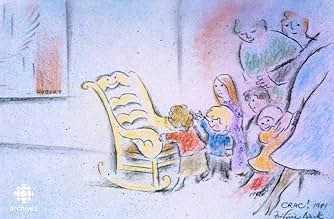
The story is about a craftsman who makes a rocking chair for his love, and after they get married keeps the rocking chair at home while the couple becomes a family with the arrival of children (and plenty of them). The chair is a mute witness to their lives, as it changes from growing green to ripening red and finally fading yellow.
If you look at the Storyline section in IMDb, it says Crac is about the industrialization of Montreal as seen from the view of a rocking chair. This description seems too literal and banal and would discourage youngsters from watching the short. To me, Crac is the celebration of human life in the wonderful, advancing world symbolized in the form of a swaying rocking chair. More than the event, it is the human experience that counts; if we disregard the human aspect that concomitantly progresses in order to adapt to changing circumstances, than we remain narrow-minded. Frederick Back, like the literary stalwart Leo Tolstoy, has enmeshed history and humanity with more poignancy but using hand drawn Impressionistic strokes instead of words, than most modern Pixar films can do with spectacular life-like animation.
Frederic Back's mind works like Walt Disney's as both visualize the world in a profoundly imaginative way. Watch a Walt Disney short and you may find a living train panting and tugging the rail tracks to reach the destination. Similarly, in Crac, the crib inside which a child is play acting turns into the car he imagines. Also, minimalistic paintings come alive and dance surreally in the art gallery. Only a childlike mind could show the images so beautifully without making the action seem corny or saccharine. There are delightful and ingenious moments in Crac, for example, the dance sequence during the marriage where at first, only the craftsman and his wife begin after which a third character magically appears from behind and then the entire space is filled with happy couples. Also wonderful is the dreamy sequence of sheep in the sky when the mother is putting her kids to sleep. And the spectacular moment at the art gallery after the curator leaves. Or even the tiny bit in the beginning where the craftsman proposes to the lady and she blushes, and her upper body looks like a heart. But the most striking part is Back's observation of children. In the art gallery, while the adults in their expensive clothes try to make sense out of abstract works, the children are lured by this simple rocking chair, and a ride on it puts a big smile on their faces. Also commendable is the use of music and sounds, which mainly consist of folk music, the echoing sound of a child's laughter, the switch, the bursting bubble gum etc.
I'm borrowing Robert Christgau's words to describe Crac in a nutshell: 'Frederic Back's Crac evinces a remarkable resemblance to care- that is to care, that is to caring in the best, broadest, most emotional sense.' Tell whoever you know to watch it.
My Rating: 5 out of 5
The story is about a craftsman who makes a rocking chair for his love, and after they get married keeps the rocking chair at home while the couple becomes a family with the arrival of children (and plenty of them). The chair is a mute witness to their lives, as it changes from growing green to ripening red and finally fading yellow.
If you look at the Storyline section in IMDb, it says Crac is about the industrialization of Montreal as seen from the view of a rocking chair. This description seems too literal and banal and would discourage youngsters from watching the short. To me, Crac is the celebration of human life in the wonderful, advancing world symbolized in the form of a swaying rocking chair. More than the event, it is the human experience that counts; if we disregard the human aspect that concomitantly progresses in order to adapt to changing circumstances, than we remain narrow-minded. Frederick Back, like the literary stalwart Leo Tolstoy, has enmeshed history and humanity with more poignancy but using hand drawn Impressionistic strokes instead of words, than most modern Pixar films can do with spectacular life-like animation.
Frederic Back's mind works like Walt Disney's as both visualize the world in a profoundly imaginative way. Watch a Walt Disney short and you may find a living train panting and tugging the rail tracks to reach the destination. Similarly, in Crac, the crib inside which a child is play acting turns into the car he imagines. Also, minimalistic paintings come alive and dance surreally in the art gallery. Only a childlike mind could show the images so beautifully without making the action seem corny or saccharine. There are delightful and ingenious moments in Crac, for example, the dance sequence during the marriage where at first, only the craftsman and his wife begin after which a third character magically appears from behind and then the entire space is filled with happy couples. Also wonderful is the dreamy sequence of sheep in the sky when the mother is putting her kids to sleep. And the spectacular moment at the art gallery after the curator leaves. Or even the tiny bit in the beginning where the craftsman proposes to the lady and she blushes, and her upper body looks like a heart. But the most striking part is Back's observation of children. In the art gallery, while the adults in their expensive clothes try to make sense out of abstract works, the children are lured by this simple rocking chair, and a ride on it puts a big smile on their faces. Also commendable is the use of music and sounds, which mainly consist of folk music, the echoing sound of a child's laughter, the switch, the bursting bubble gum etc.
I'm borrowing Robert Christgau's words to describe Crac in a nutshell: 'Frederic Back's Crac evinces a remarkable resemblance to care- that is to care, that is to caring in the best, broadest, most emotional sense.' Tell whoever you know to watch it.
My Rating: 5 out of 5
10llltdesq
One of the most exceptional animated shorts I've ever seen in my life!
This short, one of the most deserving winners of the Academy Award in its category that I've had the pleasure of seeing, is simply magnificent, Excellent idea, wonderful animation and music, marvelous pacing and transitions, just glorious on all counts! The ending is perfect! Frederic Back made at least three other shorts besides this one and I truly wish I could find any or all of them in-print on VHS. So far as I know, they've never been available in the United States. *SIGH* Well, Crac is in print, at least. Most completely and joyously recommended.
Canada from the eyes of a chair
The Best Animated Short Film winner for 1981 looks at the development of Canada. Frédéric Back's "Crac" presents a contrast between the old ways and modernity, while also incorporating an art museum. The use of a chair for the protagonist is a good angle; after all, many chairs are made of wood, meaning that a tree had to get cut down.
This is one of the few productions that I've seen that comes from Québec. Having seen this one and "The Barbarian Invasions", I hope to see more productions that come from Canada's francophone province (not to mention that I'd love to go there). I certainly would like to see more of Back's work.
Really good cartoon.
This is one of the few productions that I've seen that comes from Québec. Having seen this one and "The Barbarian Invasions", I hope to see more productions that come from Canada's francophone province (not to mention that I'd love to go there). I certainly would like to see more of Back's work.
Really good cartoon.
Does this Count as a Christmas Special?
"Crac" is beautifully animated short following the life and creation of a rocking chair. It is a testament to the power of visual story telling. The short is an excellent pairing of charming colored pencils sketches and wonderful thematically appropriate music. The story reminds me of Shel Silverstein's "The Giving Tree". The impact this tree and this chair had on the life of this man his family and future generations. This could also be seen as a precursor of Pixar projects. The idea of giving emotion to the inanimate object can lead to some sweet and thoughtful moments. Overall, this is a very charming and likable short, and I will try to keep my thoughts on it likewise.
You Will Never Look At a Rocking Chair the Same Way Again!
In the days of high-tech screen wizardry, this delightful French-Canadian film is a joy of gentle, simple animation. It depicts a slice of the history of Quebec, or Acadia or just about anywhere in frontier North America, in a touching and somewhat sentimental fashion, through the tale of the life and times of a lowly, hand-crafted rocking chair. Only small details, such as the rich background of traditional Quebecois folk music and the attire of certain figures, shows this story to be that of French Canada; the story is otherwise seemingly universal, expressed with no dialog. The animation is a rich palette of pastels and illustration seemingly from the children's literature genre, which works marvelously for the story at hand. It's not a perfect film--a brief flit with contemporary political commentary disrupts the story flow momentarily--but I have seen people moved to tears by the film's darker moments and then tears of joy at the conclusion.


Did you know
- TriviaThe only word in this film that is clearly visible and not distorted is its title, when the tree falls in the beginning.
- ConnectionsFeatured in Animated Century (2003)
Details
Contribute to this page
Suggest an edit or add missing content