IMDb RATING
6.8/10
1.8K
YOUR RATING


An imaginative and somewhat disturbed young girl fantasizes about evil creatures and other oddities to mask her insecurities while growing up in rural Australia.An imaginative and somewhat disturbed young girl fantasizes about evil creatures and other oddities to mask her insecurities while growing up in rural Australia.An imaginative and somewhat disturbed young girl fantasizes about evil creatures and other oddities to mask her insecurities while growing up in rural Australia.
- Awards
- 2 wins & 2 nominations total



- Director
- Writer
- All cast & crew
- Production, box office & more at IMDbPro
6.81.8K
1
2
3
4
5
6
7
8
9
10
Featured reviews
Unique, superb and rare period film
As a film lover who immigrated to Australia, I've invested a fair bit of effort in seeking out Aussie films that aren't well known abroad, from the popular like 'The Castle' and 'Storm Boy' to Ozploitation like 'Razorback' and 'Next of Kin' to cult classics like 'Wake in Fright' and 'Bad Boy Bubby'. Yet after many years here, I'd never heard of 'Celia' until I saw it pop up on the Arrow site. What a glorious gem to uncover!
It's almost best to go into this film knowing nothing, because it's an extremely difficult one to classify. While there are horror elements, it's most definitely not a horror film. It's probably best described as a period coming of age drama with fantasy elements. But it's not a kids' film-it's very dark.
It's also very hard to pin a date on this film, as it looks like it could have been shot in the '70s or last year, a testament to the quality of the director and crew. The photography, the art direction, the writing and acting are all top shelf. Serious craft here.
I won't give away the story, other than the top-line: It's about a girl named Celia with an active imagination growing up in fifties Cold War Australia and the politics of the time play into the general anxiety of the film.
All you really need to know is, it's a well-crafted film and completely entrancing. It's playful and joyful and sad and dark. The more films I watch, the more I appreciate films that are unlike any other film out there. This is one of them.
It's almost best to go into this film knowing nothing, because it's an extremely difficult one to classify. While there are horror elements, it's most definitely not a horror film. It's probably best described as a period coming of age drama with fantasy elements. But it's not a kids' film-it's very dark.
It's also very hard to pin a date on this film, as it looks like it could have been shot in the '70s or last year, a testament to the quality of the director and crew. The photography, the art direction, the writing and acting are all top shelf. Serious craft here.
I won't give away the story, other than the top-line: It's about a girl named Celia with an active imagination growing up in fifties Cold War Australia and the politics of the time play into the general anxiety of the film.
All you really need to know is, it's a well-crafted film and completely entrancing. It's playful and joyful and sad and dark. The more films I watch, the more I appreciate films that are unlike any other film out there. This is one of them.
Rabbit Season
Celia is a spirited 9 year old girl with a vivid imagination.
Reeling from the death of her beloved grandmother, she seeks out the company of her new neighbours, The Tanners - a warm and loving family harbouring a secret.
Set in an Australian suburb in the late 1950's, the film tackles the prevailing social issues of the time including the "red scare" and the "rabbit pestilence", drawing a parallel between the two.
The film is essentially a drama, but with an added element of dark fantasy (which, although an interesting idea, is used inconsistently and often feels out of place).
But as a coming of age story, Celia is a triumph - an honest and unvarnished exploration of the trials and tribulations of childhood, featuring an astonishing performance by Rebecca Smart in the titular role.
Reeling from the death of her beloved grandmother, she seeks out the company of her new neighbours, The Tanners - a warm and loving family harbouring a secret.
Set in an Australian suburb in the late 1950's, the film tackles the prevailing social issues of the time including the "red scare" and the "rabbit pestilence", drawing a parallel between the two.
The film is essentially a drama, but with an added element of dark fantasy (which, although an interesting idea, is used inconsistently and often feels out of place).
But as a coming of age story, Celia is a triumph - an honest and unvarnished exploration of the trials and tribulations of childhood, featuring an astonishing performance by Rebecca Smart in the titular role.
Adults have no clue to a child's world - do we?
As far as I can see, "Celia" is a complex movie about childhood that lacks something. It fails to make the viewer understand the way the heroine feels and thinks. The heroine is Celia, a young girl who grows up in Australia in the 1950s.
I must mention that I was way disappointed by the contents of the movie. If only because the plot summaries I read about it in diverse magazines turned out pretty wrong. They were like: "9-year-old Celia has no playmates except for her rabbit. When a policeman takes away the rabbit from her, she vows revenge." Alright, but that's not the gist of it. Celia is not an isolated or lonely little girl, first of all, she's rather horrifyingly lively. She does have playmates, three neighbour kids whose parents are communists. Celia actually spends more time with these kids and with their mother than she does with her own parents. Moreover, many scenes deal only with these children's play. Most of the time they play in some desert landscape, which seems kind of grotesque, where there is caves and rocks and sand - but hardly any people or animals. Grotesque - that's what the movie appears to be like. We have these two parties of kids: The children of the communists and the "communist haters" and they fight a rather serious battle. And we have that crazy idea of the government that rabbits were pests. I don't object to "grotesque" stories, but a certain deal of irony is required to make them enjoyable - this movie lacks irony.
Still we get a good impression of how complex the worlds children make up of their fantasy really are. We also learn how adults don't have any idea about the thoughts children have, about the crazy wars they deliver, about the friendship or the hate they feel. As this movie is seen through the eyes of a child, of course the adult's "play", i.e. the hate towards communists, is not dealt with very openly.
That wouldn't matter, if we were really offered the opportunity to identify with the child. But here the movie lacks care and empathy, we don't get close enough to little Celia - played by Rebecca Smart. This young actress doesn't do a bad job, that's for sure, but she isn't outstanding either. She's working about on the same level as the whole movie is.
I'll vote "6" for "slightly above mediocre", v e r y slightly, honestly.
I must mention that I was way disappointed by the contents of the movie. If only because the plot summaries I read about it in diverse magazines turned out pretty wrong. They were like: "9-year-old Celia has no playmates except for her rabbit. When a policeman takes away the rabbit from her, she vows revenge." Alright, but that's not the gist of it. Celia is not an isolated or lonely little girl, first of all, she's rather horrifyingly lively. She does have playmates, three neighbour kids whose parents are communists. Celia actually spends more time with these kids and with their mother than she does with her own parents. Moreover, many scenes deal only with these children's play. Most of the time they play in some desert landscape, which seems kind of grotesque, where there is caves and rocks and sand - but hardly any people or animals. Grotesque - that's what the movie appears to be like. We have these two parties of kids: The children of the communists and the "communist haters" and they fight a rather serious battle. And we have that crazy idea of the government that rabbits were pests. I don't object to "grotesque" stories, but a certain deal of irony is required to make them enjoyable - this movie lacks irony.
Still we get a good impression of how complex the worlds children make up of their fantasy really are. We also learn how adults don't have any idea about the thoughts children have, about the crazy wars they deliver, about the friendship or the hate they feel. As this movie is seen through the eyes of a child, of course the adult's "play", i.e. the hate towards communists, is not dealt with very openly.
That wouldn't matter, if we were really offered the opportunity to identify with the child. But here the movie lacks care and empathy, we don't get close enough to little Celia - played by Rebecca Smart. This young actress doesn't do a bad job, that's for sure, but she isn't outstanding either. She's working about on the same level as the whole movie is.
I'll vote "6" for "slightly above mediocre", v e r y slightly, honestly.
the rabbit-proof fence didn't work
In summer, 2003, I took a class about Australian cinema. We watched films like "Walkabout", "Gallipoli" and "Rabbit-Proof Fence"; it might have thrown a wrench in the works had we watched "Celia". At the video/DVD store, I found it under the horror section, but it's only a horror flick in the loosest terms. The movie deals with a nine-year-old girl (Rebecca Smart) in 1950s Australia whose amorality and alienation from society drive her to complete madness; I think that that was the plot. Certainly it's ugly what Celia does, but seeing what the adults around her are like, I felt that I had no choice except to root for Celia.
The historical context involves the Cold War and the government's efforts to stop the rabbit infestation. As people tell Celia not to fraternize with children of communists, she grows more and more disenchanted with the world around her - after all, friends are supposed to be friends no matter what the parents' political activity. But when a cop takes away her pet rabbit, she really gets nasty (it also shows that the rabbit-proof fence that lent its name to the 2002 movie clearly didn't work in holding back the leporid plague).
So how to interpret this movie? It looks at face value like one of the many instances of a seemingly cute girl having a not so cute side (think "The Bad Seed"). One might say that the rabbits play a role similar to the ones in "Night of the Lepus" and "Donnie Darko", even though Celia's rabbit doesn't do anything. I guess that it's worth seeing, if only once.
The historical context involves the Cold War and the government's efforts to stop the rabbit infestation. As people tell Celia not to fraternize with children of communists, she grows more and more disenchanted with the world around her - after all, friends are supposed to be friends no matter what the parents' political activity. But when a cop takes away her pet rabbit, she really gets nasty (it also shows that the rabbit-proof fence that lent its name to the 2002 movie clearly didn't work in holding back the leporid plague).
So how to interpret this movie? It looks at face value like one of the many instances of a seemingly cute girl having a not so cute side (think "The Bad Seed"). One might say that the rabbits play a role similar to the ones in "Night of the Lepus" and "Donnie Darko", even though Celia's rabbit doesn't do anything. I guess that it's worth seeing, if only once.
An atmospheric, effective dark childhood fantasy
"Celia" follows the title character, a young girl growing up on the outskirts of 1950s Melbourne during the "Red Scare." After her beloved grandmother's death, Celia, prone to fantasies and possessing an extreme imagination, begins to imagine the tumultuous world around her as plagued by fairytale monsters, inadvertently leading her toward tragic events.
This little-seen fantasy horror film from Australia was largely missed by audiences when first released, though it is due for some reevaluation. Writer-director Ann Turner offers here a vivid portrait of childhood loneliness that illustrates the ways in which serious matters of the "adult" world (here, Turner focuses largely on political turmoil) impact the psyche of impressionable youth.
The lead character is brilliantly portrayed by the young Rebecca Smart, and the film is underpinned by strong performances from the entire cast. In some ways, it recalls the dreamy nightmare world of something like "Lemora" or "Valerie and Her Week of Wonders," and in others, functions as a precursor to Peter Jackson's "Heavenly Creatures"--though in this case, it is an even younger child whose loose grip on reality hurls her toward oblivion. Despite the serious implications and consequences at hand, the film still manages to retain some lightness to it that makes it highly watchable, and, though often been classified as a horror film, it really plays more like a dark fantasy with tinges of the macabre.
The one downfall is that the film's conclusion does feel slightly irresolute given the established gravity of the situation, but "Celia" remains a stolid, effective portrait of a child whose alienation from the world around her is drawn in a way that adults can empathize with. After all, we were all children once, right? 9/10.
This little-seen fantasy horror film from Australia was largely missed by audiences when first released, though it is due for some reevaluation. Writer-director Ann Turner offers here a vivid portrait of childhood loneliness that illustrates the ways in which serious matters of the "adult" world (here, Turner focuses largely on political turmoil) impact the psyche of impressionable youth.
The lead character is brilliantly portrayed by the young Rebecca Smart, and the film is underpinned by strong performances from the entire cast. In some ways, it recalls the dreamy nightmare world of something like "Lemora" or "Valerie and Her Week of Wonders," and in others, functions as a precursor to Peter Jackson's "Heavenly Creatures"--though in this case, it is an even younger child whose loose grip on reality hurls her toward oblivion. Despite the serious implications and consequences at hand, the film still manages to retain some lightness to it that makes it highly watchable, and, though often been classified as a horror film, it really plays more like a dark fantasy with tinges of the macabre.
The one downfall is that the film's conclusion does feel slightly irresolute given the established gravity of the situation, but "Celia" remains a stolid, effective portrait of a child whose alienation from the world around her is drawn in a way that adults can empathize with. After all, we were all children once, right? 9/10.


Did you know
- TriviaThe fairy tale from which extracts were recited in the film was The Hobyahs by James H. Fassett and Robert D. San Souci.
- GoofsThe burn mark on Celia's rabbit is missing at the fishing docks.
- How long is Celia?Powered by Alexa
Details
- Release date
- Country of origin
- Official sites
- Language
- Also known as
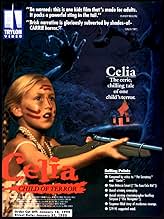
- Celia: Child of Terror
- Filming locations
- Production company
- See more company credits at IMDbPro
- Runtime
- 1h 43m(103 min)
- Sound mix
- Aspect ratio
- 1.85 : 1
Contribute to this page
Suggest an edit or add missing content