Dekalog, osiem
- Episode aired Jun 22, 1990
- TV-MA
- 56m
IMDb RATING
7.5/10
3.9K
YOUR RATING

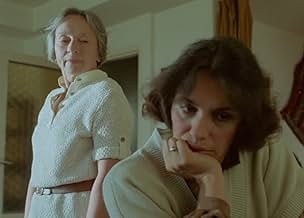
A researcher meets a professor and reveals herself as the child to whom she refused shelter during World War II.A researcher meets a professor and reveals herself as the child to whom she refused shelter during World War II.A researcher meets a professor and reveals herself as the child to whom she refused shelter during World War II.
- Director
- Writers
- Stars




Jerzy Schejbal
- Ksiadz
- (credit only)

Marek Kasprzyk
- Student
- (uncredited)
- Director
- Writers
- All cast & crew
- Production, box office & more at IMDbPro
7.53.9K
1
2
3
4
5
6
7
8
9
10
Featured reviews
False
Everyone, and I mean everyone who is alive, should spend some time with Kieslowski. And to do it right, you need to spend time with these ten experiments.
Yes, they are experiments and they are important to the history of cinematic imagination.
They are all cowritten. The writing partner sets a knot, a dramatic tangle. Kieslowski then enters this scribble and adds cinematic reality in two ways. The first is simply the cinematic platform of storytelling. The second are a set of cinematic elaborations. Its this second bit that makes him so exciting.
They're what I call cinematic folds, but because this is the short form (the movie equivalent of short stories) they only have to be suggested. Taken together, the collection of ten short films is a few hundred loose fishooks, many of which catch you unawares.
In his "colors" work he folds these back in his long form experiments.
To make this a real experience for us and him, he does most of his work after the project begins filming. And to up the ante, for each of these ten he uses a different creative crew. So you would expect some of these ten to be more adventurous and successful than others.
This is the case. This is the least successful of them so far.
The value, at least to me, in these is how much Kieslowski there is compared to Piesiewicz. The more of Kieslowski's visual improvisation, the better. This has very little. Blunt viewers will still enjoy the story, which is interesting as such things go. But there's little of the master here. Must have been a time of rest.
Ted's Evaluation -- 2 of 3: Has some interesting elements.
Yes, they are experiments and they are important to the history of cinematic imagination.
They are all cowritten. The writing partner sets a knot, a dramatic tangle. Kieslowski then enters this scribble and adds cinematic reality in two ways. The first is simply the cinematic platform of storytelling. The second are a set of cinematic elaborations. Its this second bit that makes him so exciting.
They're what I call cinematic folds, but because this is the short form (the movie equivalent of short stories) they only have to be suggested. Taken together, the collection of ten short films is a few hundred loose fishooks, many of which catch you unawares.
In his "colors" work he folds these back in his long form experiments.
To make this a real experience for us and him, he does most of his work after the project begins filming. And to up the ante, for each of these ten he uses a different creative crew. So you would expect some of these ten to be more adventurous and successful than others.
This is the case. This is the least successful of them so far.
The value, at least to me, in these is how much Kieslowski there is compared to Piesiewicz. The more of Kieslowski's visual improvisation, the better. This has very little. Blunt viewers will still enjoy the story, which is interesting as such things go. But there's little of the master here. Must have been a time of rest.
Ted's Evaluation -- 2 of 3: Has some interesting elements.
What a shame ! ! ! Mysterious are the vagaries of human mind.
Dekalog 8: "Thou Shalt Not Bear False Witness" is a short film which will surely move any human being with heart to tears.By making this film,one of the greatest masters of Polish cinema Kieslowski has given birth to a highly mature work of art which needs to be seen at regular intervals to fathom the true meaning of human existence found in human heart.One can learn that there is no yardstick by which greatness or wickedness of an individual,a society,a nation or a religion can be measured.Everybody has reasons to accept or decline a good action."Dekalog,Osiem" suggests that individual sense prevails sometimes over a good act.Rules have to be broken on some occasions to save precious,human lives.It is a human instinct that old memories cannot be separated from human soul.This is the reason why old memories induce people to visit places where they could have died,see a house where they were hidden,meet a person who saved a life.This short film is remarkable for its depiction of young Polish university students.It is a good sign that young generation have been shown as interested in tackling ethical and moral questions.It is hard to say whether Kieslowski had ideas about the liberation of communist Poland in his mind when he was making this film.
Movie Itself Bears False Witness
American Jewish Holocaust survivor returns to Poland to confront the woman who refused to save her from the Nazi's by refusing to falsify her Baptism papers when she was 6 (same age as the little girl of VII). This issue of the long-buried, unresolved/unresolvable hatred of the victim and guilt of the tormentor was much more effectively dramatized by the movie Death and the Maiden. As in VII, so much of the conflict takes place in the past, that the film ends up overly talky, too chatty. As usual, color coding intrudes.
Two major problems make the movie specious, morally duplicitous. One, the survivor's physical features, her thick lips, big nose, dark eyes, and coarse black hair, conform exactly to the derisive stereotype of the Jew used in myriad anti-Semitic cartoons dating from the 19th century through the 3rd Reich. It's like casting an African-American who looks just like a cartoon Sambo. Her homeliness stands in marked contrast to the attractiveness of each and every other female in the series. One can only wonder to what degree this was unintentional, unconscious, reflecting an accepted assumed bigotry.
Second, just like the contortionist in the park (was he meant to mock the film?), K. bends over backward to exonerate the Pole from guilt. The plot twist of her having received word in advance that the SS was sending out children in need of Baptism papers as decoys is just too convenient (again, that problem of credibility). Her belonging to the Polish underground is even harder to swallow, even more unlikely. What Polish underground? That must have been a really exclusive minority. There was no organized effort by any Polish underground to save Jews; whatever Jews happened to be rescued were done so by individuals acting on their own. To claim otherwise, as K. does, is to lie. Widespread deep-seated Polish anti-Semitism both predated and survived the Nazi invasion; Poles killed Jews even after the Nazi's retreated. To this day they make life insufferable for the scarce Jews who remain in their country. (I have this directly from a Jewish colleague who grew up in and fled modern Communist Poland.)
The bonding between victim and tormenter seems a hollow contrivance to evade responsibility. This is the only episode with a pat ending. In fact, it casts all those that preceded in a dubious light. It itself bears false witness.
Two major problems make the movie specious, morally duplicitous. One, the survivor's physical features, her thick lips, big nose, dark eyes, and coarse black hair, conform exactly to the derisive stereotype of the Jew used in myriad anti-Semitic cartoons dating from the 19th century through the 3rd Reich. It's like casting an African-American who looks just like a cartoon Sambo. Her homeliness stands in marked contrast to the attractiveness of each and every other female in the series. One can only wonder to what degree this was unintentional, unconscious, reflecting an accepted assumed bigotry.
Second, just like the contortionist in the park (was he meant to mock the film?), K. bends over backward to exonerate the Pole from guilt. The plot twist of her having received word in advance that the SS was sending out children in need of Baptism papers as decoys is just too convenient (again, that problem of credibility). Her belonging to the Polish underground is even harder to swallow, even more unlikely. What Polish underground? That must have been a really exclusive minority. There was no organized effort by any Polish underground to save Jews; whatever Jews happened to be rescued were done so by individuals acting on their own. To claim otherwise, as K. does, is to lie. Widespread deep-seated Polish anti-Semitism both predated and survived the Nazi invasion; Poles killed Jews even after the Nazi's retreated. To this day they make life insufferable for the scarce Jews who remain in their country. (I have this directly from a Jewish colleague who grew up in and fled modern Communist Poland.)
The bonding between victim and tormenter seems a hollow contrivance to evade responsibility. This is the only episode with a pat ending. In fact, it casts all those that preceded in a dubious light. It itself bears false witness.
'Dekalog': Part 8- The difficulties of truth amid evil and the sanctity of truth
'Dekalog' is a towering achievement and a televisual masterpiece that puts many feature films to shame, also pulling off a concept of great ambition brilliantly. Although a big admirer of Krzysztof Kieślowski (a gifted director taken from us too early), and who has yet to be disappointed by him, to me 'Dekalog' and 'Three Colours: Red' sees him at his best.
All of 'Dekalog's' episodes have so many great things, and it is an example of none of the lesser episodes being bad. This is testament to the high quality of 'Dekalog' as an overall whole and how brilliant the best episodes are.
Episode 8 may be one of the weaker 'Dekalog' episodes, but it is still very good. With it being the simplest of all ten stories, it is not quite as thematically rich or as emotionally impactful as some of the others, and the other commandments explored with a little more naturalness.
Every single one of 'Dekalog's' episodes are exceptionally well made. The production values in Episode 8 are as ever atmosphere-enhancing, beautiful and haunting to look at and fascinating, definitely cannot be faulted on the technical front. The direction is quietly unobtrusive, intelligently paced and never too heavy, and the music is suitably intricate.
The characters are still interesting and their interactions and relationships with each other resonate. Even though most of the other episodes are richer thematically, Episode 8's themes are still explored intelligently and without any preachiness and there are some very atmospheric and moving moments (just not quite as much as the previous episodes). The acting is superb as to be expected, with complexity and nuances by the bucket-load.
To conclude, may be one of the weaker 'Dekalog' episodes but it is still very good. 8/10 Bethany Cox
All of 'Dekalog's' episodes have so many great things, and it is an example of none of the lesser episodes being bad. This is testament to the high quality of 'Dekalog' as an overall whole and how brilliant the best episodes are.
Episode 8 may be one of the weaker 'Dekalog' episodes, but it is still very good. With it being the simplest of all ten stories, it is not quite as thematically rich or as emotionally impactful as some of the others, and the other commandments explored with a little more naturalness.
Every single one of 'Dekalog's' episodes are exceptionally well made. The production values in Episode 8 are as ever atmosphere-enhancing, beautiful and haunting to look at and fascinating, definitely cannot be faulted on the technical front. The direction is quietly unobtrusive, intelligently paced and never too heavy, and the music is suitably intricate.
The characters are still interesting and their interactions and relationships with each other resonate. Even though most of the other episodes are richer thematically, Episode 8's themes are still explored intelligently and without any preachiness and there are some very atmospheric and moving moments (just not quite as much as the previous episodes). The acting is superb as to be expected, with complexity and nuances by the bucket-load.
To conclude, may be one of the weaker 'Dekalog' episodes but it is still very good. 8/10 Bethany Cox
10sfuss
Simple and Terrific
With a minimum of histrionics, this film tells a simple story about the legacy of the holocaust in Poland.
A college professor who once turned away a little Jewish girl who sought refuge is confronted by that same girl -- now in her forties -- and must explain to her the real reason for turning her away. While the two women are able to forge a deep friendship, the man (a tailor) who risked his life to try and save the girl has become, with time, too closed off to allow her to form any sort of bond with him. The film's last image, of the lonely tailor looking out the window of his shop to see the professor and her friend laughing together, has the same straight forward and unassuming emotional wallop that ends many of Kieslowski's films.
This may be the best fictional film ever made about the holocaust.
A college professor who once turned away a little Jewish girl who sought refuge is confronted by that same girl -- now in her forties -- and must explain to her the real reason for turning her away. While the two women are able to forge a deep friendship, the man (a tailor) who risked his life to try and save the girl has become, with time, too closed off to allow her to form any sort of bond with him. The film's last image, of the lonely tailor looking out the window of his shop to see the professor and her friend laughing together, has the same straight forward and unassuming emotional wallop that ends many of Kieslowski's films.
This may be the best fictional film ever made about the holocaust.

Did you know
- TriviaAll entries contain spoilers
Details
Contribute to this page
Suggest an edit or add missing content