IMDb RATING
7.4/10
14K
YOUR RATING

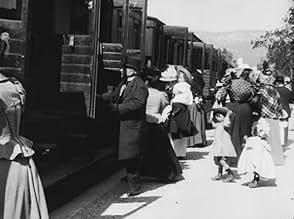
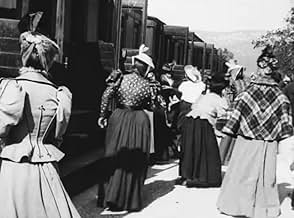
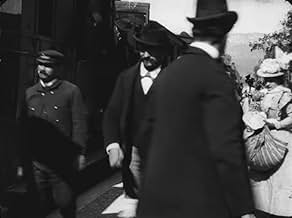
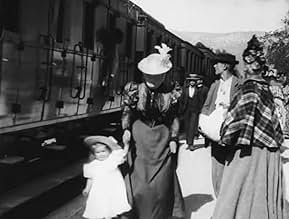
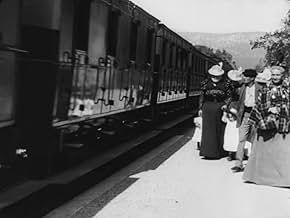
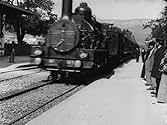
A train arrives at La Ciotat station.A train arrives at La Ciotat station.A train arrives at La Ciotat station.



7.413.8K
1
2
3
4
5
6
7
8
9
10
Featured reviews
First iconic image of cinema
On December 28, 1895, at Paris's Salon Indien Du Grand Café, the brothers Auguste and Louis Lumière transformed the industry of entertainment when they did a demonstration of their new invention. The brothers projected a series of images on a screen, but those images were nothing like a normal slide-show, those images were moving as if they were alive. While the idea of motion pictures wasn't new to the audience (Edison's Kinetoscope was a popular entertainment), the devise's ability to project them on a screen was something they had never seen before. 10 short films of barely a minute of duration each were shown that day, and the invention proved to be an enormous success for the brothers, so immediately they decide to keep making movies in order to improve their catalog. One of those new movies would become the first iconic image of the new art.
"L' Arrivée d'un train à La Ciotat" (literally, "Arrival of a Train at La Ciotat") is without a doubt, one of the most famous films in history, as its image of a train arriving to the station, passing very close to the camera as it slows its speed, quickly became an iconic scene of the new invention. While initially conceived as just another one of the brothers' many "actuality films", it's clear that director Louis Lumière knew exactly where to put his camera in order to get the best image of the event as the film shows he had a good idea of the use of perspective (many consider it a study about long shot, medium shot and close-up). As a side-note, this is the film that originated the classic urban legend about people running away scared from the arriving train, thinking it was a real locomotive what was appearing on the screen.
While this famous tale has been debunked by historians as a fake story, it's existence is another testament of this movie's importance and continuous influence on the younger generations. Among the many different art-forms that we can find today, cinema is perhaps the one that better reflects the modern society that arose after the industrial revolution of the 19th Century; because, as painting and sculpture did before, it has become a keeper of the most representative icons of our history. "L' Arrivée d'un train à La Ciotat" was not the first movie the brothers screened, and it definitely wasn't the first movie ever made, but despite those details, the image of the arriving train represents the first icon of cinema, and literally, the arrival of a new art form. 9/10
"L' Arrivée d'un train à La Ciotat" (literally, "Arrival of a Train at La Ciotat") is without a doubt, one of the most famous films in history, as its image of a train arriving to the station, passing very close to the camera as it slows its speed, quickly became an iconic scene of the new invention. While initially conceived as just another one of the brothers' many "actuality films", it's clear that director Louis Lumière knew exactly where to put his camera in order to get the best image of the event as the film shows he had a good idea of the use of perspective (many consider it a study about long shot, medium shot and close-up). As a side-note, this is the film that originated the classic urban legend about people running away scared from the arriving train, thinking it was a real locomotive what was appearing on the screen.
While this famous tale has been debunked by historians as a fake story, it's existence is another testament of this movie's importance and continuous influence on the younger generations. Among the many different art-forms that we can find today, cinema is perhaps the one that better reflects the modern society that arose after the industrial revolution of the 19th Century; because, as painting and sculpture did before, it has become a keeper of the most representative icons of our history. "L' Arrivée d'un train à La Ciotat" was not the first movie the brothers screened, and it definitely wasn't the first movie ever made, but despite those details, the image of the arriving train represents the first icon of cinema, and literally, the arrival of a new art form. 9/10
The beginning of a great adventure
A train arrives at a station. And changes everything.
There isn't a lot to really say about L'arrivée d'un train a La Ciotat as a film itself. It's under a minute and shows a train pull up at a busy station. But what it signifies is another thing altogether. When we see that train come closer and closer until it stops in the station, on a surface level we watch a train arrive but it actuality what we are really witnessing is cinema arrive. This short film may not be the earliest movie but it is the first iconic image of the moving picture age.
Auguste and Louis Lumière weren't really artists. Their early films don't stand up to the highly imaginative work of George Méliès for example. But they still remain enormously important cinema giants. Not for the content of their films but for the fact that they kicked things off in the first place and produced the first iconic moment in cinema history. And for this reason L'arrivée d'un train a La Ciotat will always be remembered. Everyone who has a love of cinema should really take a minute of their time to pay homage to the first moment in an amazing journey.
There isn't a lot to really say about L'arrivée d'un train a La Ciotat as a film itself. It's under a minute and shows a train pull up at a busy station. But what it signifies is another thing altogether. When we see that train come closer and closer until it stops in the station, on a surface level we watch a train arrive but it actuality what we are really witnessing is cinema arrive. This short film may not be the earliest movie but it is the first iconic image of the moving picture age.
Auguste and Louis Lumière weren't really artists. Their early films don't stand up to the highly imaginative work of George Méliès for example. But they still remain enormously important cinema giants. Not for the content of their films but for the fact that they kicked things off in the first place and produced the first iconic moment in cinema history. And for this reason L'arrivée d'un train a La Ciotat will always be remembered. Everyone who has a love of cinema should really take a minute of their time to pay homage to the first moment in an amazing journey.
Not the Last Stop, but the First
At just under a minute, L'Arrivée d'un train à La Ciotat (1895) is one of Louis Lumiere's earliest excursions into film-making. As was formulaic with what he called "actualités," or non-narrative shorts, Louis Lumiere set up his cinematographe (a portable crank-handled camera that triples as a film projector and developer) at such an accomplished angle as to catch the arrival of a train at La Ciotat, where it captures the bustling comers-and-goers of the station who happen to stray in front of the lens, looking altogether curious, or else wary of the unfamiliar contraption. The crowd seems lively enough, but just for good measure, Lumiere's refined wife and mother-in-law can be seen actively searching for an imaginary, but eagerly expected passenger.
As uninteresting as it is (and it IS, even for the most pretentious film buff), L'Arrivée d'un train à La Ciotat's historical appeal is undeniable, if not legendary. The film's effect upon its first public viewing is a well-worn myth told to enthusiastic film students by their professors. Apparently, initial audiences, unaware of film's capacity to fully imitate reality, fled in fear of the image of a train barreling down upon the screen. The French newspaper, Le courrier du centre, (July 14, 1896) alleged the advancing locomotive made "spectators draw back instinctively fearing they'd be run over by the steel monster." Nevertheless, such a widespread and instantaneous physical response seems foolish or naïve even then, especially when the projector would have been visible and the sound audible to all seated in what at that time passed as a "theater." In reality, it is far more likely that this incident was limited to a few isolated cases, and was later exaggerated to enhance its appeal and boost the film's reputation. Consequently, the commerciality of the venture succeeded with tremendous results. Over a hundred years later, not only is L'Arrivée d'un train à La Ciotat a cinematic icon, but proof of how powerful and impressionable moving pictures could (and would) become.
Recommended for those with an interest in film as an art form, or for those looking for early examples of film in history.
As uninteresting as it is (and it IS, even for the most pretentious film buff), L'Arrivée d'un train à La Ciotat's historical appeal is undeniable, if not legendary. The film's effect upon its first public viewing is a well-worn myth told to enthusiastic film students by their professors. Apparently, initial audiences, unaware of film's capacity to fully imitate reality, fled in fear of the image of a train barreling down upon the screen. The French newspaper, Le courrier du centre, (July 14, 1896) alleged the advancing locomotive made "spectators draw back instinctively fearing they'd be run over by the steel monster." Nevertheless, such a widespread and instantaneous physical response seems foolish or naïve even then, especially when the projector would have been visible and the sound audible to all seated in what at that time passed as a "theater." In reality, it is far more likely that this incident was limited to a few isolated cases, and was later exaggerated to enhance its appeal and boost the film's reputation. Consequently, the commerciality of the venture succeeded with tremendous results. Over a hundred years later, not only is L'Arrivée d'un train à La Ciotat a cinematic icon, but proof of how powerful and impressionable moving pictures could (and would) become.
Recommended for those with an interest in film as an art form, or for those looking for early examples of film in history.
Genesis
I have little to add to other reviewers, except to say that this film took a sudden importance in my life last year. In 2002 I was travelling by train to my first ever Cannes Film Festival. At one point the train was moving slowly and I looked out of the window and found that we were pulling through La Ciotat, and the platform hadn't changed a bit. Sadly the train didn't stop, otherwise I would have been tempted to jump off for a moment, but given the purpose of my journey I felt a strange thrill at being there. Just a little personal anecdote, but perhaps it shows something of the power and importance of those early steps in film.
I Love the 90's...the 1890's!
Like the notorious inflation adjustment that gives Gone With the Wind (1939) the unbreakable box-office high, a slight technological adjustment given the time (109 years ago!) gives Arrival of a Train at La Ciotat (1895) the best special effects ever (relatively speaking, of course). Forget King Kong (1933), throw out Star Wars (1977), Arrival of a Train' blew audiences away with a little thing called moving pictures. There's a classic rumor of audiences running away from the movie screen, expecting the train to crash right through! As scary as Kong was, nobody expected him to reach into the audience and pick out a few snacks!
Also, it may not have been all that intentional, but the composition of this static, one-minute shot is excellent, and still unrivaled. The perspective of the train zooming past the lens like a wild stampede, the quick stop, then, the explosion of activity: people coming, going, on the train, off the train. What crisp energy! What a film! Viva la Lumiere!
Also, it may not have been all that intentional, but the composition of this static, one-minute shot is excellent, and still unrivaled. The perspective of the train zooming past the lens like a wild stampede, the quick stop, then, the explosion of activity: people coming, going, on the train, off the train. What crisp energy! What a film! Viva la Lumiere!


Did you know
- TriviaPopular legend has it that, when this film was shown, the audience fled in terror, fearing being run over by the "approaching" train. This legend has since been identified as promotional embellishment, though there is evidence to suggest that people were astounded at the capabilities of the Lumières' cinématographe.
- ConnectionsEdited into Louis Lumière (1968)
Details
- Release date
- Country of origin
- Language
- Also known as
- Arrival of a Train at La Ciotatt
- Filming locations
- Production company
- See more company credits at IMDbPro
- Runtime
- 1m
- Color
- Sound mix
- Aspect ratio
- 1.31 : 1
Contribute to this page
Suggest an edit or add missing content