
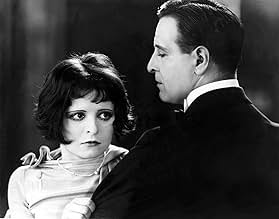
A young girl becomes a "flapper", defying her parents and the community.A young girl becomes a "flapper", defying her parents and the community.A young girl becomes a "flapper", defying her parents and the community.
- Director
- Writers
- Stars
- Awards
- 2 wins total





- Director
- Writers
- All cast & crew
- Production, box office & more at IMDbPro
6.7227
1
2
3
4
5
6
7
8
9
10
Featured reviews
All Alone with Alice Joyce
Former stage star Alice Joyce (as Ethel "Buddy" Westcourt) stays at home while her husband and daughter enjoy a life of cruising, boozing, and romantic entanglements. When she finally decides to go out on the town, Ms. Joyce meets playboy Conway Tearle (as Gerald "Jerry" Naughton), who has been seen with Joyce's frequently tipsy daughter Clara Bow (as Catherine "Kittens" Westcourt). To protect Ms. Bow's tenuous honor, Joyce makes a date with Mr. Tearle. Her loneliness is over when Joyce unexpectedly falls in love with Tearle. He returns her love, and proposes. But, husband Norman Trevor (as Hugh "Hughie" Westcourt) has called it quits with his latest mistress, and wants his wife back...
What should Joyce do?
Her character's decision puts "Dancing Mothers" ahead of its time. This was a great role for Joyce, who became one of film's first huge movie actresses in 1912 (and, she was wildly popular throughout the decade). Her restrained style was often heralded by critics, and Joyce might have been considered for a "Best Actress" Oscar, had they started a couple of years earlier. Joyce's confrontation with Bow, and her final scene, are most memorable. It helped that Joyce was directed by Herbert Brenon, a favorite director who used her well. This was a top "Paramount" production, with veterans Dorothy Cumming and Eleanor Lawson, plus young Donald Keith rounding out what could then be called an "All-Star" cast.
******** Dancing Mothers (3/1/26) Herbert Brenon ~ Alice Joyce, Conway Tearle, Clara Bow, Donald Keith
What should Joyce do?
Her character's decision puts "Dancing Mothers" ahead of its time. This was a great role for Joyce, who became one of film's first huge movie actresses in 1912 (and, she was wildly popular throughout the decade). Her restrained style was often heralded by critics, and Joyce might have been considered for a "Best Actress" Oscar, had they started a couple of years earlier. Joyce's confrontation with Bow, and her final scene, are most memorable. It helped that Joyce was directed by Herbert Brenon, a favorite director who used her well. This was a top "Paramount" production, with veterans Dorothy Cumming and Eleanor Lawson, plus young Donald Keith rounding out what could then be called an "All-Star" cast.
******** Dancing Mothers (3/1/26) Herbert Brenon ~ Alice Joyce, Conway Tearle, Clara Bow, Donald Keith
What's Sauce for the Goose...
A typical 'saucy' 20's comedy with a rather innocuous story hiding behind a racy title. Everybody in it is filthy rich (both the Westcourt family and dissolute playboy Gerald Naughton have butlers) and there's plenty of dancing but little else when they get their partners back home.
The use in the title of the plural belies the fact that the plot centres on just one mother: Ethel Westcourt, played by Alice Joyce. (We do not see how her friend Mrs Mazzarene, played by Dorothy Cumming, spends her nights out, but her story - as well as Naughton's - would doubtless have been far naughtier than Ethel's.)
If Ethel's daughter Kittens (played by Clara Bow with an infectious kinetic charm the character would otherwise largely have lacked) had kept her trap shut in the incredible climactic scene in Naughton's lair where most of the cast's paths eventually collide, Ethel would not have been forced to call the bluff of both Kittens and her straying, tombstone-faced banker father Hugh (played by Norman Trevor) in the abrupt unexpected ending, which could only have been possible if Ethel had enjoyed considerable financial means of their own.
The use in the title of the plural belies the fact that the plot centres on just one mother: Ethel Westcourt, played by Alice Joyce. (We do not see how her friend Mrs Mazzarene, played by Dorothy Cumming, spends her nights out, but her story - as well as Naughton's - would doubtless have been far naughtier than Ethel's.)
If Ethel's daughter Kittens (played by Clara Bow with an infectious kinetic charm the character would otherwise largely have lacked) had kept her trap shut in the incredible climactic scene in Naughton's lair where most of the cast's paths eventually collide, Ethel would not have been forced to call the bluff of both Kittens and her straying, tombstone-faced banker father Hugh (played by Norman Trevor) in the abrupt unexpected ending, which could only have been possible if Ethel had enjoyed considerable financial means of their own.
1926 Shocker
Dancing Mothers is a rather dull film except for the vivacious Clara Bow playing "Kittens." Also of interest are the truly ugly sets (check out the hideous pirate-themed nightclub) and the great women's clothes. Clara Bow wears some really bizarre outfits as the jazz baby who sets her sights on Conway Tearle, who plays a "famed lady killer." Tearle is old and dull but was a star in 1926. Alice Joyce is the nominal star. She was billed as "the madonna of the screen," but shows little vitality here as the mother who decides to "live." Dorothy Cumming (whose named is misspelled as "Cummings" in the credits) is good as Mazzy, and Leila Hyams, Donald Keith, Norm Trevor, and Eleanor Lawson round out the supporting cast. Worth seeing for the always-good Clara Bow and for the shocking ending. The whole film seemingly leads up to the conventional ending, but then takes a different route. Dancing Mothers was a big hit in 1926 and helped make Bow one of the biggest stars of the last 20s.
"kittens" is the life of the party
clara bow plays "kittens westcourt," a spoiled girl of wealthy parents. she spends her evenings dancing and partying all night long at clubs, which her father also attends. her mother stays at home wondering why her family is so selfish, and neglectful towards her. one day a friend tells mom to start living it up. she takes this advice and is soon off to the dance clubs herself. kittens and mother then proceed to compete for the same man's affections. above average clara bow film. she is not the lead actress in the film, but she has lots of screen time. clara is funny, full of energy, and just wonderful.
The It Girl at her itsiest
To see the kind of radiance one generally only finds in Edie
Sedgwick (in her might-as-well-be-silent Warhol movies), check
out the scene with racy Clara Bow in a fatcat's apartment while
he's away, swilling his liquor and kicking up her heels on his
couch. Literally. (Was this scene the inspiration for the invasion of
Jerry Lewis' house in THE KING OF COMEDY?) Guzzling gallons
of expensive booze and tracing the line of warmth down her
tummy, Bow is a miraculous fireworks show of life-love and gay
impiety. This is star acting! Our biggest names o\f the moment
seem feeble and class-free by contrast.
Sedgwick (in her might-as-well-be-silent Warhol movies), check
out the scene with racy Clara Bow in a fatcat's apartment while
he's away, swilling his liquor and kicking up her heels on his
couch. Literally. (Was this scene the inspiration for the invasion of
Jerry Lewis' house in THE KING OF COMEDY?) Guzzling gallons
of expensive booze and tracing the line of warmth down her
tummy, Bow is a miraculous fireworks show of life-love and gay
impiety. This is star acting! Our biggest names o\f the moment
seem feeble and class-free by contrast.


Did you know
- TriviaPrints of this film--at 65 minutes--are held by the Library of Congress and the UCLA Film and Television Archives.
- Quotes
Mrs. Mazzarene: I warn you--you're playing with fire.
Ethel Westcourt: I'm playing with life!
- ConnectionsFeatured in Hollywood (1980)
Details
- Runtime
- 1h 6m(66 min)
- Sound mix
- Aspect ratio
- 1.33 : 1
Contribute to this page
Suggest an edit or add missing content