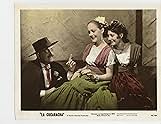
Senor Martinez, a famous theater owner, visits a local cafe in Mexico because of its reputation for good food and to audition the famous dancer who performs there.Senor Martinez, a famous theater owner, visits a local cafe in Mexico because of its reputation for good food and to audition the famous dancer who performs there.Senor Martinez, a famous theater owner, visits a local cafe in Mexico because of its reputation for good food and to audition the famous dancer who performs there.
- Won 1 Oscar
- 1 win total
5.7415
1
2
3
4
5
6
7
8
9
10
Featured reviews
Audition for an Audition
I sought this out because I'm on a quest to understand the influence of Spanish-speaking filmmakers. I'm really impressed with the current crop wherever they live. Surely there's a literary tradition of folding behind this: Cervantes, Borges, Cortazar...
Now this isn't quite a Spanish film, it is by gringos and only references Spanish idioms. But it is interesting nonetheless.
It is the first film made with the three strip Technicolor process, so it is an audition of sorts. And the audition is for color and spice, if you will.
So the story centers on an audition and on spice, both wrapped in Spanish trappings. That allows our performers in the show within the show to be colorful, especially with greens and blues. Very nice.
The fellow that has to be pleased has an encounter with the girl who we are to receive as sexy. He blushes and a subtle red light is used on his face. Pretty good. The folding here is that the judge in the on screen audience likes the "color." And we are meant to as well.
Then there's a bit with two warring numbers, one the title song that mentions marijuana.
Ted's Evaluation -- 1 of 3: You can find something better to do with this part of your life.
Now this isn't quite a Spanish film, it is by gringos and only references Spanish idioms. But it is interesting nonetheless.
It is the first film made with the three strip Technicolor process, so it is an audition of sorts. And the audition is for color and spice, if you will.
So the story centers on an audition and on spice, both wrapped in Spanish trappings. That allows our performers in the show within the show to be colorful, especially with greens and blues. Very nice.
The fellow that has to be pleased has an encounter with the girl who we are to receive as sexy. He blushes and a subtle red light is used on his face. Pretty good. The folding here is that the judge in the on screen audience likes the "color." And we are meant to as well.
Then there's a bit with two warring numbers, one the title song that mentions marijuana.
Ted's Evaluation -- 1 of 3: You can find something better to do with this part of your life.
La Cucaracha
If Technicolor was ever going to be used to good effect early on, then this scenario would seem to have been a good choice. The story is all largely predicable as impresario "Sr. Martinez" (Paul Porcasi) arrives at a café for a nice supper and to watch a dancer he hopes to sign up. The resident singer "Chaquita" (Steffi Duna) overhears his plans and sees an opportunity for stardom herself. That tees us up for some flamboyant Spanish dancing from "Pancho" (Don Alvarado) and a fine rendition of the old folk song "La Cucaracha" from Miss Duna. We get the impression that dancer and singer are a bit hung up on each other, and that "Martinez" is heading for a fall, but none of that really matters here as the whole thing is really about showing us just how bright and vital the colours and costumes are when lit properly and the dancing creatively choreographed.
Sure, it's not great, but for film experts, cinephiles and historians, it's a must.
"La Cucaracha" is a short that features lots of singing and dancing....and about a billion choruses of the song! Yes, THAT song...the one about cockroaches. Señor Martinez comes to the cantina looking for talent for his shows. Conchita is afraid that Martinez will take away Pancho, so she spends most of the film annoying Martinez--to drive him off!
"La Cucaracha" is a film that would have been completely forgotten over the years except for one thing--it's the first color film made using true color. Let me explain. In the early part of the 20th century, a few films actually were hand-painted--and the results were color...or sorts. Later, two-color processed (such as Two Color Technicolor and Cinecolor) were developed and the results were fair. The problem was that the films looked very orange and very green and a true spectrum of colors was absent. So, for example, true blues were not possible with the films. Now when you see "La Cucaracha", you might not be very impressed with the color. It looks garish--and a lot like it's been colorized but with much more vibrant colors (particularly blues and yellows). I am not sure if this ugly look is because of the effects of time and degradation on the film stock, the quality of the new Three Color Technicolor or because the 'experts' just didn't know what they were doing since it was such a new thing. But, regardless, the film is mega-important from a historical perspective. And, by the way, some might think "Becky Sharp" was the first full-color film. It's actually the first full-color FULL-LENGTH film--"La Cucaracha" was a short. Overall, the film is mildly entertaining and moderately funny--but nothing more. It's only fair entertainment but for film buffs it's a must-see.
A Fun Lightweight Feature
It's pretty lightweight, but "La Cucaracha" is fun to watch, and it is not without a couple of clever touches to go with the colorful setting, the likable characters, and the simple story. The early Technicolor still looks pretty good, and it has held up better than the sound (as the other reviewers here have mentioned, the sound is sometimes a bit muddled). It also has a good energy level and an upbeat feel to it.
Steffi Duna stars as a café singer in love with the dancer who also performs there. She becomes worried when a visiting impresario considers taking the dancer to the city to give him his big break, so she makes plans to disrupt his visit. Duna works well in the part, since she is attractive in a mischievous sort of way, and she makes the simple character believable. Paul Porcasi, so often cast in tiny parts, gets a chance to play a larger role here, and he is well cast as Martinez.
The story is somewhat predictable, but pleasant, and it has some funny moments. The whole movie works pretty well for a short feature of its era and genre.
Steffi Duna stars as a café singer in love with the dancer who also performs there. She becomes worried when a visiting impresario considers taking the dancer to the city to give him his big break, so she makes plans to disrupt his visit. Duna works well in the part, since she is attractive in a mischievous sort of way, and she makes the simple character believable. Paul Porcasi, so often cast in tiny parts, gets a chance to play a larger role here, and he is well cast as Martinez.
The story is somewhat predictable, but pleasant, and it has some funny moments. The whole movie works pretty well for a short feature of its era and genre.
Bad Movie, Interesting Curio
Señor Martinez, a famous theater owner, visits a local café in Mexico because of its reputation for good food and to audition the famous dancer who performs there.
Martinez tells the café owner that if the dancer is as good as he has heard, he will offer the dancer a contract to perform in his theater.
The café's female singer hears about this and is determined that he won't leave the café without her.
First full color live action film. Odd that they'd choose this topic.
Also odd that it came from Pioneer Pictures and not a big studio.
It's an interesting curio and not much more.
In fact, as a short, it feels like a feature and it's horribly directed.
The use of color is just OK but the entire production was out of focus.
Not sure if that's just the copy or if it was like that originally.
Martinez tells the café owner that if the dancer is as good as he has heard, he will offer the dancer a contract to perform in his theater.
The café's female singer hears about this and is determined that he won't leave the café without her.
First full color live action film. Odd that they'd choose this topic.
Also odd that it came from Pioneer Pictures and not a big studio.
It's an interesting curio and not much more.
In fact, as a short, it feels like a feature and it's horribly directed.
The use of color is just OK but the entire production was out of focus.
Not sure if that's just the copy or if it was like that originally.
Did you know
- TriviaThe first full-color live-action film.
- Quotes
Señor Martinez: How's your sister?
Chaquita: How's your salad?
- ConnectionsEdited into Governing Body (2023)
Details
Box office
- Budget
- $50,000 (estimated)
- Runtime
- 20m
- Aspect ratio
- 1.37 : 1
Contribute to this page
Suggest an edit or add missing content
