
The story of life in the 18th century Jewish ghetto of Wurtemburg. Suess tries to better himself with the help of an evil Duke.The story of life in the 18th century Jewish ghetto of Wurtemburg. Suess tries to better himself with the help of an evil Duke.The story of life in the 18th century Jewish ghetto of Wurtemburg. Suess tries to better himself with the help of an evil Duke.
- Director
- Writers
- Stars




Pamela Mason
- Naomi
- (as Pamela Ostrer)


- Director
- Writers
- All cast & crew
- Production, box office & more at IMDbPro
6.5266
1
2
3
4
5
6
7
8
9
10
Featured reviews
Historical value!
A few years later, the Jew Suss by Halan was giving its own perception of this historical fact for the purpose of Nazi propaganda. Yet, in 1934, Conrad Veidt and director Lothar Mendes escaped from Germany for the US and both participated to this well filmed movie that had a sort of Hollywood twich of the story of Josef Oppenheimer.
Watch this film and watch it again.
My copy of Jew Suss is exceptionally bad, being an ageing VHS recording with poor image and sound but nevertheless this is a film worth repeated viewing. I wonder which other countries in the 1930s would have had the confidence to film such a controversial story. Jew Suss, on the surface, is a call to oppose the growth of anti-semitism but the hero of the film is no likable chap, he is a ruthless exploiter, a womaniser, a procurer of women-and a father and a son with a tender side to his nature. He despises his master, the Duke and as much as Suss is in the Duke's power, so is the opposite the case. The only person Suss fears is the Rabbi Gabriel who one can call, perhaps,his conscience or at least the one means whereby Suss is kept connected to the reality of the world in which he lives. It is Gabriel who reminds Suss to visit his mother and his child and it is during these visits that we see his tenderness. Apart from anything else, though, the key to the character of Suss is that, good or bad, he is true to himself and his principles and it is this which finally brings about his downfall. He would only have to declare himself a Christian (and in the book this is what his cousin has already done) for all to be forgiven but he will not do it, even though a rather dubious plot device would make this the obvious thing to do. I find without exception that all performances in this film are excellent.
Jewish martyr seeks power in antisemitic Germany
All I know about Director Lothar Mendes (unusual surname for a German in the late 19th, early 20th Century - any relation to Sam Mendes?) is that he made some fine films and that it took a great deal of courage to come up with JEW SUSS, a no holds barred insight into antisemitism at a time when Nazis had just come to power in Germany.
As it turns out, POWER is the very thing Josef Suss Oppenheimer, a Jew living in Germany, harks after, and he rises through the ranks to become Minister of Finance to Duke Karl Alexander. Intent on improving social and economic conditions for his people, he does all he can, resorting even to illegalities to deliver on that quest. The results are, of course, mixed. He succeeds then pays with his life.
The entire cast delivers with distinction, Cedric Hardwicke standing as the conscience rock in the film. Conrad Veidt's at times over the top, at times contained, performance deserves the highest plaudits and conveys the man's difficulty in achieving his aims in a society that denigrates, berates and tries to ridicule him, right up to the Duke. In line with the title given to the film in the USA, POWER, he certainly achieves power to the point of wreaking vengeance on the Duke for attempting to rape and causing the lethal fall of Suss' young daughter.
Suss is not without contradictions or sin, and he suffers horribly to learn that his father was a gentile and that his adamant stance in favor of Jews may have been misguided and against his own interests.
The copy that I watched on Youtube was decent, considering the very poor copies that originally came out in VHS, but still it is difficult to rate the quality of Bernard Knowles' photography.
The screenplay off the original novel by Lion Feuchtwanger is uneven but gripping nonetheless.
Despite occurring in a long gone age, many of the antisemitic and racial issues it raises continue to apply today, showing that mankind's technological progress has been less than matched by race relations.
Definite must-see, though not for all tastes. 8/10.
As it turns out, POWER is the very thing Josef Suss Oppenheimer, a Jew living in Germany, harks after, and he rises through the ranks to become Minister of Finance to Duke Karl Alexander. Intent on improving social and economic conditions for his people, he does all he can, resorting even to illegalities to deliver on that quest. The results are, of course, mixed. He succeeds then pays with his life.
The entire cast delivers with distinction, Cedric Hardwicke standing as the conscience rock in the film. Conrad Veidt's at times over the top, at times contained, performance deserves the highest plaudits and conveys the man's difficulty in achieving his aims in a society that denigrates, berates and tries to ridicule him, right up to the Duke. In line with the title given to the film in the USA, POWER, he certainly achieves power to the point of wreaking vengeance on the Duke for attempting to rape and causing the lethal fall of Suss' young daughter.
Suss is not without contradictions or sin, and he suffers horribly to learn that his father was a gentile and that his adamant stance in favor of Jews may have been misguided and against his own interests.
The copy that I watched on Youtube was decent, considering the very poor copies that originally came out in VHS, but still it is difficult to rate the quality of Bernard Knowles' photography.
The screenplay off the original novel by Lion Feuchtwanger is uneven but gripping nonetheless.
Despite occurring in a long gone age, many of the antisemitic and racial issues it raises continue to apply today, showing that mankind's technological progress has been less than matched by race relations.
Definite must-see, though not for all tastes. 8/10.
A Sympathetic adaptation
This is actually a very sympathetic adaptation of the original novel by Leon Feuchtwanger (who was himself Jewish), and should not be confused with the Nazi travesty of 1940, which was a crude, anti-semitic propaganda vehicle.
Positive propaganda counters a Nazi agenda
German financier Josef Süss Oppenheimer vowed to attain power at any cost in order to help his brethren in the Jewish ghetto of Württemberg and his friendship with Field Marshall Karl Alexander pays off when the war hero inherits a Duchy. Süss becomes the unscrupulous Duke's Minister of Finance and is able to build schools and hospitals for his people but the beginning of the end comes when the lecherous Duke tries to rape Süss' daughter and she commits suicide. Süss concocts a brilliant plan for revenge but it kills the Duke and the financier's arrested, tried, and sentenced to death for having sex with Gentile women, an old law that hadn't been enforced for hundreds of years. He's offered an out if he converts to Christianity and he'd kept the fact his father was Christian a secret ...but will Süss save himself?
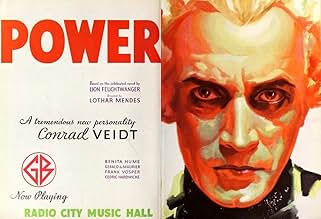
Süss is warned early on not to underestimate anti-Semitism which was "here in 1430 and will be here in 1930" so it's easy to see Lothar Mendes' elaborate historical biography as "positive propaganda", a response to the rise of Hitler and the closing epilogue asks for an end to prejudice, hoping it "falls like the Walls of Jerico and people can live as one." (yeah, tell that to ISIS) Here, Süss is portrayed as a philanthropic opportunist foolish enough to think he could harness evil for the greater good and the opulence of the eighteenth century aristocracy is vividly contrasted with the poverty of the Jewish ghetto by German émigré Mendes. Conrad Veidt's tormented martyr, guilty only of being too smart for his own good in a bad world, recalls the actor's THE MAN WHO LAUGHS and is positively riveting. Cedric Hardwicke's Rabbi Gabriel is the financier's solemn moral conscience and Benita Hume (a Mrs. George Sanders) is also very good as the "let them eat cake" Duchess. The U.S. title was POWER and the adult, sexually frank narrative must have been trimmed quite a bit for its release here.
Süss is warned early on not to underestimate anti-Semitism which was "here in 1430 and will be here in 1930" so it's easy to see Lothar Mendes' elaborate historical biography as "positive propaganda", a response to the rise of Hitler and the closing epilogue asks for an end to prejudice, hoping it "falls like the Walls of Jerico and people can live as one." (yeah, tell that to ISIS) Here, Süss is portrayed as a philanthropic opportunist foolish enough to think he could harness evil for the greater good and the opulence of the eighteenth century aristocracy is vividly contrasted with the poverty of the Jewish ghetto by German émigré Mendes. Conrad Veidt's tormented martyr, guilty only of being too smart for his own good in a bad world, recalls the actor's THE MAN WHO LAUGHS and is positively riveting. Cedric Hardwicke's Rabbi Gabriel is the financier's solemn moral conscience and Benita Hume (a Mrs. George Sanders) is also very good as the "let them eat cake" Duchess. The U.S. title was POWER and the adult, sexually frank narrative must have been trimmed quite a bit for its release here.


Did you know
- TriviaNot to be confused with Jud Süß (1940), an antisemitic propaganda film produced in Nazi Germany.
- Quotes
Josef Süss Oppenheimer: Is the Duke guilty of her death?
Rabbi Gabriel: You are guilty of her death.
- ConnectionsVersion of Jud Süß (1940)
Details
Box office
- Budget
- £100,000 (estimated)
- Runtime
- 1h 44m(104 min)
- Color
- Aspect ratio
- 1.37 : 1
Contribute to this page
Suggest an edit or add missing content