IMDb RATING
7.3/10
7.7K
YOUR RATING


In 1922, an Irish rebel informs on his friend, then feels doom closing in.In 1922, an Irish rebel informs on his friend, then feels doom closing in.In 1922, an Irish rebel informs on his friend, then feels doom closing in.
- Director
- Writers
- Stars
- Won 4 Oscars
- 13 wins & 4 nominations total


Joe Sawyer
- Barty Mulholland
- (as Joseph Sauers)


Steve Pendleton
- Dennis Daly
- (as Gaylord Pendleton)


Denis O'Dea
- Street Singer
- (as Dennis O'Dea)

Frank Baker
- Small Role
- (uncredited)
- Director
- Writers
- All cast & crew
- Production, box office & more at IMDbPro
7.37.7K
1
2
3
4
5
6
7
8
9
10
Featured reviews
9sol-
My brief review of the film
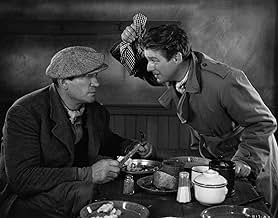
A thought-provoking drama of desperate living, paranoia, and the consequences of one's actions, John Ford gives the film an appropriately dark atmosphere, and the sets have a nightmarish quality to them. As McLaglen stumbles half-drunk through the night, everything around him shows his feelings. His character tends to often feel guilty, but at other times he feels in the mood to celebrate. He is overcome by a wave of different emotions, upset from different things. McLaglen handles all of this very well, giving a startling realistic performance that is good enough to provide some compensation for Margot Grahame's over-acting. However, this is just the one character that is complex and fascinating. The supporting characters all are very thin, and the romance between Foster and Angel adds nothing to the tale. Even so, this is very effective film-making, with some clever use of dissolve editing and a haunting music score by Max Steiner. It is overall quite an effective film about moral play, desperation and responsibility.
King Gypo impressed the hell out of me
One of John Ford's best films 'The Informer' doesn't feature any grand scenery of the American West. Instead the intense drama Ford was known for plays out on the no less rugged terrain of British character actor Victor McLaglen's face. The former prizefighter, who once faced Joe Louis in the ring, delivers an Academy Award-winning portrayal of disgraced IRA soldier Gypo Nolan on the worst night of his life.
The plot is gracefully simple: In 1922 Dublin, a starving and humiliated man who's been thrown out of the IRA for being unable to kill an informant in cold blood, himself becomes an informant. For £20 he betrays a friend to "the Tans" and for the rest of the night he drinks and gives away his blood money in rapidly alternating spasms of guilt, denial, self-pity, and a desperate desire to escape the consequences of his actions.
It is the remarkable complexity given to the character of the seemingly simple Gypo that is the film's most impressive achievement. In most movies a burly lout of Gypo's type would be cast as the heavy, he'd have at best two or three lines and be disposed of quickly so the hero and the villain could have their showdown. In 'The Informer' Gypo himself is both hero and villain, while the showdown is in his inner turmoil, every bit of which is explicitly shared with the audience.
Because Liam O'Flaherty's novel had previously been filmed in 1929, RKO gave Ford a very modest budget. The director and his associates, particularly cinematographer Joseph H. August, turned this to their advantage in creating a claustrophobic masterpiece about a man at war with himself. In addition to McLaglen's Oscar 'The Informer' also won John Ford his first along with wins for Best Screenplay and Best Score.
The plot is gracefully simple: In 1922 Dublin, a starving and humiliated man who's been thrown out of the IRA for being unable to kill an informant in cold blood, himself becomes an informant. For £20 he betrays a friend to "the Tans" and for the rest of the night he drinks and gives away his blood money in rapidly alternating spasms of guilt, denial, self-pity, and a desperate desire to escape the consequences of his actions.
It is the remarkable complexity given to the character of the seemingly simple Gypo that is the film's most impressive achievement. In most movies a burly lout of Gypo's type would be cast as the heavy, he'd have at best two or three lines and be disposed of quickly so the hero and the villain could have their showdown. In 'The Informer' Gypo himself is both hero and villain, while the showdown is in his inner turmoil, every bit of which is explicitly shared with the audience.
Because Liam O'Flaherty's novel had previously been filmed in 1929, RKO gave Ford a very modest budget. The director and his associates, particularly cinematographer Joseph H. August, turned this to their advantage in creating a claustrophobic masterpiece about a man at war with himself. In addition to McLaglen's Oscar 'The Informer' also won John Ford his first along with wins for Best Screenplay and Best Score.
Visually Powerful
The Informer(1935) is a movie that made people aware of a director named John Ford. Became a big name in Hollywood for the years after the movie. Gives a detailed look at the early history of the IRA. The Informer(1935) deals with a man who informs on his best friend and feels guilty afterwards. Victor Mclaglen as Gypo Nolan gives a performance of great human depth. The themes of betrayal and redemption are present through the entire film. Of all John Ford's films this is his most religious themed film. The Informer(1935) ends in the style of an An American Gangster Film.
After 65 years, this film is still all too timely
This film deals with the Irish rebellion in the 1920s and more specifically one man's life after he informs on a friend for the bounty on his head and the subsequent consequences. Watching the film, I got the feeling that you could take the script and with just some minor updates, do it again and it, sadly, would still fit contemporary events. But te remake wouldn't be nearly as good. A magnificent performance by Victor McLaglen (for which he deservedly got an Oscar) and a fine ensemble cast that includes most, if not all the actors with brogues in Hollywood at the time, most of them recognizable character actors either established at the time or just starting out. A very good film well worth watching. Highly recommended.
Judas's timeless story.
A lot of movies of John Ford (Sean O'Feeney) deal with Ireland.At every stage of a long and brilliant career,he gets back to his roots in his homeland:"the informer" and "the plough and the stars" are early period;"the quiet man " is middle, "young Cassidy" is late.
Far from being "one of the worst movies of the thirties" ,"the informer " belongs to its time:that's true that the studios deny realism but that was true for Fritz Lang's "M" and Marcel Carné's "réalisme poétique" too.Anyway,at a pinch,no matter if it's a political subject in the Ireland of the twenties:what Ford has to say to us is universal:when a man betrays his best friend,be it for thirty coins of silver or for twenty quids,he will be eaten with remorse ,everything that he'll see and hear will remember him of the awful thing he's done.Gypo won't take advantage of his pitiful reward,he will loose everything except the victim's mother's compassion and forgiveness. All through this dark movie,Gypo will roam the foggy streets ,a desperate man:you should not forget that he is an outcast from the beginning:dismissed by the IRA,because he hadn't guts enough to kill a prisoner,and outside a girl,and Jackie (the man he will betray),he's on his own ,a man who suffers from hunger and,worse, lack of self-esteem -the one time when he finds solace is when he has a rest near his girl's fireplace-This character is not that much far from Peter Lorre's part in "M":both movies feature a secret trial.
As always in Ford's cinema,women are figures of peace love and understanding,and for them a man can always redeem his soul: here Katie and the mother.In "quiet man" ,Wayne is given a second chance thanks to Ireland and... Maureen O'Hara.And after all Ford's last movie will be "seven women" (1966) :a doctor(Ann Bancroft) will triumph over barbary against all odds.
Far from being "one of the worst movies of the thirties" ,"the informer " belongs to its time:that's true that the studios deny realism but that was true for Fritz Lang's "M" and Marcel Carné's "réalisme poétique" too.Anyway,at a pinch,no matter if it's a political subject in the Ireland of the twenties:what Ford has to say to us is universal:when a man betrays his best friend,be it for thirty coins of silver or for twenty quids,he will be eaten with remorse ,everything that he'll see and hear will remember him of the awful thing he's done.Gypo won't take advantage of his pitiful reward,he will loose everything except the victim's mother's compassion and forgiveness. All through this dark movie,Gypo will roam the foggy streets ,a desperate man:you should not forget that he is an outcast from the beginning:dismissed by the IRA,because he hadn't guts enough to kill a prisoner,and outside a girl,and Jackie (the man he will betray),he's on his own ,a man who suffers from hunger and,worse, lack of self-esteem -the one time when he finds solace is when he has a rest near his girl's fireplace-This character is not that much far from Peter Lorre's part in "M":both movies feature a secret trial.
As always in Ford's cinema,women are figures of peace love and understanding,and for them a man can always redeem his soul: here Katie and the mother.In "quiet man" ,Wayne is given a second chance thanks to Ireland and... Maureen O'Hara.And after all Ford's last movie will be "seven women" (1966) :a doctor(Ann Bancroft) will triumph over barbary against all odds.


Did you know
- TriviaJohn Ford kept Victor McLaglen continually off-balance (and thus in character) by getting him drunk, changing his schedules, verbally abusing him on and off the set and filming scenes when he'd told McLaglen that they were only rehearsing. For the crucial rebel court scene, the story goes that Ford reduced the actor to a trembling wreck by promising him the day off only to bring him into the studio early and extremely hung over, insisting that he spit out his lines. McLaglen was so furious with Ford over this that he threatened to quit acting and kill the director.
- GoofsFrankie McPhillip tells his mother he travelled to her house via O'Connell Street. In 1922, the year the movie is set, O'Connell Street was still offically called Sackville Street, but the Irish Home Rule Party had unsuccessfully attempted to change it to "O'Connell Street" prior to this and this name was commonly used by nationalist Dubliners.
- Quotes
Gypo Nolan: And now the British think I'm with the Irish, and the Irish think I'm with the British. The long and short of it is I'm walkin' around without a dog to lick my trousers!
- Crazy creditsOpening credits prologue: 1920 "Then Judas repented himself-and cast down the thirty pieces of silver - and departed."
- Alternate versionsSince its original release, the UK prints of this film have omitted all references to the IRA, but a 1998 release on a budget video label restored these cuts.
- ConnectionsFeatured in Directed by John Ford (1971)
- How long is The Informer?Powered by Alexa
Details
Box office
- Budget
- $243,000 (estimated)
- Runtime
- 1h 31m(91 min)
- Color
- Aspect ratio
- 1.37 : 1
Contribute to this page
Suggest an edit or add missing content