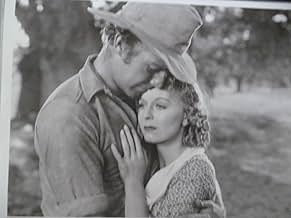
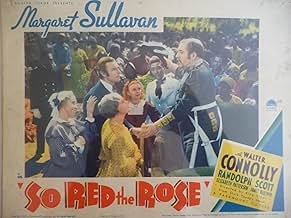
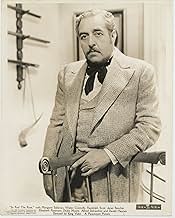
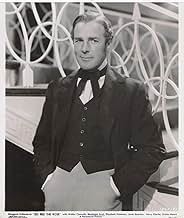
"So Red the Rose" is King Vidor's quietly-affecting Civil War romance starring Margaret Sullavan as a Southern aristocrat, the mistress of a Southern plantation, whose sheltered life is torn... Read all"So Red the Rose" is King Vidor's quietly-affecting Civil War romance starring Margaret Sullavan as a Southern aristocrat, the mistress of a Southern plantation, whose sheltered life is torn apart by the War between the States. During the war's darkest days she is sustained by he... Read all"So Red the Rose" is King Vidor's quietly-affecting Civil War romance starring Margaret Sullavan as a Southern aristocrat, the mistress of a Southern plantation, whose sheltered life is torn apart by the War between the States. During the war's darkest days she is sustained by her love for a distant cousin, a Confederate officer played by Randolph Scott.
- Confederate Officer
- (uncredited)
- Cavalry Captain
- (uncredited)
- Slave
- (uncredited)
Featured reviews
Robert Cummings and Randolph Scott
pre-GWTW antebellum
This family, the Bedfords, has it a little tougher than the Tara group, though what went on in GWTW was pretty harrowing. This film focuses on the loss of family members, and slaves rebelling, although the family is shown here as being loving and supportive.
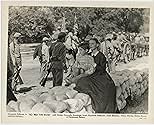
Their treatment is very typical Hollywood, though it is true that some slaves were well treated, learned to read, etc., which is no justification for it. But they want their freedom, and they hear it's coming. On the day the rebellion was filmed, 500 African Americans were needed. So it was filmed during a city-wide "Maid's Day Off" in Los Angeles.
What Sullavan says to the slaves who want to quit is interesting and actually realistic. Slavery, she says, is at an end, and you'll be free. But what are you free to do? Are you promised land? Freedom means you work for wages or for yourself.
This actually is a good handle on the issues faced during Reconstruction. This topic is not shied away from in "So Red the Rose" at all.
In the beginning, I almost turned this off because it was so over the top. Margaret Sullavan as Vallette flounces around in what looks like a parody of an antebellum gown. And the accents - yikes. Cummings is a friend of Vallette's brother - his performance is just too big.
Randolph Scott plays a distant cousin who objects to the war and refuses to fight. Vallette is in love with him, but he is focused on other things.
All in all, a darker film, though one is less attached to the characters as we are in Gone with the Wind. What I like about both Wind and Rose is that it shows that the way of life of southerners changed within minutes. And they weren't prepared for what it meant.
Wow....most folks would LOVE to be slaves in this strange world!!
In "So Red the Rose", the black slaves (especially the house slaves) are super-loyal and decent and it's only the wicked field hands that become 'uppity' towards the end of the Civil War. The message seems to be that without the war, everything would have just been fine!
As far as the story goes, it's all about a rich antebellum family, the Bedfords. While the womenfolk stay home, the men are out giving their all for the South. It's all told in a highly sympathetic and melodramatic fashion...with lots of sweet music, tenderness and style. And, when the war is over the blacks are no longer slaves and are rebellious and ungrateful for the wonderful treatment they'd received from their owners!!
The bottom line is that this film is very slickly made and well acted...and complete crap! I do not understand how so many reviewers loved the film and didn't seem to notice that it was also a complete lie. Strange.
Vidor's humanism shines through.
Strong performances from Margaret Sullavan, Walter Connolly, Elizabeth Patterson and especially Janet Beecher give the film a solid base - and Vidor's technical skill and Victor Milner's cinematography give the film beauty. But it is Vidor's humanism that gives it heart. He was a remarkable artist - much over-looked by film historians. "So Red the Rose" is not a great film, but it is a remarkable one.
Not What I Hoped!
Did you know
- TriviaOne of over 700 Paramount Productions, filmed between 1929 and 194; its, which were sold to MCA/Universal in 1958 for television distribution, and have been owned and controlled by Universal ever since; its earliest documented telecast took place in Seattle Tuesday 24 March 1959 on KIRO (Channel 7); it first aired in Boston 6 December 1959 on WBZ (Channel 4).
- GoofsAt about 52 mins, a pickup truck can be seen driving slowly in the distance, followed by a horse-drawn vehicle.
- ConnectionsFeatured in Black Shadows on the Silver Screen (1975)
Details
- Runtime
- 1h 22m(82 min)
- Color
- Aspect ratio
- 1.37 : 1