
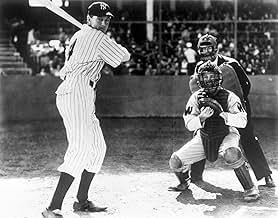
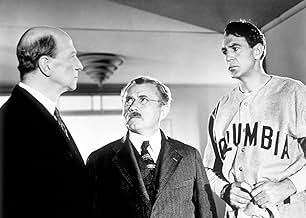
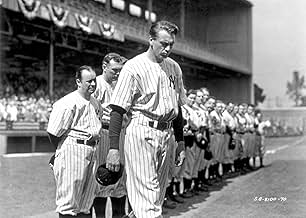
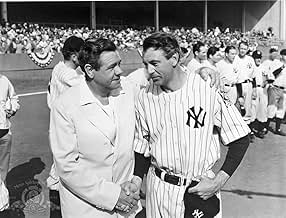
The story of the life and career of famed baseball player Lou Gehrig.The story of the life and career of famed baseball player Lou Gehrig.The story of the life and career of famed baseball player Lou Gehrig.
- Won 1 Oscar
- 5 wins & 10 nominations total



Ludwig Stössel
- Pop Gehrig
- (as Ludwig Stossel)


Bob Meusel
- Robert W. Meusel
- (as Robert W. Meusel)


7.612.7K
1
2
3
4
5
6
7
8
9
10
Featured reviews
The Life of Lou Gehrig: Baseball Player and American Hero.
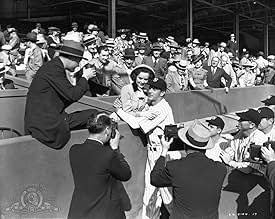
A touching and emotional experience about the life of late-New York Yankees first baseman Lou Gehrig (played brilliantly by the always excellent Gary Cooper, Oscar-nominated). By 1939 Gehrig was saying farewell to baseball prematurely due to a rare muscle disorder that today bears the hero's name. Shortly after Gehrig's famous speech, he would indeed pass away. "The Pride of the Yankees" (made less than three years after his death) is a moving tribute that is first-class in every way imaginable. We meet the character as a young boy whose strict mother wants him to be an engineer. As the years pass though he cannot deny his love of the grand old game. Sportswriter Walter Brennan (who was always outstanding as well) becomes the biggest supporter of Gehrig, even though Gehrig seems out-of-place in the big city at times and seems more concerned about baseball than anything else (which bothers some inside of the Yankees circle, mainly due to Babe Ruth's famous antics). As the years pass, championships come and a constant is always Gehrig who set a record with 2,130 consecutive games played (Cal Ripken, Jr. would later break that record in 1995). He finds love with a young woman from Chicago (Oscar-nominee Teresa Wright) and it appears that happiness is all that the couple will experience. Sadly that would not be the case though. Sam Wood's heart-felt direction and a focused screenplay (which is a bit sappy at times) just add an odd element of grace that endears the film to most all movie-goers. Babe Ruth does play himself here and is a surprisingly excellent performer who allows himself to be taken out of the spotlight to tell Gehrig's story. He ends up being a really solid supporting actor. I do admit that "The Pride of the Yankees" is slightly flawed. Some things seem a bit staged (most notably the young child in the hospital), but overall the film is right on target. Anyone who loves baseball, loves movies and has feelings (whether good, bad or indifferent) about the Yankees should definitely give "The Pride of the Yankees" an at-bat. It is a stunning experience that is suitable for the whole family and teaches the whole audience about love, friendship, compassion, life, death and heroism. 4.5 out of 5 stars.
Best sports biopic....ever
Being a lifelong Yankee fan this movie is my all time favorite. At times it can be a bit "hokey", but that is part of the charm. Even though you know the eventual fate of Lou Gehrig you cant help feeling that somehow he would get better.
My favorite scene was after his marriage to Eleanor and they were in the car driven by Walter Brennan heading to Yankee Stadium. When the motorcycle cop pulled them over for speeding. It was so "campy" but I loved it.
This movie hit all the emotions you can have! I dare anyone to tell me that after his farewell at Yankee Stadium they didn't get a lump in their throat.
My favorite scene was after his marriage to Eleanor and they were in the car driven by Walter Brennan heading to Yankee Stadium. When the motorcycle cop pulled them over for speeding. It was so "campy" but I loved it.
This movie hit all the emotions you can have! I dare anyone to tell me that after his farewell at Yankee Stadium they didn't get a lump in their throat.
Moving biography of legendary baseball player
In today's era of greedy athletes and their employers, the story of Lou Gehrig seems almost quaint. Here's a young man who by all accounts was selfless, kind-hearted, and rather introverted. And, of course, it didn't hurt that he was also a very good baseball player too. Put him on a lineup card today and he might not be the same player. Up until a few years ago, Gehrig's record of 2,130 consecutive games played was a record, a record that many thought would stand forever. For 16 years he was in the lineup as the Yankees' first baseman, never asking out for any reason. That alone should show you how special a person Gehrig was.
This biography is pretty straightforward. Unlike many of its kind, it doesn't show its protagonist somehow succeeding against all odds. Gehrig didn't have an abusive mother, he wasn't beaten up by kids at school, he wasn't learning-disabled, he didn't have attention-deficit disorder, he didn't come from abject poverty. He was simply a son in a working-class, immigrant family, as many were during the early decades of this century. And that's why Gehrig is so special to so many people - he symbolises their own hopes.
Gary Cooper is aces as Gehrig, and Teresa Wright is wonderful as his wife, Eleanor. If there's anything imperfect about the movie, it's that it is...well, a little predictable. That's something biopics can't avoid, of course, so it's no big problem. But even if most of the film doesn't impress you, the final speech at Yankee Stadium - when Gehrig was suffering visibly from the disease that would eventually be named after him - will move you past tears. And even better, when Gehrig's done his brief speech, he walks offscreen. If that movie were written today, he'd play another game and hit a game-winning home run. It's this film's honesty and sincerity that win you over.
This biography is pretty straightforward. Unlike many of its kind, it doesn't show its protagonist somehow succeeding against all odds. Gehrig didn't have an abusive mother, he wasn't beaten up by kids at school, he wasn't learning-disabled, he didn't have attention-deficit disorder, he didn't come from abject poverty. He was simply a son in a working-class, immigrant family, as many were during the early decades of this century. And that's why Gehrig is so special to so many people - he symbolises their own hopes.
Gary Cooper is aces as Gehrig, and Teresa Wright is wonderful as his wife, Eleanor. If there's anything imperfect about the movie, it's that it is...well, a little predictable. That's something biopics can't avoid, of course, so it's no big problem. But even if most of the film doesn't impress you, the final speech at Yankee Stadium - when Gehrig was suffering visibly from the disease that would eventually be named after him - will move you past tears. And even better, when Gehrig's done his brief speech, he walks offscreen. If that movie were written today, he'd play another game and hit a game-winning home run. It's this film's honesty and sincerity that win you over.
Made me even more of a baseball fan
After seeing this movie, I went out and bought the Ken Burns documentary on Baseball. It's amazing how nice of a guy Lou Gherig was! He was a true gentleman. He brought his Mom to ALL THE GAMES. He was a true hero as well. I liked this movie and it was very sad to see Lou get stiff toward the end of the movie. Babe Ruth played himself and that was no hard task for him. I bought this movie it was so darn good.
Cooper's most likeable performance...a heartfelt tribute to a great man...
Gary Cooper may have won his Oscar for SERGEANT YORK--but I think he deserved it even more for PRIDE OF THE YANKEES. I've never seen him give a more heartfelt, natural and completely likeable performance than I have here. And Teresa Wright is glowing as his sweetheart.
It tells Lou Gehrig's story in a simple, straightforward manner with only an occasional bit of Hollywood corn, the kind so typical of the 1940s. But the main storyline is carried by Cooper and Wright with some great assist from Walter Brennan. Brennan drops a lot of his cornball mannerisms (the kind he uses he in all his Western roles) and plays it straight here--with excellent results.
But it's Cooper's achievement--no doubt about that. If the last twenty minutes of the film don't move you to tears, you're made of stone. Cooper gets across the panic and fear that hits him with the first signs of his illness--with a subtle show of facial expressions. He's really into his character here and gives one of the best performances of his career.
Knowing someone who died from this disease, I was especially moved at how the first signs of illness were shown here.
Douglas Croft does a fine job as the young Lou--and by the way, whatever happened to him? He played Ronald Reagan as a boy in KINGS ROW and did several other films in the '40s. And how come Dane Clark received no billing in the credits? He was only seen early on in the film but he had a line of dialogue as one of Lou's fraternity pals. He had no credit in Alan Ladd's THE GLASS KEY too--he's the man Brian Donlevy shoves through a plate glass window. A year later he was being given the star buildup at Warner Bros.
A great film and a wonderful tribute to Lou Gehrig.
It tells Lou Gehrig's story in a simple, straightforward manner with only an occasional bit of Hollywood corn, the kind so typical of the 1940s. But the main storyline is carried by Cooper and Wright with some great assist from Walter Brennan. Brennan drops a lot of his cornball mannerisms (the kind he uses he in all his Western roles) and plays it straight here--with excellent results.
But it's Cooper's achievement--no doubt about that. If the last twenty minutes of the film don't move you to tears, you're made of stone. Cooper gets across the panic and fear that hits him with the first signs of his illness--with a subtle show of facial expressions. He's really into his character here and gives one of the best performances of his career.
Knowing someone who died from this disease, I was especially moved at how the first signs of illness were shown here.
Douglas Croft does a fine job as the young Lou--and by the way, whatever happened to him? He played Ronald Reagan as a boy in KINGS ROW and did several other films in the '40s. And how come Dane Clark received no billing in the credits? He was only seen early on in the film but he had a line of dialogue as one of Lou's fraternity pals. He had no credit in Alan Ladd's THE GLASS KEY too--he's the man Brian Donlevy shoves through a plate glass window. A year later he was being given the star buildup at Warner Bros.
A great film and a wonderful tribute to Lou Gehrig.


Did you know
- TriviaReleased just 17 months after Lou Gehrig's death.
- GoofsAs Gehrig (Cooper) is doing his homework at Columbia, he writes with his right hand. Whilst Gehrig batted and threw left-handed, like many lefties of the era (perhaps because of "correction" in school), he wrote with his right hand.
- Quotes
[last lines]
Lou Gehrig: [his farewell speech]
Lou Gehrig: Today, I consider myself the luckiest man on the face of the earth... play ball!
- Crazy creditsOpening credits acknowledgment: Appreciation is expressed for the gracious assistance of Eleanor Gehrig (as Mrs. Lou Gehrig) and for the cooperation of Ed Barrow (as Mr. Ed Barrow) and the New York Yankees arranged by Christy Walsh.
- Alternate versionsA colorized version is available.
- ConnectionsFeatured in Diamonds on the Silver Screen (1992)
- SoundtracksTake Me Out to the Ball Game
(1908) (uncredited)
Music by Albert von Tilzer
Played during the opening credits and often in the score
Details
- Runtime
- 2h 8m(128 min)
- Color
- Aspect ratio
- 1.37 : 1
Contribute to this page
Suggest an edit or add missing content