
This lavish, impudent, adult fairy tale takes the viewer from 18th-century Braunschweig to St. Petersburg, Constantinople, Venice, and then to the moon using ingenious special effects, stunn... Read allThis lavish, impudent, adult fairy tale takes the viewer from 18th-century Braunschweig to St. Petersburg, Constantinople, Venice, and then to the moon using ingenious special effects, stunning location shooting.This lavish, impudent, adult fairy tale takes the viewer from 18th-century Braunschweig to St. Petersburg, Constantinople, Venice, and then to the moon using ingenious special effects, stunning location shooting.
- Director
- Writers
- Stars
- Awards
- 1 nomination total





- Director
- Writers
- All cast & crew
- Production, box office & more at IMDbPro
Featured reviews
The Mysteriously Unknown Masterpiece
Acclaimed director Terry Gilliam of Monty Python and 12 Monkey's fame, obviously tried to draw more attention to this striking wonder when he made his own version of this tale 'The Adventures Of Baron Munchausen' in 1988. If it wasn't for Mr.Gilliam, I probably would have never bothered to even watch this film. So I owe him many thanks as Münchhausen has easily become one of my all time favorite films. The pace, humour, and sheer originality of this fantasy make it one of the easiest subtitled films to watch in existence, period. It ranks up there with the greatest pre-1950's films such as The Treasure Of The Sierra Madre, and Chaplin's brilliant City Lights. If you love movies, if you love classic cinema, if you love original fantasy films, if you love humorous films; Seek out 1943's Münchhausen whatever you do. It will not disappoint. This film is certainly not for children. However, in terms of flat out fantasy entertainment, I would say that this nearly 70 year old antique blows away Peter Jackson's Lord Of The Rings films any day, and easily. Enough said.
9/10
The Fabled Baron
The Munchhausen Stories in German culture are akin to Jonathan Swift's Gulliver's Travels. The author Rudolf Erich Raspe was trying for Swift like satire of the political events of his time. In time though they became beloved for their face value alone. In fact the protagonist became a synonym, Munchhausen's syndrome is a diagnosis for one who tells exaggerated stories or outright lies the better to ingratiate themselves with another individual or a group.
In fact at the same time that German romantic cinema star Hans Albers was doing Munchhausen over in Germany, a different kind of Munchhausen was popular in America. Jack Pearl, a former vaudevillian, had a radio series based on the Munchhausen character and his famous line to those who questioned the authenticity of his stories was "Vas you dere Charlie". Quite popular back in the day.
The story of the fabled Munchhausen is told in flashback during a party in modern Germany by the current Baron Munchhausen . By the way, another reviewer said that it would be Germany in the Thirties before World War II started. Not necessarily because the Nazi regime was notorious for not asking the kind of sacrifices demanded of its civil population until late in the war. Such a lavish type party was definitely in keeping with the regime's culture of the time.
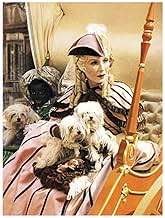
Though Goebbels kept it light as he did most of UFA's product except those that were outright propaganda, they did get their shots in. During the part of the film concerning Munchhausen's visit to Imperial Russia, the German background of Catherine the Great played by a fetching Brigitte Horney is emphasized. Catherine was a name she took when she married the Czar, she was in fact Sophia of Anhalt-Zerbst. Also there is a scene when Pugachev, the peasant leader of a revolt in Siberia, is brought in caged like an animal and looking like something from Dr. Moreau's laboratory. Pugachev was later played by Van Heflin in the film Tempest in the next decade. The caricature was definitely in keeping with the Nazi ideas to depict Slavic people as some kind of subhumans, almost as bad as Jews.
Throughout the film as Munchhausen travels from St. Petersburg, to Istanbul, to Venice and even the moon, Albers's faithful sidekick is Herman Speelmans who is like Sancho Panza or even Gabby Hayes if you will. Speelmans does a fine job and dies on the moon in a beautifully played scene.
As the propaganda is kept to a minimum, Munchhausen has survived to be appreciated on its own merits which are considerable.
An interesting and somewhat disturbing movie
Revisiting the movie now, as a euphemistically labeled "senior citizen," I was surprised that it holds up quite well. It amuses, it surprises, it is well acted, the dialog is clever, written after all by the famous novelist Erich Kästner under a pseudonym to cover up the fact that the Nazis saw themselves forced to employ him after burning his books.
There is something quite disturbing in hindsight about this movie. Why was it made? It was released in the year between the Battle of Stalingrad and the Allied Normandy Invasion the two events that were to seal Germany's fate. Was it an attempt to sustain both at home and abroad the far-fetched illusion that the war was going so well that all the German people cared about was laughing at the Baron Münchhausen's lies? Or was it an attempt at showing that Babelsberg could produce a grand spectacle just as well as Hollywood? And if a spectacle was being offered, why, in a country in which mass murder and deception were the order of the day, was even the hero to be a liar?
I am asking these questions because much in this movie is disturbing for reasons related to them. Take the Baron himself, played in this movie by Hans Albers, the greatest star, the Clark Gable of German movies in those years, yet by the time of this movie a man in his fifties pretending to be irresistible to females. It is as if MGM had cast an aging Adolphe Menjou as Rhett Butler in "Gone With the Wind." Now Albers is a fine actor, but to enjoy the movie you definitely have to suspend disbelief and pretend that the aging actor riding the cannonball is not bothered by arthritic pain.
The sets look more like cheap nouveau-riche furnishings and the costumes are cut from wartime stock. Ilse Werner, as Princess Isabella d'Este, is as beautiful as ever, and as Count Cagliostro we get to see Ferdinand Marian, the actor who just a few years earlier had disgraced himself by playing the lead in "Jud Süss," the most disgusting anti-Semitic propaganda film ever made, a fact that ultimately led Marian to alcoholism and a DUI death at war's end, considered a suicide by many.
Now, one can say, let's just watch the film for what it is, and not in its historic context. But then, Marian's acting of Cagliostro, a swindler, is crafted with the same mannerisms he used in creating the Jew Süss. In short, the undeniable artistic qualities of this movie are infected with the severe moral deficiencies of its makers, and this surprisingly renders the movie more interesting than it has any right of being. This is what disturbs me.
Humble review
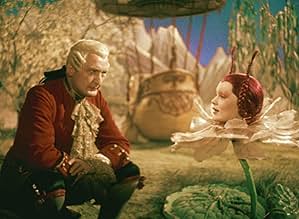
The film is very rich and vibrant in its cinematography and color, this is very much appreciated when one sees the work that went into the Moon set.
Hans Albers plays an arrogant but lovable rogue who takes many, many years to learn the lesson of what is truly important in a mans life.
I am in agreement with one reviewer in that this film is not at all for children and should be screened carefully, this is a European film and the Hayes Act didn't exist in Germany.
Magic with a dark side
It is filmed in colour and - despite being produced during WWII - no expense had been spared on the lavish sets and costumes. But this is not what this film is all about. As in Gilliam's film, this Münchhausen is a magical character, but it is not the magic you find in a modern animated Walt Disney spectacle, it is a magic with a dark side, a magic that can threaten and seduce and corrupt. Münchhausen himself comes across as an ambiguous character, charismatic and heroic, but by no means cuddly and lovable.
As a result this is more a fairy tale for adults than one for children, and the full original version with nude harem girls, sexual innuendo, etc. wouldn't have passed the American censors of its day and probably still get an R rating today.


Did you know
- TriviaWriter Erich Kästner is widely reported to be billed as "Berthold Bürger" on this film, but there is in fact no writing credit at all. Kästner was a banned author in Nazi Germany and his books were among those burnt in 1933, which was the reason for the lack of writing credit here. Joseph Goebbels gave Kästner only a special permission to write a script, on which the author was actually named as Berthold Bürger. However he also give instruction to the German press never to mention the real author of the script nor to mention the name Berthold Bürger. Therefore no writing credits in the movie was used.
- GoofsSophia's "beauty spots" disappear and reappear during the opening scenes of the film.
- Quotes
Doge: I'm glad the balloon is to launch in Venice -- it will advance the cause of science, and provide entertainment for the people. The art of the statesman is, by doing one thing, to achieve two goals.
François Blanchard: I serve only science, your Excellency.
Doge: Of course, it's best for you to believe that. Let no one convince you otherwise.
- Alternate versionsThe length of this film when submitted to the Film Review Office in March 1943, according to the Deutsches Filminstitut, was originally 134 minutes (or 3662 meters). This version was used for the premiere of the film at the Ufa-Palast am Zoo. Three months later, a second version (the general release version) was submitted, cut down to 118 minutes (3225 meters). After the war, the next version (December 1949) was 105 minutes, the 1954 version 101 minutes, the version for general audiences (shown that year) 88 minutes. In 1995, a first restoration was assembled by the F.W. Murnau Foundation, clocking in at 114 minutes. In 2017, a 35mm Agfacolor print was discovered at the Gosfilmofond of Russia. That print, which runs 131m (3590m), was restored and used for the 2019 Blu-ray release.
- ConnectionsFeatured in Die gefrorenen Blitze (1967)
- How long is The Adventures of Baron Munchausen?Powered by Alexa
Details
- Release date
- Country of origin
- Language
- Also known as
- Münchhausen
- Filming locations
- Berlin, Germany(environs)
- Production company
- See more company credits at IMDbPro
- Runtime
- 1h 50m(110 min)
- Sound mix
- Aspect ratio
- 1.37 : 1