Sahara
- 1h 37m


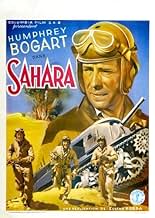
After the fall of Tobruk in 1942, during the Allied retreat in the Libyan desert, an American tank picks-up a motley group of survivors but they face advancing Germans and a lack of water.After the fall of Tobruk in 1942, during the Allied retreat in the Libyan desert, an American tank picks-up a motley group of survivors but they face advancing Germans and a lack of water.After the fall of Tobruk in 1942, during the Allied retreat in the Libyan desert, an American tank picks-up a motley group of survivors but they face advancing Germans and a lack of water.
- Nominated for 3 Oscars
- 2 wins & 3 nominations total



- Capt. Jason Halliday
- (as Richard Nugent)


- Jean Leroux - 'Frenchie'
- (as Louis T. Mercier)

- Capt. von Schletow
- (as Kurt Krueger)


- Soldier
- (uncredited)
- German Private
- (uncredited)
- Soldier
- (uncredited)
- German Private
- (uncredited)

- British Soldier
- (uncredited)
Featured reviews
An excellent WWII movie
"Sahara," the story of a rag-tag group of soldiers fleeing from Rommel's Afrika Korps in a US tank, is enjoyable throughout. The cast is fine, representing a number of nationalities and even races. I think this is one of Bogart's better acting jobs, and J. Carrol Naish, Lloyd Bridges, Rex Ingram, Dan Duryea, and the others are equally good.
While this may be a propaganda film, it is no "our hero wipes out an enemy division without a scratch" potboiler. On the contrary, the decision made by Sgt. Joe Gunn (Bogart) to stay and fight a German regiment rather than heading for British lines is a desperate gamble little better than a suicide mission. This brings up my second point; the ethical question.
St. Gunn gets the idea to stay at the oasis they have reached in order to fight and delay a German regiment in hopes that such a sacrifice may help the Allied cause. He must convince the others, and one or two do not go along without some persuading. "I don't mind fighting and dying," one says, "but this is pointless." Well, that's the issue. How easy it is to find reasons NOT to stay behind and fight! Makes me appreciate the plight of our soldiers on Bataan and Wake Island, who had no choice. But this little band does stay and fight, and the story hangs on their decision.
My third point is a bit arcane, and has to do with Hollywood business practices of the 1940s. Bogart was, when this movie started production, about the biggest star in Hollywood. Remember, he had already made High Sierra," "The Maltese Falcon," and "Casablanca." Why then, did Warner Brothers lend him out to Columbia to do this picture? Columbia was still barely a second rank studio. What did they have to trade in return? Rita Hayworth? I don't think she made any films for Warners, but I may be wrong.
Lastly, it's interesting to note that Bogart, when he started his own company (Santana Productions) in the late 40s, signed a releasing deal with Columbia. I guess he must have been impressed with Columbia while making this picture, as well as "Dead Reckoning" (1947).
I strongly recommend "Sahara" to anyone who has not seen it. It's exciting action combined with interesting characterizations.
Water
There just isn't any. It's central to the plot. Everyone is terrified of dying for lack of it. They're ready to kill for it. They're ready to die for it. They travel miles and miles out of their way to get to wells.
And yet... when they start seriously shooting at each other, both sides are laying down a practically non-stop withering fire with.... WATER-COOLED machine guns!!!!!!
I guess they must have had a whole bunch of water all along!
When Hollywood Used To Know How Good Movies Were Made
Columbia took a B-movie sized budget, a great story, excellent acting and made a classic which had a shelf-life in theaters and TV in excess of 40 years. The story was good enough to be remade as a western in 1953 called Last of the Comanchees. Two years ago, Hollywood used the same title (Sahara) to produce a huge budget color adventure movie (but with an altogether story). With unlimited resources and today's alleged high tech, Hollywood produced a mildly entertaining picture which had a shelf-life, not of 40 years, but way under 40 weeks.
The Bogart SAHARA isn't easy to find these days, but have a look on eBay or request it from Turner Classics. Timeless, it won't disappoint even after 63 years.
Very Entertaining
*** (out of 4)
Exciting and highly entertaining WW2 drama has Humphrey Bogart playing the leader of a tank crew who are slowly trying to make their way to safety by crossing the Sahara Desert. Soon the group of men begin to struggle as the sand storms and lack of water begin to have a toll on them so they decide to give their lives and battle a large number of German's. This is certainly one of the better WW2 dramas out there and I guess it's what you'd call a "man's movie" since there isn't a single woman in the film. The movie works so well because of the wonderful cast who turn in some great and memorable performances. Bogart leads the way and turns in another winning performance but I'd stop short of calling it amongst his best. He certainly fits that tough guy role better than anyone in history so there's no problem believing anything his character is doing. The supporting cast is where the real greatness is as several members are able to outshine Bogie. J. Carrol Naish gives one of his greatest performances with a spot on Italian accent. It's a real shame so many people just remember Naish from his later day exploitation titles because he was certainly one of the better character actors from this era. Lloyd Bridges, Rex Ingram, Bruce Bennett and Richard Nugent also add great support. Guy Kingsford also should receive special attention as Stegman. I think the best part of the movie is the first sixty-minutes or so where the men are having to deal with the desert as their main enemy. The effects of them dealing with a sand storm was very well done as was a terrific scene where the men get to taste water for the first time in days. I think the later part of the story gets a tad bit far fetched but one should also keep in mind that movies like this were being made to make those watching them feel proud of the troops battling in the real war.
Man and Tank
Meanwhile there is a play of nations going on around Bogart. The Nazi is arrogant and won't be touched by the Sudanese. There is a vengeful little Frenchman and a comic Italian for pathos (his name is even Guiseppe). The British display constant pluck. Now the tank is carrying so many men, that it has become a mother figure, and 45 minutes in it's already "old girl".
It's a greatly entertaining film, and it's fun watching Bogart negotiate, strong arm and wisecrack his way to glory. I think Bogart served the Allies just fine by shooting not overly propagandist movies like this. The ghostly German army, struggling forward for thirst, is a great image to finish on.


Did you know
- TriviaFor much of the production, the cast and crew were based in Brawley, CA, a small town about 40 miles from the filming location. At the time, Brawley offered little in terms of evening diversions, so Humphrey Bogart hosted many of his colleagues in his suite at the Planter's Hotel. Other cast members described Bogart as outgoing, generous and an adept bartender, but the late-night drinking meant that Bogart arrived on set hung over and quarrelsome. The behavior led to clashes with director Zoltan Korda.
- GoofsAll of the German vehicles are emblazoned with Nazi Party swastikas rather than the Balkenkreuz, the straight-armed cross that was the emblem of the Wehrmacht used on their vehicles during WWII.
- Quotes
Giuseppe: Mussolini is not so clever like Hitler, he can dress his Italians up only to look like thieves, cheats, murderers, he cannot like Hitler, make them feel like that. He cannot, like Hitler, scrape from the conscience the knowledge that right is right and wrong is wrong, or dig holes in their heads to plant his own ten commandments: steal from thy neighbor, cheat thy neighbor, kill thy neighbor.
Capt. von Schletow: You dare to insult the Führer?
Giuseppe: That would take an artiste - I am but a mechanic.
- Crazy creditsOpening credits prologue: In June, 1942, a small detachment of American tanks with American crews, joined the British Eighth Army in North Africa to get experience in desert warfare under actual battle conditions.
History has proved that they learned their lesson well - -
- ConnectionsFeatured in Going Hollywood: The War Years (1988)
- How long is Sahara?Powered by Alexa
Details
Box office
- Gross worldwide
- $9,058
- Runtime
- 1h 37m(97 min)
- Color
- Aspect ratio
- 1.37 : 1