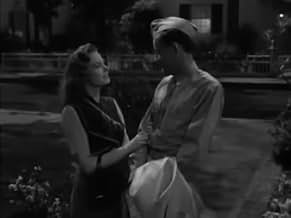
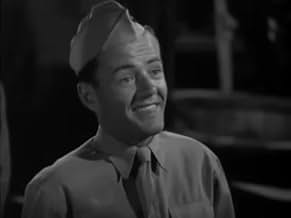
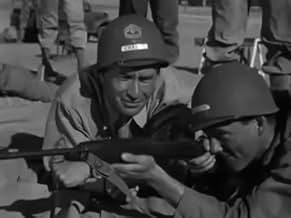
Marion Hargrove, a journalist, joins the Army to write about his training experiences. During basic training at Fort Bragg, he navigates with the aid of friends who aim to share his writing ... Read allMarion Hargrove, a journalist, joins the Army to write about his training experiences. During basic training at Fort Bragg, he navigates with the aid of friends who aim to share his writing income.Marion Hargrove, a journalist, joins the Army to write about his training experiences. During basic training at Fort Bragg, he navigates with the aid of friends who aim to share his writing income.
- Director
- Writers
- Stars
- Awards
- 2 wins & 1 nomination total
William 'Bill' Phillips
- Pvt. Bill Burk
- (as Wm. 'Bill' Phillips)
Margaret Adden
- Undetermined Role
- (unconfirmed)
- (uncredited)
Morris Ankrum
- Col. Forbes
- (uncredited)
Rod Bacon
- Field Operator
- (uncredited)
Steve Barclay
- Corporal
- (uncredited)
Robert Benchley
- Mr. Holliday
- (uncredited)
- Director
- Writers
- All cast & crew
- Production, box office & more at IMDbPro
6.2612
1
2
3
4
5
6
7
8
9
10
Featured reviews
Likable, but Dated
The running gag of scrubbing garbage cans (kp) as punishment may resonate with some of us old enough, but it's a slender thread on which to hang an entire comedy. Besides, it's a thing of the past, what with the new volunteer army that doesn't sign-up to clean garbage cans. Trouble is that Hargrove (Walker) can't stay off kp since he's a perennial screw-up, and though the episodes are well-timed, they do wear pretty thin. The movie's based on the real-life Hargrove's experiences in Army Basic Training. As Hargrove, Walker is relentlessly upbeat and energetic, reminding me of a young Jack Lemmon, while the movie itself showcases his talents more than anything else.
As a service comedy, the film is much tamer than the uproarious service comedies of the 50's (e.g. Mr. Roberts {1955}; Operation Mad Ball {1957}). But then, audiences of the 50's could relax and enjoy a lighter side of WWII since they didn't have to face a shooting war on the outside. I expect that accounts for this film's milder approach, which bases its humor on character instead of uproarious situations. After all, training for war might have a lighter side, but it should not be made to look too funny, even for escapist-seeking wartime audiences (1944).
Anyway, I agree that as a comedy, the movie is pretty thin gruel, especially after six decades. Still, the main characters are lively and likable, while Walker is quite good at being youthfully naïve, which may be just enough for a slow evening.
As a service comedy, the film is much tamer than the uproarious service comedies of the 50's (e.g. Mr. Roberts {1955}; Operation Mad Ball {1957}). But then, audiences of the 50's could relax and enjoy a lighter side of WWII since they didn't have to face a shooting war on the outside. I expect that accounts for this film's milder approach, which bases its humor on character instead of uproarious situations. After all, training for war might have a lighter side, but it should not be made to look too funny, even for escapist-seeking wartime audiences (1944).
Anyway, I agree that as a comedy, the movie is pretty thin gruel, especially after six decades. Still, the main characters are lively and likable, while Walker is quite good at being youthfully naïve, which may be just enough for a slow evening.
Definitely not outdated
Reporter Hargrove (Walker) is drafted and begins his basic training. He decides to keep a record of it all to later turn into a book.
I find this one of the more entertaining and realistic depictions of army training while preparing for war overseas. It is a fun film and if you have done basic training as myself some +25 years ago (in Europe) this rings quite true. I was a bit of a goofup in the beginning, just like Hargrove, and made quite a mess but it turned out allright in the end and even made sergeant. I can sure identify with Hargrove : he does mean well but somehow it nearly always goes wrong. The depiction of life in the barracks in spot-on with the grumpy sergeants and rather distant officers. Even the manoeuvres ring true. And when did you ever witness a scene where artillerymen in training are learning to adjust the range of their heavy guns ?
Walker is absolute excellent as Hargrove : he reminds me of a young Jack Lemmon. The direction is top notch and the movie is really fast-paced. It sure compares favourably with other army 'comedies' of that time, like 'Up in Arms', also made in 1944 (with Danny Kaye) which even has a scene with a beehive of pretty nurses suntanning on a battleship.
It mostly reminds me of its British counterpart 'The Way Ahead"' by Carol Reed and Peter Ustinov, also made in 1944. If you liked this I highly recommend that one.
I find this one of the more entertaining and realistic depictions of army training while preparing for war overseas. It is a fun film and if you have done basic training as myself some +25 years ago (in Europe) this rings quite true. I was a bit of a goofup in the beginning, just like Hargrove, and made quite a mess but it turned out allright in the end and even made sergeant. I can sure identify with Hargrove : he does mean well but somehow it nearly always goes wrong. The depiction of life in the barracks in spot-on with the grumpy sergeants and rather distant officers. Even the manoeuvres ring true. And when did you ever witness a scene where artillerymen in training are learning to adjust the range of their heavy guns ?
Walker is absolute excellent as Hargrove : he reminds me of a young Jack Lemmon. The direction is top notch and the movie is really fast-paced. It sure compares favourably with other army 'comedies' of that time, like 'Up in Arms', also made in 1944 (with Danny Kaye) which even has a scene with a beehive of pretty nurses suntanning on a battleship.
It mostly reminds me of its British counterpart 'The Way Ahead"' by Carol Reed and Peter Ustinov, also made in 1944. If you liked this I highly recommend that one.
The Army is swell
More than 5,000,000 men entered the armed services in World War II and movies like See Here, Private Hargroves was an attempt to assure the folks back home and incoming draftees that Army life could be swell. You may have to scrub a few garbage cans but you will make buddies that will last a lifetime and get a chance to meet and fall in love with a beauty like Donna Reed. Even a screw-up like Hargrove eventually becomes a member of the best gunnery team in the battery and earn the respect of the drill instructors that once tormented him. One character even tells Hargrove that he will remember his Army service as the best times of his life.
Uncle Sam Wants Robert Walker
Criticized for bad reporting, young Robert Walker (as Marion Hargrove) saves himself from getting fired (yet again) by receiving his draft letter from President Franklin D. Roosevelt. Off to basic training in Fort Bragg, North Carolina, Mr. Walker meets manipulative Private Keenan Wynn (as Mulvehill) and gullible Private George Offerman Jr. (as Orrin Esty) en route. They will become fast friends, with Mr. Wynn eventually getting Walker and himself cushy office transfers. However, when their old platoon gets orders to join the fighting forces, patriotic Walker and Wynn want in on the action. The good news is Walker's furloughs include quality kissing time with pretty Donna Reed (as Carol Halliday). The bad news is he has to scrub clean a lot of garbage cans. Walker is endearing enough to make cameo-appearing Robert Benchley, as Ms. Reed's veteran father, seem more annoying than funny.
***** See Here, Private Hargrove (3/18/44) Wesley Ruggles ~ Robert Walker, Keenan Wynn, Donna Reed, George Offerman Jr.
Corporal For A Day
Robert Walker plays an extremely skinny private in the United States Army during the midst of World War Two. He scrubs lots of garbage cans and gets to woo a lovely Donna Reed. As an "in the army" genre movie the film has more of a peace time vibe to it than one that was produced during the biggest war of the twentieth century. It would be hard to imagine Germany or Japan cranking out cinematic fluff like this in 1944. It perhaps reflects the fact that the mainland of the United States was not suffering the effects of total war like other countries. The lighthearted tone also might indicate the underlying confidence the country was feeling about ultimately winning the war at the time.
Did you know
- TriviaMarion Hargrove asked permission to consult on the movie, but the Army denied his request. He had been promoted to sergeant by the time this picture was completed. The Army even denied his request to see a preview of the film.
- Quotes
Pvt. Marion Hargrove: I'm so used to K.P. that even in Fayetteville, if I see a garbage can on the street, I stop and polish it.
- ConnectionsFollowed by What Next, Corporal Hargrove? (1945)
- SoundtracksIn My Arms
(1944) (uncredited)
Lyrics by Frank Loesser
Music by Ted Grouya
Variations played in the opening credits and often throughout the movie
Sung by Bob Crosby and the soldiers in the canteen
Partially sung later by Robert Walker with modified lyrics
Details
- Release date
- Country of origin
- Language
- Also known as
- Oiga señor recluta
- Filming locations
- Camp Roberts, California, USA(summer scenes)
- Production company
- See more company credits at IMDbPro
- Runtime
- 1h 41m(101 min)
- Color
- Aspect ratio
- 1.37 : 1
Contribute to this page
Suggest an edit or add missing content