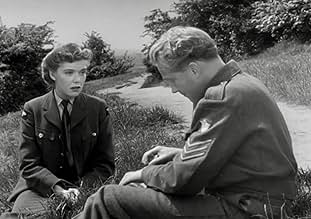
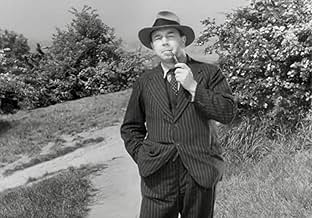
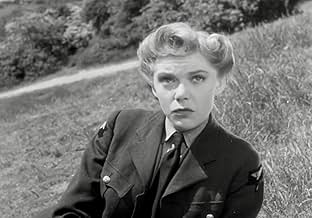
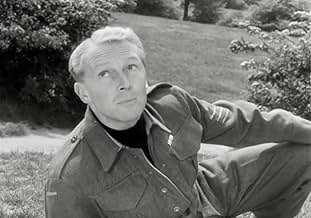
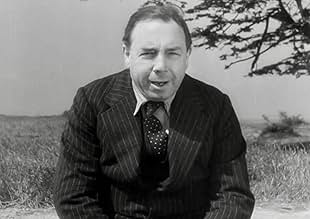
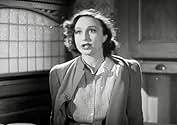
Adapted from a J.B. Priestley play with many of the original actors. The tale of various people who have come to live in an "ideal" city and their hopes and reasons for doing so.Adapted from a J.B. Priestley play with many of the original actors. The tale of various people who have come to live in an "ideal" city and their hopes and reasons for doing so.Adapted from a J.B. Priestley play with many of the original actors. The tale of various people who have come to live in an "ideal" city and their hopes and reasons for doing so.
- Director
- Writers
- Stars
Mabel Terry-Lewis
- Lady Loxfield
- (as Mabel Terry Lewis)
Fanny Rowe
- Philippa Loxfield
- (as Frances Rowe)
Brenda Bruce
- WAAF
- (uncredited)
Ralph Michael
- Sergeant Jimmy
- (uncredited)
J.B. Priestley
- J.B. Priestley
- (uncredited)
Johnnie Schofield
- Bert the Barman
- (uncredited)
- Director
- Writers
- All cast & crew
- Production, box office & more at IMDbPro
6.3462
1
2
3
4
5
6
7
8
9
10
Featured reviews
How tastes differ!
I usually enjoy malcolmgsw's reviews but this time we have to agree to differ: I consider this, far from being the worst British film, rather amongst the best. Of course, it depends upon what one considers important, how one views our history and the changes in politics. Not long ago, millions of Brits had a vision of a better and more just way of managing things and hopes for a better life for all. This film may have helped the Attlee government gain power the next year, but now all is lost and gone since Clause 4 was thrown out in 1995. The present generation is unhappy but doesn't seem interested in the hopes which this film is concerned with. The acting and the lighting effects are powerful, so it really wouldn't do to sit with one's eyes shut. Of course, if you're hoping for light entertainment and giggles, this film is not for you. It ought to be mentioned that the verse of poetry is taken slightly out of context: 'I dreamed that was the new city of Friends' with a capital 'F', meaning Quakers. It was about the hopes for the founding of Philadelphia in 1681. When a child, Walt Whitman was deeply influenced by a powerful Quaker preacher, and it shows in verses such as this. I can't imagine Whitman would mind his words being applied to this story.
City on the Edge of Forever
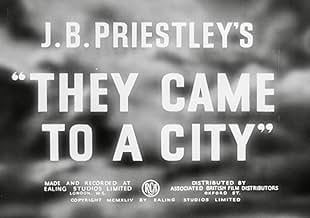
The main title actually says 'J. B. Priestley's They Came to a City', and the film constitutes the second of three brief wartime flirtations with fantasy by Ealing Studios.
Coming late in the war when enlightened opinion was already contemplating what was to come next, the ideals it expressed had already found voice in the Boulting Brothers short 'Dawn Guard' and thematically owed a lot to Sutton Vane's 'Outward Bound', James Hilton's 'Lost Horizon' and Priestley's own 1937 fantasy 'I Have Been Here Before'; while the striking production design seems to show the influence of German silent cinema.
Beginning and ending with the genial figure of Mr Priestley ambling on and off, it's not for all tastes, but is certainly quite unlike any other British film before or after.
Coming late in the war when enlightened opinion was already contemplating what was to come next, the ideals it expressed had already found voice in the Boulting Brothers short 'Dawn Guard' and thematically owed a lot to Sutton Vane's 'Outward Bound', James Hilton's 'Lost Horizon' and Priestley's own 1937 fantasy 'I Have Been Here Before'; while the striking production design seems to show the influence of German silent cinema.
Beginning and ending with the genial figure of Mr Priestley ambling on and off, it's not for all tastes, but is certainly quite unlike any other British film before or after.
A view of society in England.
Not exactly highly entertaining but it's not supposed to be entertaining as it's a comparison of posh rich people to poor ones.
Unsurprisingly the rich posh ones are not keen on a society where all are equal so the privileged positions that they currently enjoy would be lost. Eighty years later and nothing has changed as the rich continue to get richer and the poor get poorer.
My favourite character was the washerwoman who held the film together with her comments.
The set must have been very cheap to construct as it seemed to have been made of plywood painter to resemble stone.
Worth a watch but don't expect any excitement like a car chase for example.
Unsurprisingly the rich posh ones are not keen on a society where all are equal so the privileged positions that they currently enjoy would be lost. Eighty years later and nothing has changed as the rich continue to get richer and the poor get poorer.
My favourite character was the washerwoman who held the film together with her comments.
The set must have been very cheap to construct as it seemed to have been made of plywood painter to resemble stone.
Worth a watch but don't expect any excitement like a car chase for example.
Pure Utopian Propaganda - LOVED EVERY SECOND!!!
A very pleasant surprise. This is an allegory about an imagined socialist paradise, and the judgements that various archetypical citizens would have of it. I Loved it.
It happens that I watched this - on FUBI - on the same night that I watched a documentary about Jane Jacobs, the sociologist of cities and advocate of bottom-up community building. This was a perfect follow up.
It's presented as a series of exchanges between the disparate characters, contrasting their values, experience and social orientation. While it could be criticized as didactic and predictable, I found it well executed and fun. I especially loved Googie Withers as the working class gal whose been around the block a few times but isn't ready to go cynical.
In tone and flavor it's like a blend of Capra with Powell & Pressburger.
It happens that I watched this - on FUBI - on the same night that I watched a documentary about Jane Jacobs, the sociologist of cities and advocate of bottom-up community building. This was a perfect follow up.
It's presented as a series of exchanges between the disparate characters, contrasting their values, experience and social orientation. While it could be criticized as didactic and predictable, I found it well executed and fun. I especially loved Googie Withers as the working class gal whose been around the block a few times but isn't ready to go cynical.
In tone and flavor it's like a blend of Capra with Powell & Pressburger.
Nine strangers mysteriously transported to a unique city.
Nine disagreeable Britons representing different social/economic classes are mysteriously transported to a place with a door. As they wait for the door to open, we get to know them better. Eventually the door opens, and they go explore a city which the audience never sees. T The idea is that post WW2, England should become a more fair and equitable society with people who treat each other well. When the characters find themselves in such a city they have different reactions. It's interesting how some of the selfish ones try to emotionally drag those who want to live in the city back to their miserable lives. There is an episode involving a mother and daughter that is very similar to an episode in C. S. Lewis' novel "The Great Divorce" written 12 years later. It made me wonder if Mr. Lewis ever saw the film. Note: "They Came To A City" is similar to watching a stage play. At only 66 minutes long it's worth a look.
Did you know
- TriviaFinal film of Mabel Terry-Lewis.
- Quotes
Lady Loxfield: What is it?
Philippa Loxfield: I don't know, but I do know it isn't Bournemouth.
- ConnectionsFeatured in Sosialismi (2014)
- SoundtracksMusic selected from The Divine Poem
Music by Aleksandr Skryabin (as Scriabin)
Played by The London Philharmonic Orchestra
Conducted by Ernest Irving
Details
- Runtime
- 1h 18m(78 min)
- Color
- Aspect ratio
- 1.37 : 1
Contribute to this page
Suggest an edit or add missing content