IMDb RATING
6.8/10
2.2K
YOUR RATING
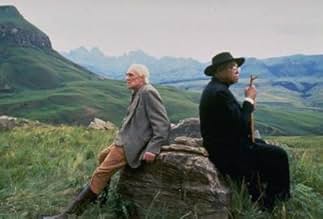
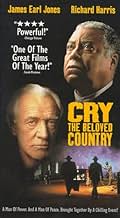
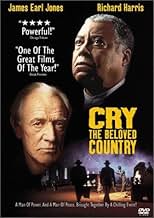
A South African preacher goes to search for his wayward son, who has committed a crime in the big city.A South African preacher goes to search for his wayward son, who has committed a crime in the big city.A South African preacher goes to search for his wayward son, who has committed a crime in the big city.
- Awards
- 1 win & 4 nominations total
Themsie Times
- Shebeen Queen
- (as Tembsie Times)
- Director
- Writers
- All cast & crew
- Production, box office & more at IMDbPro
6.82.1K
1
2
3
4
5
6
7
8
9
10
Featured reviews
Vignette of Apartheid
This film brings to life the lives of a black, country priest and a white wealthy landowner in South Africa in the 1940's.
Religion, politics, faith, healing, mercy and justice- all of these themes are present, but not in an overt, overbearing patronising way.
The two men meet due to unfortunate circumstances related to the activity of their respective sons' in the city, though they have lived in the same country area all of their lives.
Religion, politics, faith, healing, mercy and justice- all of these themes are present, but not in an overt, overbearing patronising way.
The two men meet due to unfortunate circumstances related to the activity of their respective sons' in the city, though they have lived in the same country area all of their lives.
10rondine
A 5 hanky story if you're NOT easily moved.
I could not believe as I read other reviewers of this movie that they thought it "irrelevant"! The struggle for equality, peace and love is NEVER irrelevant. This was a movie that by any standards is brillant and moving. James Earl Jones does a magnificent job of playing the main character with dignity and restraint. He makes you suffer with him as a result. A drama coach I once had told me, don't you cry, let them cry. He does both through his amazing minimalist acting. He doesn't waste himself on meaningless gestures & histronics, he lets you see the suffering of his soul. Equally brillant is Richard Harris as the father of the son killed by Jones' son. These two men are brought together in the worst of circumstances and that is when the true character of the man is revealed. Despite all his racist comments earlier in the movie, he overcomes his own self-hate (translated to Africans) to see the bigger picture that his own son knew all along. Someone once said, you cannot hate anything in someone else, unless it reflects something you hate within yourself. Through the pain & death of his son, he transcends his own sense of self-loathing. He sees with the eyes of love that people are just people, no matter what color their skin is. A movie that communicates that is never irrelevant or unimportant.
Why the beloved country?
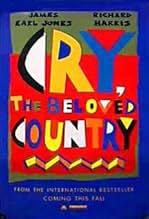
Apartheid was a grotesque social experiment aimed at perpetuating the evils of colonialism after the age of empires was past; white liberal Alan Paton one of its most celebrated literary critics. Darrell Roodt's film of perhaps his most famous book, Cry, the Beloved Country', stars Richard Harris and James Earl Jones (better known as the voice of Darth Vader, which leads to some unintentionally comic moments) and is not an awful film; but politically, it misses its targets. Aided by some slushy background music, it invests most of its black characters with a frankly ludicrous level of dignity; while oddly underplaying its depiction of the routine dehumanisation that black people suffered under white rule. In consequence, the film's only real anger appears directed not at the system but at Jones's brother, a nasty and opportunist anti-apartheid campaigner, which was surely not quite the original point. At the end of the film, an impassioned quote from Paton appears on the screen; it's a shame it seems so unconnected with what has preceded it.
Mercy for The Preacher's Son
It's been a long time since I read the Alan Paton book upon which this film is based. Paton was banned in his own country and officially silenced but the book was universally popular throughout the 1960s.
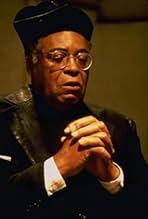
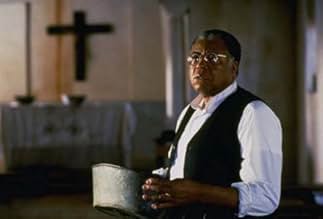
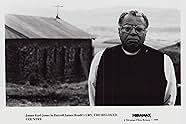
James Earl Jones once again renders a bravura performance as the African minister whose son has accidentally killed a white man. One can feel his grief and his burden as he tries to straighten the mess out. His son has confessed but others involved have denied knowledge of the offense.
Richard Harris plays an equally difficult role that of Mr Jarvis the white boy's father. One feels his grief and pain especially when he finds to his surprise that his son had disowned "baaskap," the over-lordship of the white race, something accepted as a given by most whites without a second thought just as the white housewife perfunctorily dismissed the black cleric in priestly garb as if he were a pesty door to door salesman.
Will mercy be extended to the preacher's son who accidentally pulled the trigger and cooperated with authorities or will he suffer the ultimate penalty while accomplices go free? Yet for all the misery the movie, surprisingly without excessive preaching, ends on a flicker of hope for the future.
James Earl Jones once again renders a bravura performance as the African minister whose son has accidentally killed a white man. One can feel his grief and his burden as he tries to straighten the mess out. His son has confessed but others involved have denied knowledge of the offense.
Richard Harris plays an equally difficult role that of Mr Jarvis the white boy's father. One feels his grief and pain especially when he finds to his surprise that his son had disowned "baaskap," the over-lordship of the white race, something accepted as a given by most whites without a second thought just as the white housewife perfunctorily dismissed the black cleric in priestly garb as if he were a pesty door to door salesman.
Will mercy be extended to the preacher's son who accidentally pulled the trigger and cooperated with authorities or will he suffer the ultimate penalty while accomplices go free? Yet for all the misery the movie, surprisingly without excessive preaching, ends on a flicker of hope for the future.
10anne 83
touching
I've seen this movie twice and I absolutely love it! I think it's highly underrated with the average of 6.4 from the imdb voters.
This is a movie about black and white. A welknown theme in Hollywood, but I've never seen a movie which deals with this subject so excellent as this one.
I couldn't help crying at the end.
my rate: 10
This is a movie about black and white. A welknown theme in Hollywood, but I've never seen a movie which deals with this subject so excellent as this one.
I couldn't help crying at the end.
my rate: 10
Did you know
- TriviaThe background instrumental music in the movie is the same as the theme song from the movie Zulu (1964).
- Quotes
Rev Stephen Kumalo: My brother is greatly changed.
Theophilus Msimangu: But he has some truth on his side.
Rev Stephen Kumalo: "Truth"? But how can he have truth on his side and not God?
Theophilus Msimangu: At least he's got something. Look around. What do you see? Poverty, pain, suffering. Sometimes it is hard even for me to keep faith. Perhaps God is also on his side. Only your brother does not want to know it anymore.
- ConnectionsFeatured in 2nd Annual Screen Actors Guild Awards (1996)
- How long is Cry, the Beloved Country?Powered by Alexa
Details
Box office
- Gross US & Canada
- $670,727
- Gross worldwide
- $670,727
- Runtime
- 1h 46m(106 min)
- Color
- Sound mix
- Aspect ratio
- 1.85 : 1
Contribute to this page
Suggest an edit or add missing content