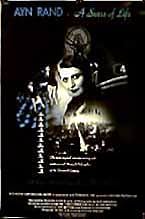
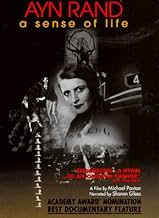
A documentary focusing on the life of novelist and philosopher Ayn Rand, the author of the bestselling novels The Fountainhead and Atlas Shrugged and originator of the Objectivist philosophy... Read allA documentary focusing on the life of novelist and philosopher Ayn Rand, the author of the bestselling novels The Fountainhead and Atlas Shrugged and originator of the Objectivist philosophy.A documentary focusing on the life of novelist and philosopher Ayn Rand, the author of the bestselling novels The Fountainhead and Atlas Shrugged and originator of the Objectivist philosophy.
- Nominated for 1 Oscar
- 1 win & 2 nominations total
Sharon Gless
- Self - Narrator
- (voice)
Michael S. Berliner
- Self - Editor of Rand's Letters
- (as Dr. Michael S. Berliner)
Harry Binswanger
- Self - Professor and Friend
- (as Dr. Harry Binswanger)
Leonard Peikoff
- Self - Intellectual Heir and Friend
- (as Dr. Leonard Peikoff)
John Ridpath
- Self - Professor: York University
- (as Dr. John Ridpath)
Buzz Aldrin
- Self - Astronaut on Moon
- (archive footage)
- (uncredited)
Neil Armstrong
- Self - Astronaut on Moon
- (archive footage)
- (uncredited)
Cecil B. DeMille
- Self - Addresses Extras
- (archive footage)
- (uncredited)
Phil Donahue
- Self - Interviews Ayn Rand
- (archive footage)
- (uncredited)
Grand Duke Nicholas
- Self - Accompanies Tsar Nicholas
- (archive footage)
- (uncredited)
Edith Head
- Self - Pins Costume
- (archive footage)
- (uncredited)
- Director
- Writer
- All cast & crew
- Production, box office & more at IMDbPro
6.5675
1
2
3
4
5
6
7
8
9
10
Featured reviews
Rand the great philosopher?
Rand philosopher or Novelist?
Rand seems to exemplify the notion that our unreflected ideas are products of our environment and childhood experiences. The chief force motivating her life was a hatred of left-wing politics from the time when her family was expelled from Russia, and an accompanying acceptance of the glamour of the fascist dictators of the 1930s and 40s.
Is she a philosopher? I have just read a rather good synthesis of the History of Philosophy from Plato to the modern day. "The Passion of the Western Mind" by Richard Tarnas. I heartily recommend it to all. He does not mention Ayn Rand once. In fact he does not mention ANY novelist because novelists do not do serious philosophy. Rand plays no part in Philosophy her ideas are bankrupt and without merit. They are second hand and undigested reflections on the now discredited Vienna school of logical positivism applied to wider society, yet her limited bourgeois effete experiences prove of no use for the sort of pan-social application to which her words are increasingly being used by the neo-cons of the present day. Her ideas are simple and appeal to simple people. The sort of people who glean their philosophical ideas from the back of a Cornflakes packet: homespun red-neck notions delivered by a naive middle-class woman under the spell of the glamour of the fascists of the pre1945 period.
Rand is no philosopher.
Chazwin
Rand seems to exemplify the notion that our unreflected ideas are products of our environment and childhood experiences. The chief force motivating her life was a hatred of left-wing politics from the time when her family was expelled from Russia, and an accompanying acceptance of the glamour of the fascist dictators of the 1930s and 40s.
Is she a philosopher? I have just read a rather good synthesis of the History of Philosophy from Plato to the modern day. "The Passion of the Western Mind" by Richard Tarnas. I heartily recommend it to all. He does not mention Ayn Rand once. In fact he does not mention ANY novelist because novelists do not do serious philosophy. Rand plays no part in Philosophy her ideas are bankrupt and without merit. They are second hand and undigested reflections on the now discredited Vienna school of logical positivism applied to wider society, yet her limited bourgeois effete experiences prove of no use for the sort of pan-social application to which her words are increasingly being used by the neo-cons of the present day. Her ideas are simple and appeal to simple people. The sort of people who glean their philosophical ideas from the back of a Cornflakes packet: homespun red-neck notions delivered by a naive middle-class woman under the spell of the glamour of the fascists of the pre1945 period.
Rand is no philosopher.
Chazwin
Good biography of a unique writer and philosopher
I've been interested in Ayn Rand ever since I read "Atlas Shrugged" when I was only 22 years old. I didn't quite get everything Ayn was trying to say in that book at the time, and I chalked it up to my lack of life experience given my youth. When I was 40, I ran across this documentary on public TV. I figured that since 18 years had passed, watching this documentary combined with my maturity would enable me to understand Ayn Rand.
This biography is a very sanitized version of Ayn Rand's life. The biography is accurate if not complete, since there is a lack of balance in the presentation due to the absence of information that shows the flawed and even somewhat "kookie" facets of the woman. For example, she encouraged her followers to smoke to highlight mankind's dominance over fire. The film also makes out her relationship with her husband, Frank, to be an ideal romance that lasted for decades. In fact, Ayn cheated on Frank for years with colleague Nathaniel Branden. To give her credit, she was true to her philosophy in being "objective" about the affair in the sense that she insisted that both her and Branden's spouse know what was going on. She ceased being objective, though, when Branden tired of her and began having an affair with a younger woman. She threw Branden and his research out the door with all of the emotion of any human being whose heart was being "subjectively" stomped on. I bring these points up not for the purpose of character assassination. Instead, I think that that it is difficult to get a balanced view of someone whose life work was pronouncing how life should be lived without examining the both the flaws and triumphs in that person's own life.
The documentary did give me some insight into Ayn Rand's philosophy, though, and I'll have to say that she seems to be someone who threw the baby out with the bath water at every turn. As a youth in Russia, prior to the Russian revolution, she saw the failure of the Russian orthodox church to connect with the parishioners and help their lives in any way. This caused her to become an atheist without causing her to explore if it was in fact that this particular institution of religion was the failure, rather than the concept of God. After the revolution she saw the utter failure of the policies of Communism, and this caused her to believe that pure unadulterated capitalism is the only economic system that works, not bothering to realize that there might be a middle ground that looks out for society's weaker members while also rewarding enterprise and hard work.
The fact that Ayn was what is an "odd bird" in 21st century America - an atheist capitalist - can only make me wonder what she would have to say about today's situation of fundamentalist Christian dogma intertwined with cut-throat capitalism that has become today's Republican party.
If you are interested in learning the main points about Ayn Rand's life, this is a good source for the facts and even some insights - particularly good are the clips from her appearances on the Donahue show shortly before her death. However, realize that this biography is somewhat sanitized.
This biography is a very sanitized version of Ayn Rand's life. The biography is accurate if not complete, since there is a lack of balance in the presentation due to the absence of information that shows the flawed and even somewhat "kookie" facets of the woman. For example, she encouraged her followers to smoke to highlight mankind's dominance over fire. The film also makes out her relationship with her husband, Frank, to be an ideal romance that lasted for decades. In fact, Ayn cheated on Frank for years with colleague Nathaniel Branden. To give her credit, she was true to her philosophy in being "objective" about the affair in the sense that she insisted that both her and Branden's spouse know what was going on. She ceased being objective, though, when Branden tired of her and began having an affair with a younger woman. She threw Branden and his research out the door with all of the emotion of any human being whose heart was being "subjectively" stomped on. I bring these points up not for the purpose of character assassination. Instead, I think that that it is difficult to get a balanced view of someone whose life work was pronouncing how life should be lived without examining the both the flaws and triumphs in that person's own life.
The documentary did give me some insight into Ayn Rand's philosophy, though, and I'll have to say that she seems to be someone who threw the baby out with the bath water at every turn. As a youth in Russia, prior to the Russian revolution, she saw the failure of the Russian orthodox church to connect with the parishioners and help their lives in any way. This caused her to become an atheist without causing her to explore if it was in fact that this particular institution of religion was the failure, rather than the concept of God. After the revolution she saw the utter failure of the policies of Communism, and this caused her to believe that pure unadulterated capitalism is the only economic system that works, not bothering to realize that there might be a middle ground that looks out for society's weaker members while also rewarding enterprise and hard work.
The fact that Ayn was what is an "odd bird" in 21st century America - an atheist capitalist - can only make me wonder what she would have to say about today's situation of fundamentalist Christian dogma intertwined with cut-throat capitalism that has become today's Republican party.
If you are interested in learning the main points about Ayn Rand's life, this is a good source for the facts and even some insights - particularly good are the clips from her appearances on the Donahue show shortly before her death. However, realize that this biography is somewhat sanitized.
The problem isn't bias, it's shallowness.
Let's face it. Every documentary is biased. No matter how objective (forgive the situational wordplay) a documentary filmmaker wants to be in presenting his/her subject, he/she has a point of view, or else why bother making the film at all?
The problem here is not Michael Paxton's bias, although he is clearly an adoring fan of the writer/philosopher. The problem is that in painting a portrait of this equally celebrated and vilified woman, he never shows, and only barely tells of, the vilification. As a result, he doesn't give viewers, not even her most ardent admirers, reason to celebrate her.
The film mentions in passing some of her flaws as a person, and repeatedly talks of the criticism surrounding her ideas. But we never hear any of the criticism, any of the arguments against, anything at all to cast her in the light of "defender of the faith," or defender of anything at all, for that matter. She states her case time and again, in interviews, in excerpts from her novels and philosophical works, etc. But we're left with a feeling of "Great. Why should I care?"
Not many people will see this film -- 2 1/2 hour docs rarely draw the masses in theater, on video or anywhere else -- so I'll make a rather simplistic analogy. Think of "Star Wars". How compelled would we be to root for the good of the force if we hadn't heard Darth Vader expound on the power of evil (the Dark Side)? How can you convince anyone of any point, positive or negative, without at least presenting the counterpoint?
Viewers who already adore Rand will no doubt cheer this film. For them, it's very palatable candy. Her detractors shouldn't waste their time. But a documentary is supposed to educate viewers in some way, and the uneducated will get nothing more than a biography and an unquestioned statement of philosophy. That's not much for any doc, but especially for one this long.
The problem here is not Michael Paxton's bias, although he is clearly an adoring fan of the writer/philosopher. The problem is that in painting a portrait of this equally celebrated and vilified woman, he never shows, and only barely tells of, the vilification. As a result, he doesn't give viewers, not even her most ardent admirers, reason to celebrate her.
The film mentions in passing some of her flaws as a person, and repeatedly talks of the criticism surrounding her ideas. But we never hear any of the criticism, any of the arguments against, anything at all to cast her in the light of "defender of the faith," or defender of anything at all, for that matter. She states her case time and again, in interviews, in excerpts from her novels and philosophical works, etc. But we're left with a feeling of "Great. Why should I care?"
Not many people will see this film -- 2 1/2 hour docs rarely draw the masses in theater, on video or anywhere else -- so I'll make a rather simplistic analogy. Think of "Star Wars". How compelled would we be to root for the good of the force if we hadn't heard Darth Vader expound on the power of evil (the Dark Side)? How can you convince anyone of any point, positive or negative, without at least presenting the counterpoint?
Viewers who already adore Rand will no doubt cheer this film. For them, it's very palatable candy. Her detractors shouldn't waste their time. But a documentary is supposed to educate viewers in some way, and the uneducated will get nothing more than a biography and an unquestioned statement of philosophy. That's not much for any doc, but especially for one this long.
Ayn Rand is my most favourite Philosopher!!!
Ayn Rand has helped me to have an integrated view of life.
She teaches for reason and trade, instead of faith and force.
She is against mysticism, which rules by means of guilt, by keeping men convinced of their insignificance on earth. She is against the dogma of man's poverty and misery on earth.
She teaches you to face the universe, free to declare your mind is competent to deal with all the problems of existence and that reason is the only means of knowledge.
Ayn Rand states that intellect is a practical faculty, a guide to man's successful existence on earth, and that its task is the study of reality (as well as the production of wealth), not contemplation of unintelligible feelings nor a special monopoly on the "unknowable".
She is for that productive person who is confident of his ability to earn his living - who takes pride in his work and in the value of his product - who drives himself with inexhaustible energy and limitless ambition to do better and still better and even better - who is willing to bear penalties for his mistakes and expects rewards for his achievements - who looks at the universe with the fearless eagerness of a child, knowing it to be intelligible - who demands straight lines, clear terms, precise definitions - who stands in full sun light and has no use for the murky fog of the hidden, the secret, the unnamed, or for any code from psycho-epistemology of guilt.
Her words will help people to free themselves from fear and force forever.
Thanks Ayn for you direction. She has given me an integrated view of life. I hope, by reading her books, you get it too.
She teaches for reason and trade, instead of faith and force.
She is against mysticism, which rules by means of guilt, by keeping men convinced of their insignificance on earth. She is against the dogma of man's poverty and misery on earth.
She teaches you to face the universe, free to declare your mind is competent to deal with all the problems of existence and that reason is the only means of knowledge.
Ayn Rand states that intellect is a practical faculty, a guide to man's successful existence on earth, and that its task is the study of reality (as well as the production of wealth), not contemplation of unintelligible feelings nor a special monopoly on the "unknowable".
She is for that productive person who is confident of his ability to earn his living - who takes pride in his work and in the value of his product - who drives himself with inexhaustible energy and limitless ambition to do better and still better and even better - who is willing to bear penalties for his mistakes and expects rewards for his achievements - who looks at the universe with the fearless eagerness of a child, knowing it to be intelligible - who demands straight lines, clear terms, precise definitions - who stands in full sun light and has no use for the murky fog of the hidden, the secret, the unnamed, or for any code from psycho-epistemology of guilt.
Her words will help people to free themselves from fear and force forever.
Thanks Ayn for you direction. She has given me an integrated view of life. I hope, by reading her books, you get it too.
Advertising Selfishness
I find this film to be little more than veneration for a woman who claimed she had no time for veneration but was more than willing to have people worship her. Rand was a hypocrite. At the end of her life she took Medicare for her lung cancer which was due to her lifetime of smoking. Thats not even mentioned in the film. I gave Rand's ideas my full attention for some 3 months a few years ago and was intrigued by them before coming to the conclusion her ideas are badly flawed. I read the Fountainhead and a number of her essays but didn't get far with Atlas Shrugged, by then I'd had enough. I'm a geriatric nurse, and I meet many people near the end of their lives and I meet their families, and see the quality of their relationships (or lack there of) and I can tell you, consistently, its those who live and care for others and open themselves and receive the care of others who have the happiest lives. I see it again and again and again. There's a name for it, its called love. Rands "individualism" is suicidal for the individual, the family and society. I'm rating this film so low because it does little more than promote these ill gotten ideas.
Did you know
- ConnectionsFeatures The Mark of Zorro (1920)
Details
- Release date
- Country of origin
- Official site
- Language
- Also known as
- Ayn Rand: Un sentido de la vida
- Filming locations
- Production companies
- See more company credits at IMDbPro
Box office
- Budget
- $1,000,000 (estimated)
- Gross US & Canada
- $205,246
- Opening weekend US & Canada
- $26,101
- Feb 16, 1998
- Gross worldwide
- $205,246
- Runtime
- 2h 25m(145 min)
- Color
- Sound mix
- Aspect ratio
- 1.85 : 1
Contribute to this page
Suggest an edit or add missing content