Orphans
- 1998
- 1h 41m
IMDb RATING
6.9/10
1.9K
YOUR RATING
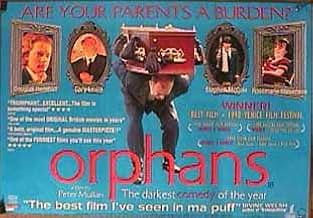
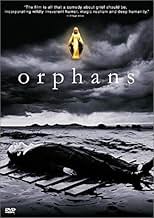
Four siblings gathered together for their mother's funeral in Glasgow face individual torments over night during a tumultuous storm that rips the roof off the church.Four siblings gathered together for their mother's funeral in Glasgow face individual torments over night during a tumultuous storm that rips the roof off the church.Four siblings gathered together for their mother's funeral in Glasgow face individual torments over night during a tumultuous storm that rips the roof off the church.
- Awards
- 10 wins & 2 nominations total
Linda Jane Devlin
- Evelyn (Waitress in Bar)
- (as Linda Cuthbert)
- Director
- Writer
- All cast & crew
- Production, box office & more at IMDbPro
6.91.9K
1
2
3
4
5
6
7
8
9
10
Featured reviews
Orphans: Ingeniously Funny
With his third film as director Neds seeing release just recently, the previous two films of Peter Mullan were given a back-to-back television showing. I managed to catch his first, Orphans, having never before heard anything of it.
Meeting to mourn the loss of their mother, four Glaswegian siblings gather in a pub. When an inconsiderate group laugh at the lugubrious singing of the eldest, one of his brothers retorts physically and is stabbed. The remaining brother vows to avenge this whilst the handicapped sister finds herself stuck in a darkened alley, her wheelchair broken.
Orphans begins with a solemn scene, the four siblings gathered around their mother's coffin. Some gentle humour is created through the siblings' confusion at their elder's request that they place some hair in the coffin. This introduces us to the film's primary structure: scenes of genuine heartfelt drama lined with a subtle comedy to balance the mood. As things progress, we begin to see in increase in this comic factor, the film's clever blending of its contrasting elements creating a wonderful dichotomy. The true beauty of the film, however, is in its juxtaposition of its constituent elements. Many are the scenes which Mullan allows to play out, drawing us in with a barrage of riotous laughter, before effortlessly turning this on its head with a disarming simplicity and forcing us to comprehend the dramatic implications of the events unfolding before us. In a simple moment, we go from laughing at something to considering its grim seriousness. It is a stunning effect, one often attempted but rarely realised so fantastically as here. Mullan ends his scenes by inviting us to reconsider what we have just seen; we find ourselves looking at events with a melancholy when just moments ago they had us reduced to breathless laughter. He allows us to indulge ourselves in the fantastic comedy his writing engenders before showing us that these scenarios are in fact tremendously dark and dramatic. We may chuckle at Michael's determination to pass off his stab wound as an industrial accident, but we quickly reevaluate the true humour of this when we realise that he is slowly dying, his lightening pallor eventually quite frightening. This is just one example of the many such twists Mullan throws at us, showing himself to be as dramatically dark as he is ingeniously funny.
A truly fantastic combination of drama and comedy, done in a subversive way which forces us to reevaluate what we thought of a scene just seconds before, Orphans is a fantastic exploration of the closeness of drama and comedy. Splendidly supported by fantastic, hilarious, and realistically authentic Glaswegian performances, this film has certainly proclaimed Peter Mullan as a masterful director.
Meeting to mourn the loss of their mother, four Glaswegian siblings gather in a pub. When an inconsiderate group laugh at the lugubrious singing of the eldest, one of his brothers retorts physically and is stabbed. The remaining brother vows to avenge this whilst the handicapped sister finds herself stuck in a darkened alley, her wheelchair broken.
Orphans begins with a solemn scene, the four siblings gathered around their mother's coffin. Some gentle humour is created through the siblings' confusion at their elder's request that they place some hair in the coffin. This introduces us to the film's primary structure: scenes of genuine heartfelt drama lined with a subtle comedy to balance the mood. As things progress, we begin to see in increase in this comic factor, the film's clever blending of its contrasting elements creating a wonderful dichotomy. The true beauty of the film, however, is in its juxtaposition of its constituent elements. Many are the scenes which Mullan allows to play out, drawing us in with a barrage of riotous laughter, before effortlessly turning this on its head with a disarming simplicity and forcing us to comprehend the dramatic implications of the events unfolding before us. In a simple moment, we go from laughing at something to considering its grim seriousness. It is a stunning effect, one often attempted but rarely realised so fantastically as here. Mullan ends his scenes by inviting us to reconsider what we have just seen; we find ourselves looking at events with a melancholy when just moments ago they had us reduced to breathless laughter. He allows us to indulge ourselves in the fantastic comedy his writing engenders before showing us that these scenarios are in fact tremendously dark and dramatic. We may chuckle at Michael's determination to pass off his stab wound as an industrial accident, but we quickly reevaluate the true humour of this when we realise that he is slowly dying, his lightening pallor eventually quite frightening. This is just one example of the many such twists Mullan throws at us, showing himself to be as dramatically dark as he is ingeniously funny.
A truly fantastic combination of drama and comedy, done in a subversive way which forces us to reevaluate what we thought of a scene just seconds before, Orphans is a fantastic exploration of the closeness of drama and comedy. Splendidly supported by fantastic, hilarious, and realistically authentic Glaswegian performances, this film has certainly proclaimed Peter Mullan as a masterful director.
A film for anyone who's ever lost someone
Traditions in life and death are important but, in this film they are carried to extreme.It's Glasgow,it's late and anything can happen and does.Peter Mullen provides an ironic view of reactions to grief as epitomized by the family.Each pursues a tragic/comedic personal journey through the night prior to their mother's funeral. A great asset to the Tourist industry highlighting Glasgow's night life. A great cast who feed of each other magnificently. Very funny film.
A magnificent film that deals with grief in a very black yet warm manner.
Three brothers and a sister are torn apart upon the death of their mother. In the lead up to her funeral they all express their loss in different ways, from the recklessly violent to the automated responses of dealing with the ritual of the funeral itself.
Peppered with wonderful moments of Glaswegian humour - the graveside scene, though obviously contrived, is a moment of pure comic genius - this film is both deeply touching and funny.
If you like your humour dark, see it now.
Three brothers and a sister are torn apart upon the death of their mother. In the lead up to her funeral they all express their loss in different ways, from the recklessly violent to the automated responses of dealing with the ritual of the funeral itself.
Peppered with wonderful moments of Glaswegian humour - the graveside scene, though obviously contrived, is a moment of pure comic genius - this film is both deeply touching and funny.
If you like your humour dark, see it now.
What is the point of this movie?
Having recently seen 'My name is Joe' I was looking forward to Peter Mullin's directorial debut but this movie disappoints. What is the point of this movie? If it's a comedy then it's not very funny (but it has one brilliant scene). It's difficult at times to work out what's meant to be funny and what's meant to be serious. If it's a social commentary then it fails to impart a coherent message. The lasting impression is that Glasgow is a bleak and violent city (as if we didn't know this). The acting varied from very good (most of the main characters were well played) to amateurish (several bit parts were badly acted). I left the theatre promising to write this review quickly before I forgot what the movie was about. I gave it 6/10. Go see it on a rainy afternoon in Glasgow.
Did you know
- TriviaPeter Mullan was horrified to learn that the film's production company, FilmFour, had accidentally burned over 30 minutes of footage. This was due to a clerical error.
- ConnectionsFeatured in Siskel & Ebert: Mission to Mars/Ghost Dog/Agnes Browne/Deterrence (2000)
- How long is Orphans?Powered by Alexa
Details
Box office
- Gross US & Canada
- $54,754
- Opening weekend US & Canada
- $16,098
- Mar 12, 2000
- Gross worldwide
- $54,754
- Runtime
- 1h 41m(101 min)
- Color
- Sound mix
- Aspect ratio
- 1.85 : 1
Contribute to this page
Suggest an edit or add missing content