IMDb RATING
7.0/10
2.6K
YOUR RATING
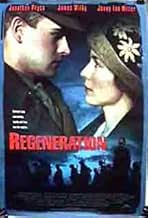
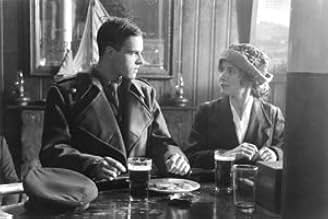
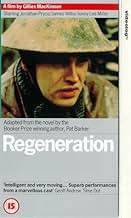
Based on Pat Barker's novel of the same name, "Regeneration" tells the story of soldiers of World War One sent to an asylum for emotional troubles. Two of those soldiers are England's most i... Read allBased on Pat Barker's novel of the same name, "Regeneration" tells the story of soldiers of World War One sent to an asylum for emotional troubles. Two of those soldiers are England's most important WW1 poets.Based on Pat Barker's novel of the same name, "Regeneration" tells the story of soldiers of World War One sent to an asylum for emotional troubles. Two of those soldiers are England's most important WW1 poets.
- Nominated for 1 BAFTA Award
- 17 nominations total
- Director
- Writers
- All cast & crew
- Production, box office & more at IMDbPro
7.02.5K
1
2
3
4
5
6
7
8
9
10
Featured reviews
An excellent treatment of an inglorious war
There are very few films glorifying the first world war, called the "Great War" by those who fought and lived through it. If anything, Hollywood has avoided the subject and left it to a few European filmmakers, for very good reason. For sheer carnage, nothing has surpassed it. The slaughter of very young men was truly appalling. One can only imagine the reaction today if 50,000 men were dying each month to hold or advance over 100 yards of desolate mud. I went to school in England where the walls of our classroom were covered with the photos of pupils who had died in the war. Mostly aged 17. It was not until much later that I realised why there were so many unmarried middle aged women around in the 50's, when the writer Dr. Phyllis Bentley explained that there was no one for them to marry. An entire generation of men had been wiped out.
Regeneration is a thoughtful anti-war film where the paradox of war is implied in a Scottish hospital for the treatment of shell shocked officers. The doctor has to get them well so they can be returned to the front lines, where they will more than likely be killed. The script is intelligent and the acting is superb. There are some allegorical scenes which do more to underscore the pigheaded arrogant mentality of the "establishment" which continued a war until quite simply, there was no one left to fight. Even sick men with TB were sent off to fight. Perhaps the saddest aspect of watching this film is when you realize that WWII began 21 years after the first once ended, just long enough for the new generation of soldiers to grow up.
Reasonably faithful rendition of a classic book
When a film is made of a classic book like this one, it has to satisfy two sets of viewers - those who have read the book and want to see it faithfully rendered on screen, and those who want to see an entertaining film. It is seldom easy to do both, but this film makes a valiant attempt. It is true to the original in spirit, and makes use of Pat Barker's excellent dialogues and one-to-one scenes. Criticisms of it as "talky" are difficult to justify, because to include lengthy action sequences that play no part in the book would clearly alter the nature of the story.
My main criticism would be that the Rivers character comes across as lacking in professionalism rather than simply sensitive to his patients. The scene where he quarrels openly with Sassoon in the dining room is not only unlikely but untrue to the book. The Prior sub-plot is also grossly simplified and his affair with the munitionette is made to appear more innocent than it is. This is inevitable in a dramatisation, and the oblique references to the future development of the character are probably a mistake, as they will mean nothing to those who have not read the book.
I particularly like the musical score, which adds to the atmosphere without distracting the viewer.
My main criticism would be that the Rivers character comes across as lacking in professionalism rather than simply sensitive to his patients. The scene where he quarrels openly with Sassoon in the dining room is not only unlikely but untrue to the book. The Prior sub-plot is also grossly simplified and his affair with the munitionette is made to appear more innocent than it is. This is inevitable in a dramatisation, and the oblique references to the future development of the character are probably a mistake, as they will mean nothing to those who have not read the book.
I particularly like the musical score, which adds to the atmosphere without distracting the viewer.
Noteworthy
This is a vastly underrated Canadian film that deserved more recognition. Is this a conventional war film? No, not at all.
The opening scenes are done quite like a painting. They are very impressive, and the overhead shots are simply majestic. The story, however, is set in a mental institution, where Doctor Rivers (played with brilliance by Jonathan Pryce) is set on 'curing' the shell-shocked patients. There are three that the movie focuses on in particular: Siegfried Sassoon, Wilfred Owen, and Billy Prior, respectively played by James Wilby, Stuart Bunce, and Johnny Lee Miller.
Previous comments have compared this film to Saving Private Ryan, yet there are several marked differences between the two. Ignoring the fact that they are set in two different wars, Saving Private Ryan examines the idea of heroism on the field, while Regeneration takes look on how war effects men psychologically.
Certainly a worthy look, and a fine addition to any film collection.
The opening scenes are done quite like a painting. They are very impressive, and the overhead shots are simply majestic. The story, however, is set in a mental institution, where Doctor Rivers (played with brilliance by Jonathan Pryce) is set on 'curing' the shell-shocked patients. There are three that the movie focuses on in particular: Siegfried Sassoon, Wilfred Owen, and Billy Prior, respectively played by James Wilby, Stuart Bunce, and Johnny Lee Miller.
Previous comments have compared this film to Saving Private Ryan, yet there are several marked differences between the two. Ignoring the fact that they are set in two different wars, Saving Private Ryan examines the idea of heroism on the field, while Regeneration takes look on how war effects men psychologically.
Certainly a worthy look, and a fine addition to any film collection.
A talky but thought provoking and original angle on War
Beginning with a fluid bird-eye-view shot tracking across the corpse-strewn muddy trenches of First World War Northern France, we are introduced to the character of the real-life war-poet Siegfried Sassoon (James Wilby), as he is shipped home and placed in Craiglockhart, a castle in Scotland being used as a military-run psychiatric hospital for soldiers suffering from war-neuroses. Sassoon's particular neurosis is little more than a conscious objection to the direction in which the war has turned in it's latter stages (1917), bringing him into conflict with the British military establishment (who had previously awarded him a Military Cross for bravery), and in particular psychiatrist Dr William Rivers (the ever reliable Jonathan Pryce), who is charged with the task of treating the various traumatised soldiers under his domain.
Taking a rather different approach from the 'war-is-hell' mass-entertainment spectacle of Spielberg's recent 'Saving Private Ryan' and Terence Malick's elliptical 'The Thin Red Line' (both made in 1998), 'Regeneration' evades easy solutions and focuses on the psychological horrors of war in a more low-key and balanced manner. The horrific battle scenes are largely eluded to in flashback, invoked during the well-meaning Pryce's therapy sessions, which utilise the entire arsenal of early Freudian psychotherapy, from dream-analysis to hypnotism as well as more quirky techniques such as putting shell-shocked officers in charge of troops of boy scouts in order to help them regain confidence in their leadership abilities. The central perplexity here is that the soldiers are being cured with the intention of sending them straight back to the front line.
With this and his following film, 'Hideous Kinky', Gillies MacKinnon is emerging as one of the most thought-provoking and technically accomplished British directors working at the moment, adopting an expressionistic cinematic style here which utilises the dark forbidding milieu of the hospital and the surrounding bleak, autumnal countryside to full claustrophobic effect. There are problems here, in the way that the script concentrates on a number of patients, including an angst-ridden Jonny Lee Miller (in his first post-Trainspotting role) who begins the film mute, without fully exploring the relationships between them, but it successfully establishes itself within a convincing historical context whilst challenging the proposition that Britain was united in its conviction to the First World War (of particular relevance today, given our involvement in the bombings of Kosovo and Iraq). Whilst not immediately accessible, it is a film that demands and rewards the closest of attention, and bodes well for future films from the director. Based on the 'Regeneration' trilogy of novels by Pat Barker.
Taking a rather different approach from the 'war-is-hell' mass-entertainment spectacle of Spielberg's recent 'Saving Private Ryan' and Terence Malick's elliptical 'The Thin Red Line' (both made in 1998), 'Regeneration' evades easy solutions and focuses on the psychological horrors of war in a more low-key and balanced manner. The horrific battle scenes are largely eluded to in flashback, invoked during the well-meaning Pryce's therapy sessions, which utilise the entire arsenal of early Freudian psychotherapy, from dream-analysis to hypnotism as well as more quirky techniques such as putting shell-shocked officers in charge of troops of boy scouts in order to help them regain confidence in their leadership abilities. The central perplexity here is that the soldiers are being cured with the intention of sending them straight back to the front line.
With this and his following film, 'Hideous Kinky', Gillies MacKinnon is emerging as one of the most thought-provoking and technically accomplished British directors working at the moment, adopting an expressionistic cinematic style here which utilises the dark forbidding milieu of the hospital and the surrounding bleak, autumnal countryside to full claustrophobic effect. There are problems here, in the way that the script concentrates on a number of patients, including an angst-ridden Jonny Lee Miller (in his first post-Trainspotting role) who begins the film mute, without fully exploring the relationships between them, but it successfully establishes itself within a convincing historical context whilst challenging the proposition that Britain was united in its conviction to the First World War (of particular relevance today, given our involvement in the bombings of Kosovo and Iraq). Whilst not immediately accessible, it is a film that demands and rewards the closest of attention, and bodes well for future films from the director. Based on the 'Regeneration' trilogy of novels by Pat Barker.
Riveting and disturbing psychological drama.
Regeneration is one of those films you know in advance is going to be painful to watch. Some of the images are quite strong, almost electric, and the photography is very good. Good performances combined with seriously good writing make this an important film to see.
Did you know
- TriviaThe film used a lot of present and former Territorial Army soldiers as extras for larger scenes. This includes soldiers from 52nd Lowland, 6th Battalion Royal Regiment of Scotland, located in Hotspur street, Glasgow.
- GoofsThe camera and the crane on which it is suspended are reflected in several puddles during the very opening shot (of the battlefield).
- Quotes
Capt. William Rivers: I find it interesting that you don't stutter.
Billy Prior: I find it even more interesting that you do.
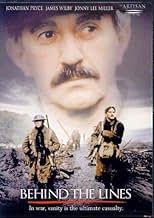
- Alternate versionsReleased in the USA in a 96 minute version under the title "Behind the Lines".
- ConnectionsFeatured in The 100 Greatest War Films (2005)
- SoundtracksJust Before The Battle, Mother
Words and Music by George Frederick Root (As G.F. Root)
Performed by Craig Titus
- How long is Regeneration?Powered by Alexa
Details
- Release date
- Countries of origin
- Language
- Also known as
- Krigets dårar
- Filming locations
- Overtoun House, Dumbarton, West Dunbartonshire, Scotland, UK(Craiglockhart Hospital)
- Production companies
- See more company credits at IMDbPro
Box office
- Gross US & Canada
- $33,131
- Opening weekend US & Canada
- $19,593
- Aug 16, 1998
- Gross worldwide
- $33,131
Contribute to this page
Suggest an edit or add missing content