
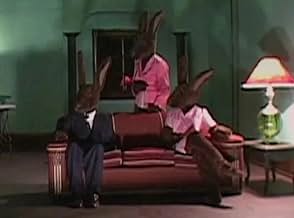
In a nameless city deluged by continuous rain, three rabbits live with a fearful mystery.In a nameless city deluged by continuous rain, three rabbits live with a fearful mystery.In a nameless city deluged by continuous rain, three rabbits live with a fearful mystery.


- Director
- Writer
- All cast & crew
- Production, box office & more at IMDbPro
6.98.9K
1
2
3
4
5
6
7
8
9
10
Featured reviews
Who would think laugh tracks and rabbit suits could be so eerie?
Here, we get a David Lynch-ized sitcom set and our three characters, dressed in Rabbit suits. The "mystery" is knawing at these characters although what they say is often incomprehensable. On top of this, the piece is supported with a laugh track. I know what you're thinking. It's an absurdist film, right? No.
I don't know how they did it with these elements that would seem laughable from afar, but you know what? You turn off the lights in your room and you watch all eight parts to this, and you'll have nightmares for a week. David Lynch can make anything terrifying. A complete surprise in mood. You won't forget it.
I don't know how they did it with these elements that would seem laughable from afar, but you know what? You turn off the lights in your room and you watch all eight parts to this, and you'll have nightmares for a week. David Lynch can make anything terrifying. A complete surprise in mood. You won't forget it.
Definitely, Something is Wrong
The rabbits are us in the way we live our entire lives separated from death only by our domestic routines of normalcy and our denial. Rabbits are bred for the slaughter; they live their entire lives in their little cage, surrounded by, and fed by, the very same people who will someday unthinkingly break their necks.
They're traumatized by the collective memory of past relatives being snatched from their cages while the characters themselves were still too young to fully comprehend the severity and reality of what was happening. The horrors they witnessed so long ago are now just an underlying feeling that something is wrong. They, and we, live their entire lives among death, ignorantly and purposely oblivious of it, until the one day when they are able to ignore it no more, until the day it is their turn.
That's what sense I made out of it anyway.
They're traumatized by the collective memory of past relatives being snatched from their cages while the characters themselves were still too young to fully comprehend the severity and reality of what was happening. The horrors they witnessed so long ago are now just an underlying feeling that something is wrong. They, and we, live their entire lives among death, ignorantly and purposely oblivious of it, until the one day when they are able to ignore it no more, until the day it is their turn.
That's what sense I made out of it anyway.
Alice Inverted
Lynch really elevated my opinion of him here. This is very, very well constructed. It is the highest art.
That means that any "explanation" will be worthless. You can read some other material to discover something of what you will see.
Its unsettling and strange, hypnotic and lyrical. That it is in several "episodes" is all a part of how certain familiar forms are subverted to give us something that has identity and also has a sort of meta-identity defined by deviance from the expected.
My observation will be highly personal. I see this as a sort of "Rosencrantz and Guildenstern" but instead of referencing "Hamlet" engages "Alice in Wonderland." It fits, especially if you are inclined as I am to blow Alice into something as world-swallowing as Hamlet. Where Hamlet is all about what it means to sit in the world, Alice works at more refined level, being all about what it means to carry a name in the world.
One is about being and the other about what we see and acknowledge about being. Its this second conceptual space that Lynch inhabits, always has. His "firewalking" TeeVee stuff bends notions of representation and discovery, the amusement being not in what we see, but in the difference between what we expect to see.
Let's look at the entire vocabulary he has toyed with. First, he acknowledges the audience (laugh track), camera (static but in and out of focus), narrative (drawn more overtly by its fragmentation), framing (with very formal, abstract composition) and "acting," which here consists more of pauses and empty spaces than anything we normally associate with acting.
And then there's the bending of the form. We have a demon that appears twice. Its noir drawn tightly, especially since there is a hint that the demon or his avatar as perhaps a "lost dog" is driving the entire situation.
And then we have three "performances," one each by the three characters. These are accompanied by an ignited set, literally ignited. The performances, which each occupy an episode, are pretty transcendent in terms of what we would see in an ordinary drama. In such a case, each would "solo" in such a way that their soul was revealed. Its the challenge of the writer to weave this into events in such a way that we don't see the performer revealing his character overtly. This is different; all pretense is removed. The character enters and opens its heart with no narrative baggage. What the character tells us actually has more information about context than the surrounding context provides.
Ted's Evaluation -- 3 of 3: Worth watching.
That means that any "explanation" will be worthless. You can read some other material to discover something of what you will see.
Its unsettling and strange, hypnotic and lyrical. That it is in several "episodes" is all a part of how certain familiar forms are subverted to give us something that has identity and also has a sort of meta-identity defined by deviance from the expected.
My observation will be highly personal. I see this as a sort of "Rosencrantz and Guildenstern" but instead of referencing "Hamlet" engages "Alice in Wonderland." It fits, especially if you are inclined as I am to blow Alice into something as world-swallowing as Hamlet. Where Hamlet is all about what it means to sit in the world, Alice works at more refined level, being all about what it means to carry a name in the world.
One is about being and the other about what we see and acknowledge about being. Its this second conceptual space that Lynch inhabits, always has. His "firewalking" TeeVee stuff bends notions of representation and discovery, the amusement being not in what we see, but in the difference between what we expect to see.
Let's look at the entire vocabulary he has toyed with. First, he acknowledges the audience (laugh track), camera (static but in and out of focus), narrative (drawn more overtly by its fragmentation), framing (with very formal, abstract composition) and "acting," which here consists more of pauses and empty spaces than anything we normally associate with acting.
And then there's the bending of the form. We have a demon that appears twice. Its noir drawn tightly, especially since there is a hint that the demon or his avatar as perhaps a "lost dog" is driving the entire situation.
And then we have three "performances," one each by the three characters. These are accompanied by an ignited set, literally ignited. The performances, which each occupy an episode, are pretty transcendent in terms of what we would see in an ordinary drama. In such a case, each would "solo" in such a way that their soul was revealed. Its the challenge of the writer to weave this into events in such a way that we don't see the performer revealing his character overtly. This is different; all pretense is removed. The character enters and opens its heart with no narrative baggage. What the character tells us actually has more information about context than the surrounding context provides.
Ted's Evaluation -- 3 of 3: Worth watching.
for Lynch fans only!!
Okay, I have been watching David Lynch's work since Twin Peaks. I have seen everything he has done from Eraserhead to Mulholland Dr. It's taken me 3 years to find a copy of RABBITS to watch and I must say... Lynch never ceases to confuse me.
I understand why some people think Lynch is overly self-indulgent, but I don't think that is a reason to hate him and his work. Lost Highway and Mulholland Dr. are two of the greatest film ever, but they are not for everybody.
RABBITS is different than his films, and I am not going to act like I understand RABBITS or pretend that I found my own interpretation to the series. I don't know what I've just seen, I can't even tell you if it was self-indulgent crap or a work of genius, all I can say is if you like Lynch and want to see something different than anything you'll ever see anywhere else, than enjoy:)
I understand why some people think Lynch is overly self-indulgent, but I don't think that is a reason to hate him and his work. Lost Highway and Mulholland Dr. are two of the greatest film ever, but they are not for everybody.
RABBITS is different than his films, and I am not going to act like I understand RABBITS or pretend that I found my own interpretation to the series. I don't know what I've just seen, I can't even tell you if it was self-indulgent crap or a work of genius, all I can say is if you like Lynch and want to see something different than anything you'll ever see anywhere else, than enjoy:)
"Pets or Food"
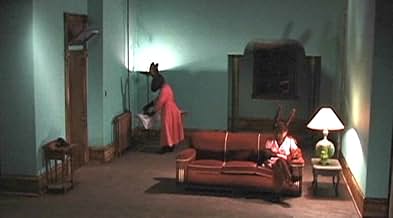
The single camera is fixed on a wide shot of a sparsely-furnished, eerily-lit apartment, a subdued den of deco and menace. Yes, a glance confirms, Mr. Lynch is caretaker here.
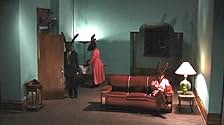
For five minutes, as Badalamenti's synths sigh over distant fog horns and muted thunder, we watch the rabbit people--actors in cheap rabbit suits worn under drab human clothing. Their day is winding down. They work at an ironing board, sit on the art deco sofa, rise, sit down again, exit, return, sing some verses about "dark, smiling teeth," and trade dark, smiling dialogue. The rabbit people play to an unseen studio audience, which greets their entrances with on-cue applause and their oblique lines with canned laughter. Minutes pass. . . Then: a superimposed mouth begins a demonic incantation. A huge match burns. The camera blurs out of focus, and then--you'd better believe it!--refocuses.
That's it. The result is weird, beautiful, unnerving, and, frankly, never far from being boring.
For five minutes, as Badalamenti's synths sigh over distant fog horns and muted thunder, we watch the rabbit people--actors in cheap rabbit suits worn under drab human clothing. Their day is winding down. They work at an ironing board, sit on the art deco sofa, rise, sit down again, exit, return, sing some verses about "dark, smiling teeth," and trade dark, smiling dialogue. The rabbit people play to an unseen studio audience, which greets their entrances with on-cue applause and their oblique lines with canned laughter. Minutes pass. . . Then: a superimposed mouth begins a demonic incantation. A huge match burns. The camera blurs out of focus, and then--you'd better believe it!--refocuses.
That's it. The result is weird, beautiful, unnerving, and, frankly, never far from being boring.


Did you know
- TriviaDescribed by Lynch as a 9 episode sitcom.
- ConnectionsFeatured in Inland Empire (2006)
Details
- Runtime
- 43m
- Color
- Aspect ratio
- 1.78 : 1
Contribute to this page
Suggest an edit or add missing content